
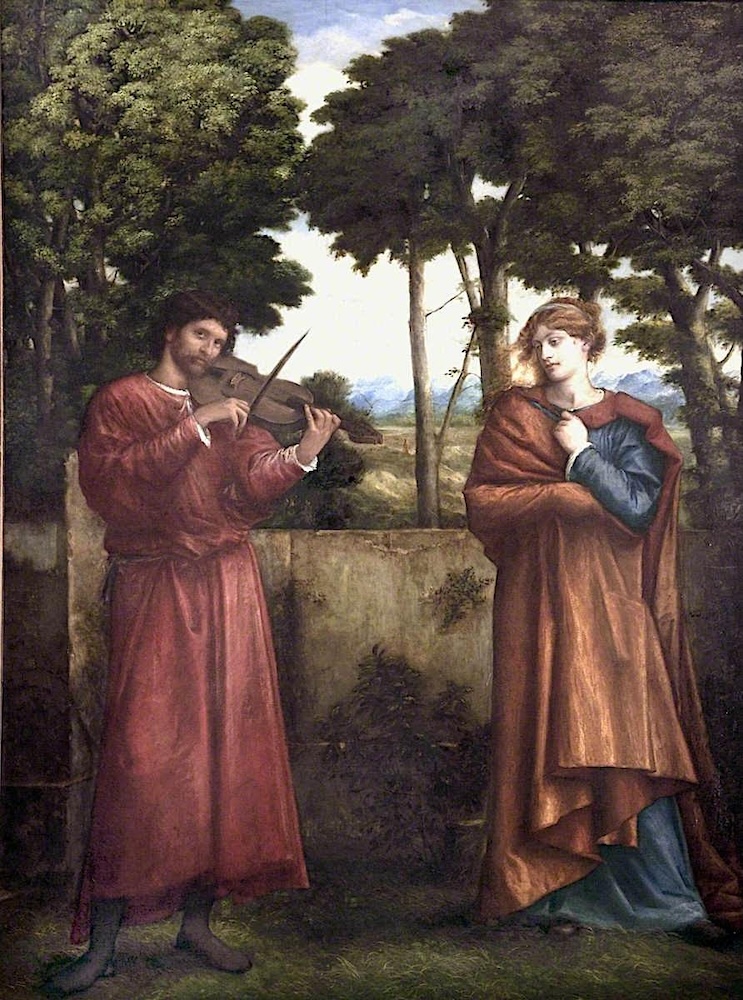
The Violin Player, by Charles Fairfax Murray (1849-1919). 1888. Oil on canvas. 86 1/2 x 62 inches (219.7 x 157.5 cm). Collection of the Walker Art Gallery, Liverpool, accession no. WAG2911. Image courtesy of the Walker Art Gallery under the terms of the Creative Commons Attribution-NonCommercial licence (CC BY-NC). [Click on the images on this page to enlarge them.]
This painting was exhibited at the Grosvenor Gallery in 1888, no. 138. It is one of the largest and most impressive of Murray's oil paintings, even if David Elliott has dismissed it as a "major undertaking" but a "work of the second rank, accomplished but derivative" (101). It features two standing figures, a red-robed bearded young man playing a violin, and an attractive young woman in a blue dress with an orange-brown overmantel who is listening to the music. The two stand in front of a stone wall, with trees behind the wall followed by a stretch of open ground in the midground, and a row of low blue mountains in the distance. The painting was unsold after its Grosvenor Gallery exhibition and was eventually given by Murray's son, R. A. Murray, to the Walker Art Gallery in 1926. In a letter from Murray to Samuel Bancroft of 6 December 1892 Murray mentioned that he has the painting still for sale, but the painting needed to be retouched (Elzea, letter 5, 14).
Edward Morris, a former curator at the Walker Art Gallery, explained how this painting exemplified the influence of early Italian painting on the Aesthetic Movement: "The influence of these paintings (particularly those of the early 16th-century Venetian School) is clear in The Violin Player. The Aesthetic Movement especially admired Venetian art of this period for its apparent disregard of defined subject and distinct narrative; in his essay, The School of Giorgione of 1877, Walter Pater insists on the role of music in Giorgione's art (and indeed in all great art), and The Violin Player might have been intended as one of Pater's 'painted idylls' with 'people with intent faces, as if listening, like those described by Plato in an ingenious passage, to detect the smallest interval of musical sounds'" (329).
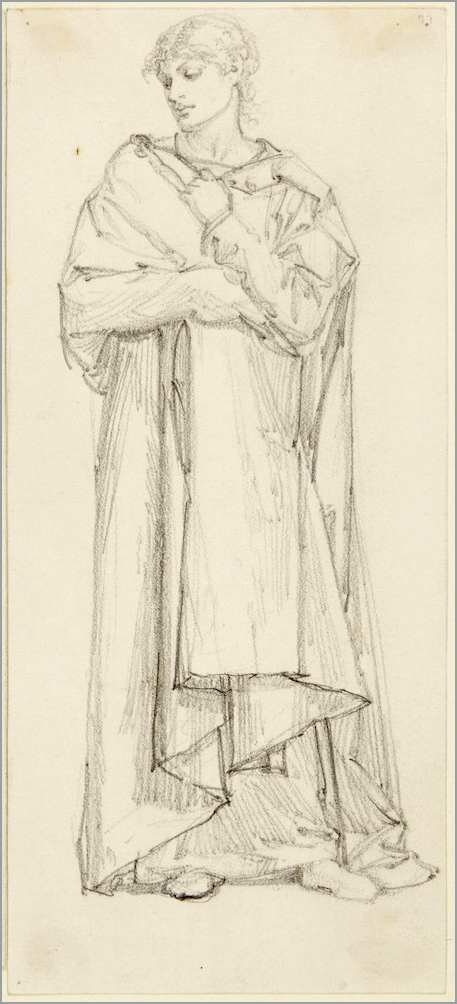
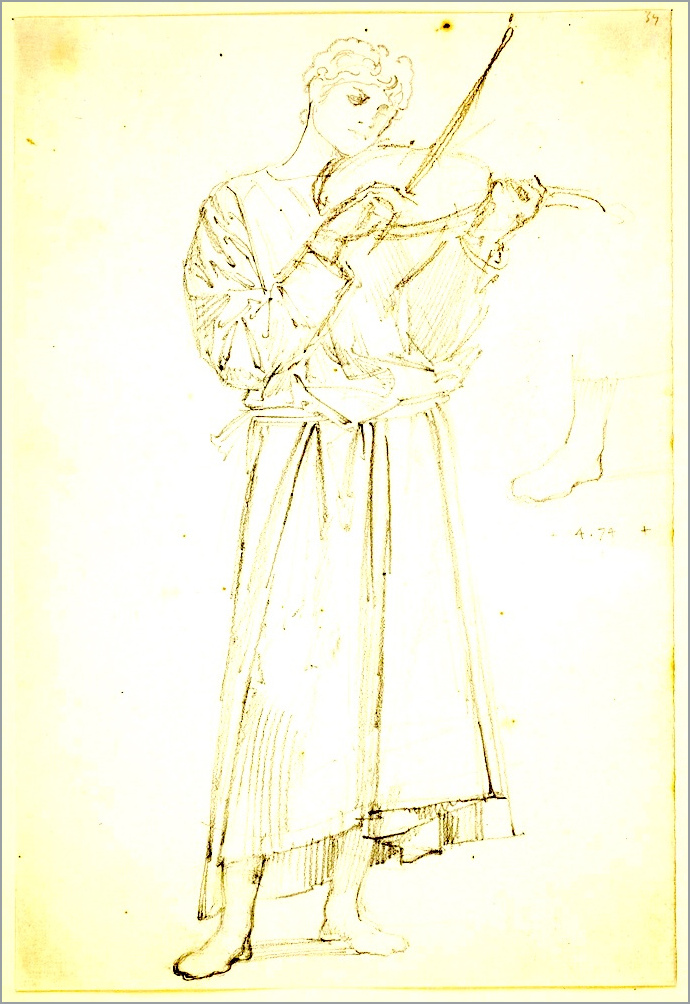
Two studies for the painting, pencil on paper, from the collection of the Princeton University Art Museum. Left: Study of the violin player. Right: Study of the standing female figure for violin player. Images courtesy of the Museum.
These are two studies for the painting in the collection of the Princeton University Art Museum, both pencil on paper: a sketch of the violin player, 9 7/8 x 6 3/4 inches (25.1 x 17.1 cm), object no. x1948-1474; and of the standing female figure, 10 1/16 x 4 1/2 inches (25.5 x 11.4 cm), object no. x1948-1495. Princeton also has an early compositional drawing featuring two young male violin players that probably relates to this painting [object no. x1948-1408].
Contemporary Reviews
When this work was shown at the Grosvenor Gallery it was not widely discussed by critics. Henry Blackburn merely describes it as: "A large canvas; two figures standing; red-blue, and orange-brown drapery. Background, a wood in the manner of the Italian school (37). George Bernard Shaw wrote of it: "Mr. Fairfax Murray's Violin Players reminds me of Bonifazio but I can not think of any work of Bonifazio's that reminds me of Mr. Fairfax Murray" (qtd. Weintraub, 221).
A critic for The Spectator, despite some reservations about flesh tints, admired Murray's use of colour and provided the painting's most thorough review:
Mr. Fairfax Murray sends one of the largest, and in its way one of the best pictures here, two life-size figures standing against a background of landscape, and clothed in very full-coloured draperies; but this artist's manner is simply an echo of the great period of Italian painting, and lacks the personal qualities of the artist almost as completely as it evidences his acquaintance with the work of the older schools. Specially unpleasant to the present writer is the colour of the flesh in this picture, which has a sort of strawberry-ice tint, and a texture akin to nothing in human nature. Still, there is no doubt that with all his defects, Mr. Murray is a colourist, and it is rather amusing to see to what a drab uniformity of hue this composition of his reduces all the surrounding pictures. [687]
Related Material
- At the Piano, by James Abbot McNeill Whistler
- The Blue Bower by Dante Gabriel Rossetti
- The Duet, by Henry Holiday
- Music, by Henry Holiday
- The Music Lesson, by Frederic Leighton
- A Music Party by Arthur Hughes
- A Music Piece [The Drawing Room], by Thomas Armstrong
- A Musician, by Albert Moore
- Musicians, by T.M. Rooke
- A Symphony, by John Melhuish Strudwick
- "Touching the Strings: Edith Martineau and Aestheticism"
Bibliography
"Art. The Grosvenor Gallery." The Spectator LXI (19 May 1888): 686-87.
Blackburn, Henry. Grosvenor Notes. London: Chatto & Windus (May 1888): cat. 138, 37.
Elliott, David B. Charles Fairfax Murray. The Unknown Pre-Raphaelite. Lewes, Sussex: The Book Guild Ltd., 2000. 67 & 101.
Elzea, Rowland Ed. The Correspondence between Samuel Bancroft Jr. and Charles Fairfax Murray 1892-1916. Delaware Art Museum Occasional Papers II. Wilmington: Delaware Art Museum (February 1980): letter 5, 14.
Morris, Edward. Victorian and Edwardian Paintings in the Walker Art Gallery & At Sudley House. London: HMSO Publications, 1996, 329-30.
Study for the Female Figure. Princeton University Art Museum. Web. 14 February 2026.
Study for the violin player. Princeton University Art Museum. Web. 14 February 2026.
The Violin Player. Art UK. Web. 14 February 2026.
Weintraub, Stanley. Bernard Shaw on the London Art Scene, 1885-1950. University Park: Pennsylvania State University Press, 1989.
Created 14 February 2026