
As a boy he had to make his own way, and used to draw and read with avidity after a very hard day’s work. While still in his teens he attracted the attention of Rossetti, Philip Webb, Burne-Jones, and William Morris, with all of whom he remained until their deaths, on terms of great intimacy. For a time he transferred Burne-Jones’s cartoons to glass and did other work for the Morris firm. He was then sent to copy Old Masters in Italy by Ruskin, who described him as “beyond comparison the most skilful of the group of artists employed ‘by him,” and his copies from Carpaccio and Botticelli as “among the principal treasures of the St. George’s Guild at Oxford and Shefield." ["Charles Fairfax Murray"]
Biographical Material
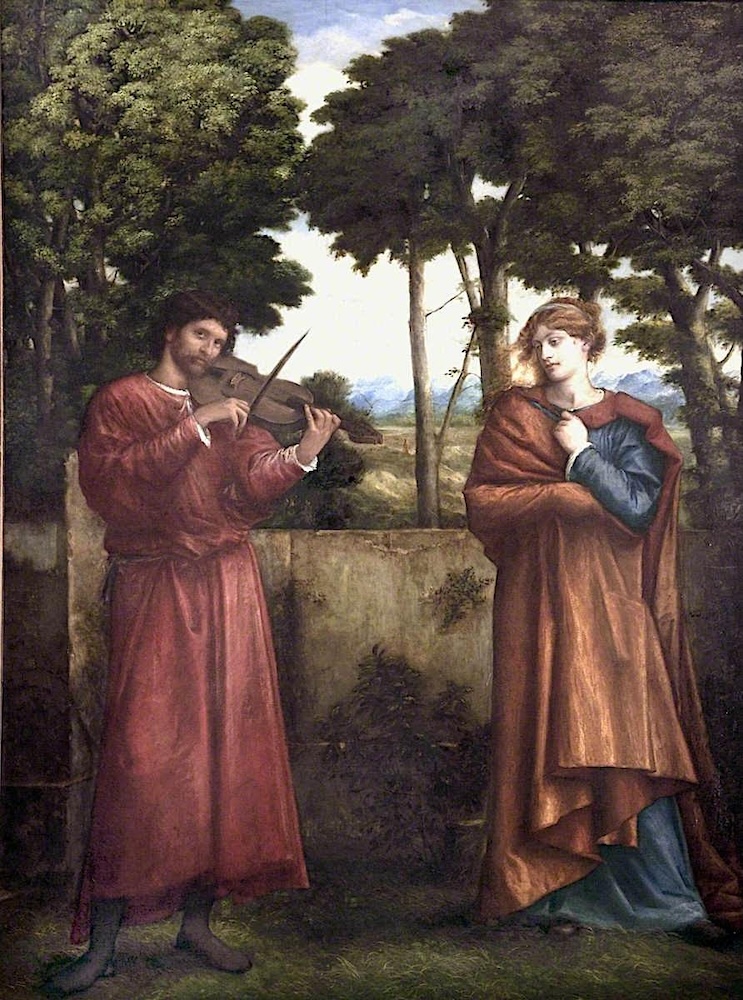
Works
Bibliography
"Charles Fairfax Murray" (Obituary). American Art News. 22 February 1919. Jstor via the Internet Archive. Web. 13 February 2026.
Codell, Julie F. "Murray, Charles Fairfax (1849-1919)." Oxford Dictionary of National Biography. Oxford: Oxford University Press, 2004.
Elliott, David B. Charles Fairfax Murray. The Unknown Pre-Raphaelite. Lewes, Sussex: The Book Guild Ltd., 2000.
Tucker, Paul. "Charles Fairfax Murray and Florence." I Giardini delle Regine: Of Queen's Gardens: The Myth of Florence in the Pre-Raphaelite Milieu and in American Culture(19th-20th centuries). Margherita Ciacci and Grazia Gobbi Sica Eds. Livorno, Italy: Sillabe, 2004.
Ruskin, John. Works. Vol. 30. Eds. E. T. Cook and Alexander Cook. London: George Allen, 1907.
Created 13 February 2026