
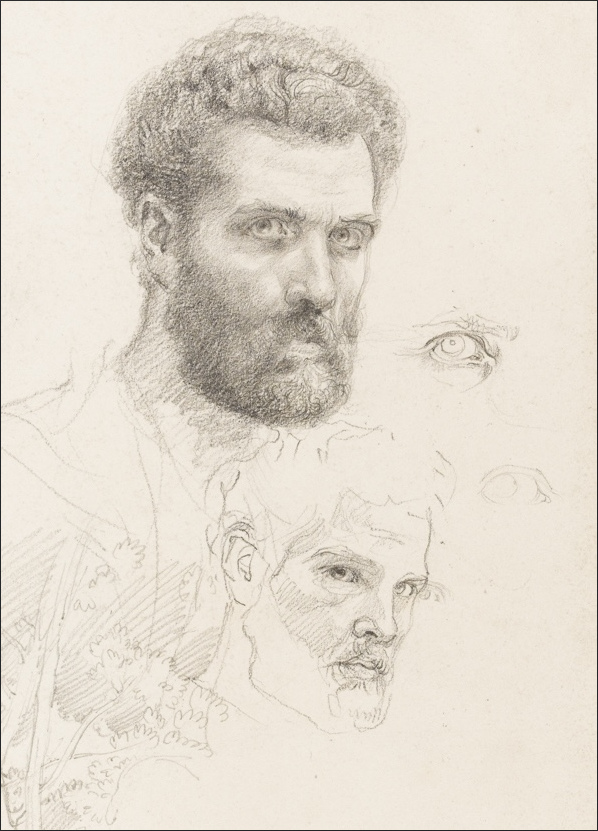
Charles Fairfax Murray was born on 30 September 1849 in Bow, an inner city suburb of London, the son and the youngest of four children of James Dalton Murray, a linen-draper, and his wife Elizabeth Scott. He was raised in Sudbury, Suffolk. He taught himself drawing by copying in the National Gallery and may have received drawing lessons from Richard Gainsborough Dupont, the great-nephew of Thomas Gainsborough. As a twelve-year-old, he worked in the drawing office of the railway construction engineers Peto & Betts as a shopboy. He was introduced into the Pre-Raphaelite circle in 1866 by Murray Marks. In that same year he enrolled for the autumn term at the Working Men's College where he first met John Ruskin. In November 1866, arranged by Ruskin, Murray entered Edward Burne-Jones' studio as his first assistant where he was employed primarily as a copyist who made second versions of existing paintings. One of his first duties was to aid Burne-Jones in completing the St. George and the Dragon series for Myles Birket Foster. Murray also worked, on occasion, as a studio assistant for D.G. Rossetti and G.F. Watts. Murray exhibited his first painting at the Royal Academy in 1867. In 1868 he first worked as a decorative artist for Morris, Marshall, Faulkner & Co. He worked there as its principal stained-glass painter and was also employed privately doing illuminations for Morris's manuscripts. Murray was a very skilful copyist. In late 1871 he made the first of many trips he would make to Italy, staying initially in Pisa. From 1874-83 he lived in Italy at least part-time, working as a copyist for Ruskin in cities like Rome, Siena, Pisa and Venice. This allowed him to increase his knowledge of the Old Masters so much so that he was eventually able to contribute documentary material and critical observations to the Italian edition of A New History of Painting in Italy from the II to XVI Century by J.A. Crowe and Giovanni Cavalcaselle.
In 1875 Charles married the sixteen-year-old Angelica Collevichi. The couple settled initially in Sienna, but later moved to Florence in November 1878. They would eventually have six children. In Florence, Murray had a house and studio in the Via de' Serragli. In 1877 he had been appointed the Italian Correspondent for the Society for the Protection of Ancient Buildings.
In 1879 Murray began to exhibit at the Grosvenor Gallery and he showed there until 1887. He later exhibited at the New Gallery. Gradually he began to devote more and more of his time to collecting and selling works of art. He was a connoisseur and an acknowledged expert, not only in Pre-Raphaelite art, but also in the earlier English Schools and Renaissance Flemish and Italian painters. He acted as the agent in Italy for Sir Frederick W. Burton, the Director of the National Gallery in London. From 1877 he also enjoyed a long connection with Dr. Wilhelm von Bode, the director of the Gemaldegalerie in Berlin. Murray was closely associated, too, with the art dealers Thomas Agnew & Sons, becoming a partner in the firm. In addition to paintings and drawings, Murray dealt in other artwork, including majolica, musical instruments, metalwork and sculpture. He also collected manuscripts and early printed books.
In November 1886 he returned to England and rented a studio in Holland Park. His wife didn't like London, however, and chose to return to Italy the following spring. In London Charles resumed his close friendships with Burne-Jones, William Morris, Philip Webb and others of the Pre-Raphaelite circle. Now too he entered into a common-law relationship with Blanche Richmond, one of his models, with whom he would have six children. In 1891 he cataloged the art collection of the Duke of Portland, one of the few art books he would write. In 1894 he lost his bid to become Director of the National Gallery to succeed Frederic Burton, which was instead given to Edward Poynter. From 1898 he leased Burne-Jones's former home, The Grange, in Fulham, following his former mentor's death.
Murray retired from painting in 1903, and in the following year sold his collection of more than 800 Pre-Raphaelite drawings to the Birmingham Museum and Art Gallery. In 1909 he sold his collection of 1400 Old Master drawings and five paintings to J. Pierpont Morgan. Murray gave early books, manuscripts, and drawings and paintings, including his Titian painting of Tarquin and Lucretia, more than a dozen works by John Constable, four early Thomas Gainsboroughs, and a Camille Corot to the Fitzwilliam Museum in Cambridge. He donated forty-six English portraits from his collection to the Dulwich Picture Gallery in 1911. In 1914 he returned to live in Florence at a new house in the Via Marsilio Ficino, but later came back to London in 1916. He died on January 25, 1919 at his home 77 Barrowgate Road, Chiswick, Middlesex, following a series of strokes. He had a noncemetery burial. He had led a productive life as an artist, art historian, connoisseur, advisor to both museum directors and private collectors, art dealer, and generous museum benefactor.
Bibliography
Barrington, Robert. “Copyist, connoisseur, collector. Charles Fairfax Murray (1849-1919).” Apollo CXL (November 1994): 15-21.
Codell, Julie F. "Murray, Charles Fairfax (1849-1919)." Oxford Dictionary of National Biography. Oxford: Oxford University Press, 2004.
Elliott, David B. Charles Fairfax Murray. The Unknown Pre-Raphaelite. Lewes, Sussex: The Book Guild Ltd., 2000. 239-47.
Tucker, Paul. "Charles Fairfax Murray and Florence." I Giardini delle Regine: Of Queen's Gardens: The Myth of Florence in the Pre-Raphaelite Milieu and in American Culture(19th-20th centuries). Margherita Ciacci and Grazia Gobbi Sica Eds. Livorno, Italy: Sillabe, 2004. 102-11.
Tucker, Paul. “A Connoisseur and his Client. The Correspondence of Charles Fairfax Murray with Frederic Burton, Wilhelm Bode and Julius Meyer (1867-1914).” The Volume of the Walpole Society LXXIX (2017): 1-340.
Created 13 February 2026