
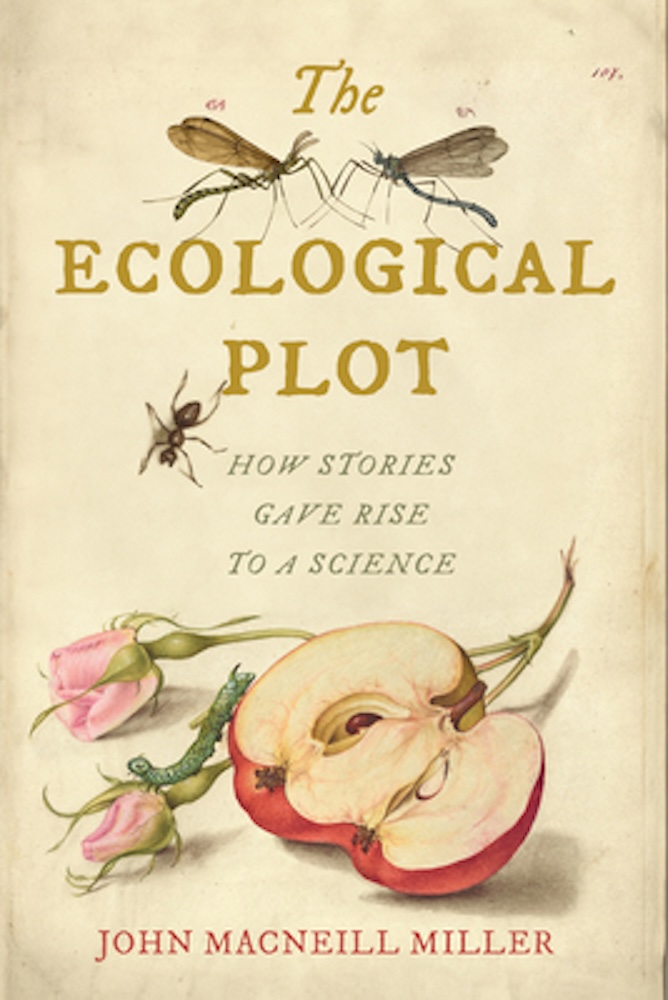

n The Ecocriticism Reader (1996), Cheryll Glotfelty defined "ecocriticism" as "the study of the relationship between literature and the physical environment" (xviii). Following Glotfelty, ecocriticism has steadily increased its academic authority thanks to the success of such formative works as Greg Garrard's Ecocriticism (2004), Laurence Buell's The Future of Environmental Criticism (2004), and Timothy Morton's Ecology Without Nature (2007). John MacNeill Miller's recent The Ecological Plot: How Stories Gave Rise to a Science (2024) promises to deliver a "new literary history of ecology" (1) through an analysis of the "forms of writing that made ecology thinkable in the first place" (7). Altogether Miller succeeds in exploring the objective of its subtitle — "how stories gave rise to a science" — and provides intriguing and fresh perspectives on a range of works by eighteenth-, nineteenth-, and even two twentieth-century authors.
In his introduction, "Telling Connections," Miller begins by observing that in the late eighteenth and early nineteenth centuries, the boundary between the arts and the sciences was still quite fluid, making the literature of the era a perfect vehicle for the expression of ecological thought. As Miller shows, a variety of eighteenth- and nineteenth-century modes of storytelling deployed by both scientists and authors of fiction enabled an "ecological understanding of the world" (3) and frequently combined insights from several connected disciplines in order to give rise to the science of ecology. Furthermore, the utilisation of a "literary lens" to transmit an idea is often effective as any "thought," as Miller insightfully points out, but it needs "representation" (2) for its fuller realisation; ecocriticism is, of course, no exception. Miller clarifies that, for the sake of concision, he has limited his study to British exemplars of ecological thought, with the notable exceptions of the pioneering American naturalist Aldo Leopold (1887-1948), the author of A Sand County Almanac (1949), and the conservationist and marine biologist Rachel Carson (1907-1964).
In the first chapter of The Ecological Plot, Miller follows Barry Commoner's notion of ecology, advanced The Closing Circle (1971), as principally a system in which "everything is connected to everything else" (3). From this starting point, Miller considers three thinkers of this period — Thomas Robert Malthus, Harriet Martineau, and Charles Darwin — through Commoner's lens. Miller's in-depth studies of Malthus and Martineau's "ecological plot[s]" are quite engaging. Both authors combine fiction, natural history, and political economy to lay bare the "web of interconnection" (34) sustaining the existence and flourishing of Homo sapiens by means of "material exchanges" (47) among human beings, animals, and the wider world of nature. Eschewing the pantheism of English Romantic thinkers, Malthus in his Essay on Population (1798) fuses economic and ecological thought by asserting that human communities are vitally sustained by the Earth. Because flourishing societies depend heavily upon the capacity of the natural resources to meet growing demands fuelled by increasing population, Malthus warns that an unchecked rise in demand for resources will inevitably create a dearth of them, leading to dire consequences for the species. Both Malthus and Darwin, Miller concludes, "created a way of telling stories without backgrounds, narratives that encouraged careful accounting of all the living and nonliving beings entangled in webs of material interdependence" (13).
According to Miller, a similar union of economic and environmental concerns also found expression in Martineau's nine-volume Illustrations of Political Economy (1832-34), a series of fictional tales about the operation of free market economies. Miller observes that Martineau's stories are peppered with what we would today call ecological concerns. In tales like "Weal and Woe in Garveloch," "Sowers Not Reapers," and "Midsummer Moonlight," Miller finds instructive examples of identifiably ecological plots. While painting the communities in these stories as isolated and closed economically, Martineau clearly holds that the "exchange of matter and energy" (4) amongst human beings, and between the human species and the natural world, form the basis of any free market economic model. Turning to "Midsummer Moonlight," for example, Miller shows how Martineau carefully studied the disastrous consequences that an ecological hazard, like a sudden thunderstorm, could have for a variety of economic agents, such as shepherds and farmers. Similarly the entire plot of "Sowers Not Reapers," Miller observes, "unfolds from the discrepant effects of the same wind, rain, and fiscal policies on this diverse catalogue of creaturely life." (36)
Miller concludes that the "[e]thical stances endorsed by other practitioners of political economy and natural history" inspired the "reductive" nature of solutions prescribed by both Malthus and Martineau (46). The checks to these problems proposed by Malthus, that is, later marriage and celibacy, and Martineau's deep commitment to the prudence of individual economic agents — positions consistent with the economic theories of Adam Smith and David Ricardo — proved to be inadequate. The task of representing how the ecology, economy, and individual relationships could be re-defined in light of these challenges subsequently fell to nineteenth-century novelists attempting to formulate "a providential moral order" that "would emerge from some combination of free markets, foresight and the innate instinct of self-preservation" (41), the exploration of which forms the basis of the second chapter of The Ecological Plot.
Studies like James Thompson's Models of Value: Eighteenth-Century Political Economy and the Novel (1996) and Political Economy and the Novel: A Literary History of 'Homo Economicus' (2018) by Sarah Comyn document in detail how the novels of Daniel Defoe, Henry Fielding, and Fanny Burney, among others, inherit the mantle of narrating the ideas of the free market and political economy post-Martineau, often by employing her model. While Miller hints at this development in fiction, a detailed exploration of these works might have provided a useful preface to his analysis of the ecological plots in various Condition-of-England novels and in nineteenth-century fiction of literary realism in his second and third chapters.
The economic upheaval caused by the Industrial Revolution, and the expansion of markets around the world due to colonialism and foreign trade, made it apparent to authors of fiction and to the public that "[t]he earth was a 'network of exchange,'" an interconnected globe where everything could be 'traded for and transformed into anything else" (44). Although, as J.A. Cuddon has noted, Condition-of-England novels were altogether a product of the "disturbance of social conscience among the middle classes" (149) about the state of the working-class people, Miller also finds in them various ecological plots. In novels like Sybil (1845) by Benjamin Disraeli, Mary Barton (1848) by Elizabeth Gaskell, and Alton Locke (1850) by Charles Kingsley, the focus shifts from the abstractions of political economy to launching enquiries into the "human cost" of "unchecked economic logic" (45), demanding the reader's "moral attention" (45) and prompting an "ethical accounting" (69).
The working-class characters in these novels fare little better than animals, as Miller's close reading of the selected texts makes clear. For example, in Sybil the "prices of meat, labouring animals, and natural resources can and do surge above the wages of human laborers" (58). In Alton Locke too, these "confused relations between humans and animals" depict a "topsy-turvy" (58) society in which "the horse, the sheep, the bullock, is the master, and the labourer is their slave" (59). Similarly in Mary Barton, the naturalist Job Leigh's "lust for specimens" blinds him to his "duties to those around him" (67). While these textual elements support Miller's claim that "class and species barriers" become diffuse when members of the working class are represented as "worse than beasts" and often "feel themselves implicitly ranked beneath domesticated animals" (74), readers might feel that the "ecological plots" of these works are not presented as distinctly as they might be.
It is additionally worth considering that since a number of late eighteenth- and early nineteenth-century poems grant considerable space to animals, and in these poems human beings are often seen as entering into a discourse with their animal counterparts, these works might conceivably host at least the germ of an "ecological plot" within them. Some famous examples include Anna Laetitia Barbauld's "The Mouse's Petition" (1773), Robert Burns's delightful "To a Mouse" (1785), and John Keats's humorous "To Mrs Reynold's Cat" (1830), to name a few. A broader selection of texts and the inclusion of poetry in the discussion might have brought the second chapter into better alignment with the objective of the monograph.
Locating the "ecological plot" in George Eliot's novels Adam Bede (1859) and The Mill on the Floss (1860) forms the crux of Miller's third chapter. According to Miller's reading of Eliot's novels, the "virtues of natural history were manifold" for Eliot, as the discipline of natural history "maintained the personalised approach to communal relations that economics had abandoned"; moreover, the "cross-species relationships provided a prototype for the way a good novelist might look at interactions across classes" (86). In this connection, Miller attends closely to the "ever-present" dog Gyp, Adam Bede's tailless, devoted pet (84). On Miller's reading, Gyp emerges as an important player in the world of the novel and is accorded mental and emotional capabilities, exhibited by Gyp's hesitancy in displaying love for Lisbeth, Adam's wife, with whom Adam frequently quarrels, so as not to appear unfaithful to his master. As a repository for Adam's sympathy, Gyp additionally provides Adam with comforting and constant company as he weathers the hardships of his life.
Published one year after Adam Bede, The Mill on the Floss is, according to Miller, a "book-length exploration of how literary form can drive humanity and the natural world apart" (95). But aside from the famous flood that precipitates the narrative's dramatic conclusion, Miller finds that the natural world plays only a minimal role in the tale: Eliot's lush descriptions of the English rural landscape, being "utterly devoid of story" (102), are relegated to the background. Eliot presents the emotional growth of the protagonist, Maggie, from being an emotionally fickle, animal-like girl who succumbs to the pressure to become a typically Victorian, middle-class lady alienated from nature, as the more important storyline. Yet there is a connection. For Miller, Maggie is a liminal figure "[s]undered from the human community and unable to break from her native landscape," as illustrated by her demise in the flood in which the "landscape itself comes to claim her." Miller comments that the deluge serves as a textual instrument permitting Eliot to sever the human world from the natural one and to "exorcise the sympathetic pull of the nonhuman world once and for all," transforming "the novel into the secular, humane, and exclusively human art form she thought the world needed most" (107-108).
Miller turns his attention to Thomas Hardy in the fourth chapter of The Ecological Plot. Hardy's "ecological plot" — or the lack thereof — is the focus here, as Miller analyzes Hardy's depiction of Egdon Heath, the primary setting of The Return of the Native (1878). Miller shows that connections between human beings and the natural world are completely replaced by the metaphorical associations of the natural world in the story. Egdon Heath becomes a repository for "expressions of human personality" (121), rather than something independent of human concern. This artificiality in Hardy's depiction of the environment is a far cry from the deeply entangled ecological ideas of thinkers like Malthus, Martineau, and Darwin, with whom Miller began his sketch of the ecological plot in nineteenth-century English literature. Furthermore, Miller writes that the idea in popular minds — propagated by writers like Hardy — that a heath was a lifeless waste of land had a direct impact on the neglect suffered by these essential liminal ecosystems due to pollution and governmental negligence. The "ecological plot" of fictions like Hardy's thus contributed, according to Miller, to the damage done to such ecosystems in the Victorian era and beyond. Miller rounds out his analysis with a brief discussion of Darwin's study of the heaths of England in On the Origin of Species (1859) and Insectivorous Plants (1875). Unlike Hardy, Darwin understood that the heaths are deeply interconnected with people and the wider environment.
Miller's final chapter, "Distant Relations," summarises the arguments presented in the preceding chapters while offering an account of Charles Elton's path-breaking and detailed interdisciplinary study, Animal Ecology (1924). Miller celebrates Elton's work for bridging the gap between the less-than-unified ecological ideas of eighteenth- and nineteenth-century England with the help of exhaustive scientific research on the interrelations between human communities and the natural world. In Elton's work, the twin pillars of the planet's "ecological plot" find expression in real-world examples. Miller concludes that Elton's work deeply influenced ecocritical thought in literature and in science.
Miller concludes by discussing the ecological and ecocritical ethos of two seminal environmental and ecocritical books of the twentieth century: Aldo Leopold's A Sand County Almanac (1949) and Rachel Carson's Silent Spring (1962). Written in the United States at a time when environmental science was emerging as an independent field, as noted by Daniel Zizzamia (2016), both texts combine fiction and non-fiction to tell ecological stories that depict the knotted realms of human and natural while calling attention to the dangers of unchecked pollution and the destruction of the "ecological plot" of the planet we call our home.
While the inclusion of more detail, especially in the second chapter, might have enhanced the monograph, The Ecological Plot is an engaging book that will be particularly useful for students and researchers working on eighteenth- and nineteenth-century English ecocriticism.
Links to Related Material
- The Victorian Environment
- Nature as Amenity and Liberal Economics in The Victorian Age
- Kingsley, Millar, Chadwick on Poverty and Epidemics
Bibliography
[Book under review] Miller, John MacNeill. The Ecological Plot: How Stories Gave Rise to a Science. Charlottesville: University of Virginia Press, 2024. eBook, 208 pp. ISBN 9780813951799.
Buell, Laurence. The Future of Environmental Criticism. Oxford: Blackwell Publishing Ltd, 2005.
Comyn, Sarah. Political Economy and the Novel: A Literary History of ‘Homo Economicus'. London: Palgrave Macmillan, 2018.
Cuddon, John Anthony Bowden. The Penguin Dictionary of Literary Terms and Literary Theory. New Delhi: Penguin Books, 2013.
Garrard, Greg. Ecocriticism: The New Critical Idiom. Taylor & Francis e-Library, 2004.
Glotfelty, Cheryll and Fromm Harold., eds. The Ecocriticism Reader: Landmarks in Literary Ecology. Athens: The University of Georgia Press, 1996.
Morton, Timothy. Ecology Without Nature: Rethinking Environmental Aesthetics. Cambridge, MA: Harvard University Press, 2007.
Thompson, James. Models of Value: Eighteenth-Century Political Economy and the Novel. Raleigh, NC: Duke University Press, 1996.
Zizzamia, Daniel. "Environmental Science." A Companion to the History of American Science. Eds. Georgina M. Montgomery and Mark A. Largent. Chichester, West Sussex: Wiley Blackwell, 2016.
Created 19 March 2026
Last modified 31 March 2026