

The following essay first appeared in Present State: The Newsletter of the Pugin Society No.20 (Spring 2023), edited by Judith Al-Seffar, pp. 13-15. We are grateful to be able to reproduce it here (slightly updated) with the permission of the author, editor, and other committee members of the Pugin Society, as part of our shared aim to promote the wider appreciation of this inspirational architect and designer. — JB
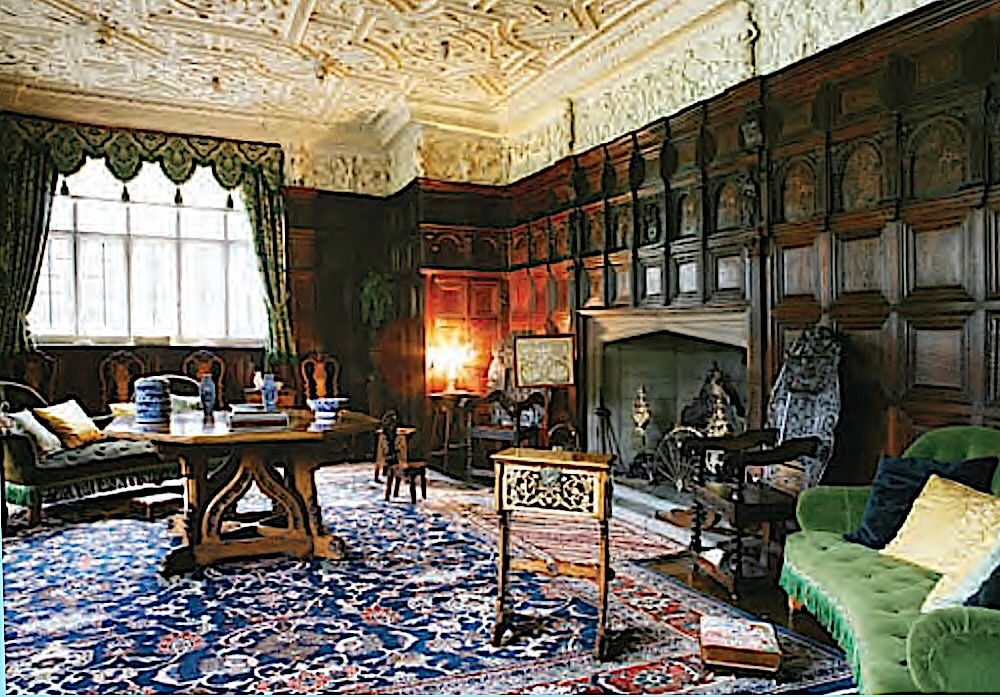
Dining Room with furniture. Photo credit: Lancashire County Council Museums Service. [Click on all the images to enlarge them.]
In 1849, newly retired from his position in Whitehall and ennobled for his efforts, Sir James Kay-Shuttleworth enlisted Charles Barry to renovate and refurbish the family home at Gawthorpe Hall in Lancashire. Whilst the accounts and letters of the builders, carpenter and Clerk of the Work, F.H. Groves, still exist there is currently little documentary evidence as to who furnished the Hall and the involvement therein of A.W.N. Pugin who was, at the time, involved with Barry's work at the Palace of Westminster. What little evidence we do have is found in the decorative elements and furniture still housed at the Hall.
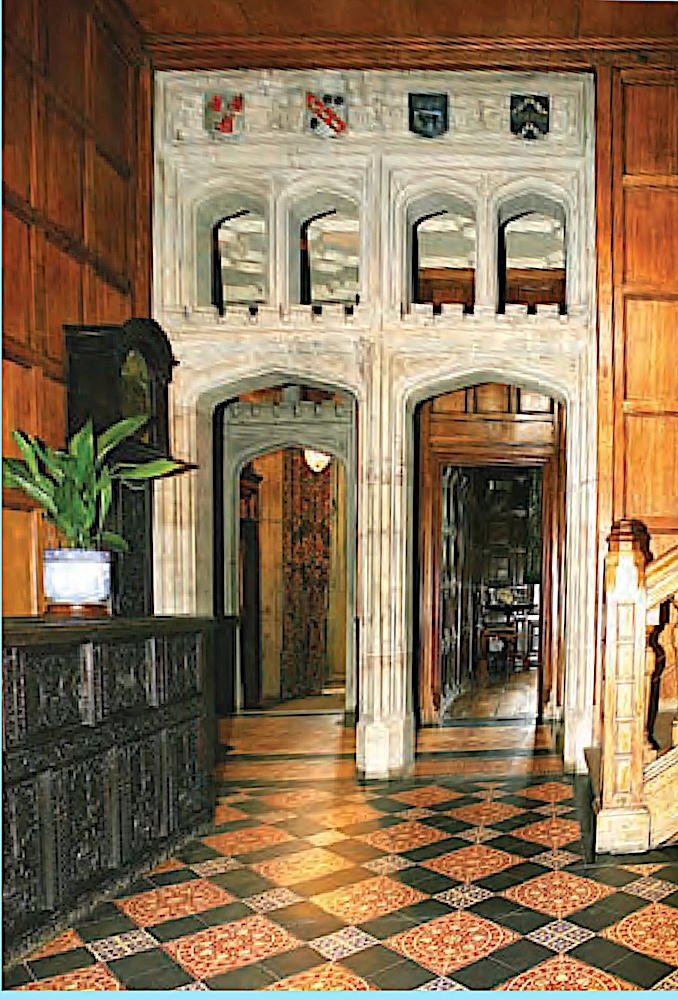
From the moment of crossing the threshold Pugin's designs are obvious. The front door is assembled with decorative ironwork – a wicket plate with openwork KS monogram, a motif taken from the family arms, and the door handle suspended from weavers' shuttles. Both were made by Hardman of Birmingham in 1851, costing £17 1s 6d, although this apparently excluded a locking mechanism. On 24 May 1852 a letter to Sir James from Mr Groves states: "From enquiries I have made, I find that Mr Bulcock or any other tradesman at Burnley would not attempt to make them (locks) themselves but would send to Birmingham…." Further metalwork elements are found in the Drawing Room with the cast iron Gothic fire grate, a good specimen of a Pugin design, with andirons carrying armorial plates and finials of wrought brass (Dean 17). Pugin's designs are also evident in the tiles of the entrance porch and staircase lobby. These were supplied by Minton in 1851 and are laid in several different configurations, some of which follow Pugin's Westminster patterns. An unsolicited basket of Minton tiles was delivered to the Hall in 1851 and only kept once Minton's had confirmed there would be no charge. The fireplace in the Dining Room was also tiled using Minton and Pugin designs but the encaustic tiles had to be replaced in the 1880s after cracking. "This early failure of glazed tile is known to have occurred at Westminster and elsewhere during the same period" (Dean 13).
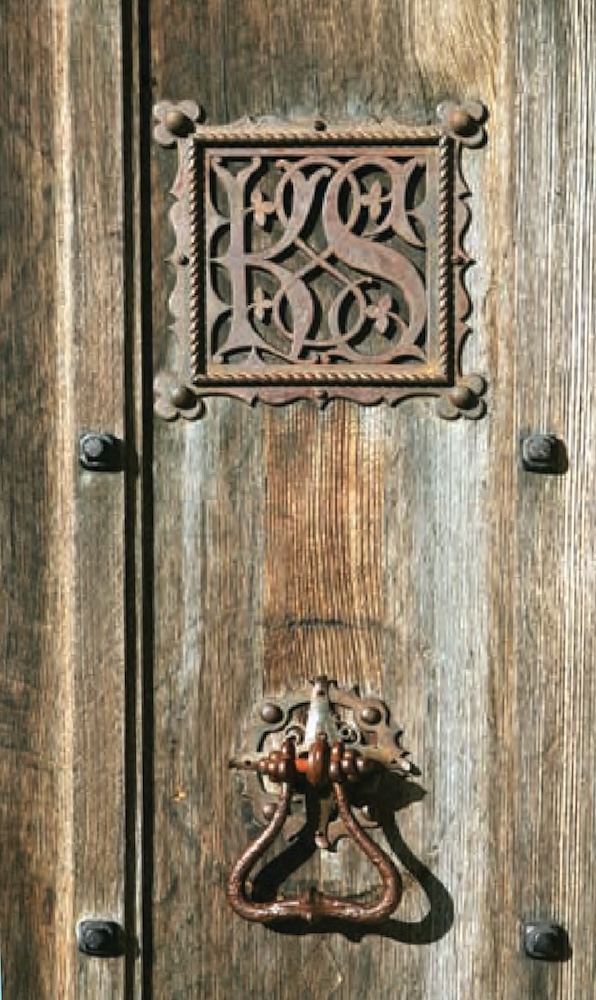
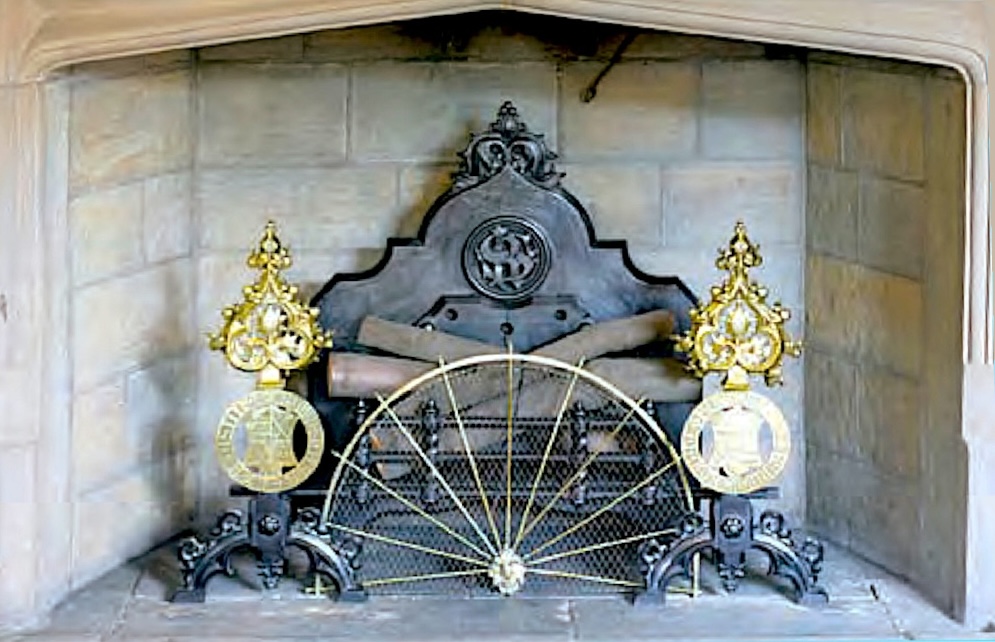
Left: Front door details (with the "K" and "S" standing for Kay-Shuttleworth). Photo credit: Lancashire County Council Museums Service. Right: Drawing Room fireplace. Photo credit: National Trust.
The Dining Room showcased two other Pugin designs: wool and brocade curtains, produced by J.G. Crace, called Gothic Tapestry. These were remade in the 1980s from fragments of the originals that had been kept at the Hall; and a Minton soup tureen and stand, minus its lid, patterned with Pugin’s Shamrock design of dark green bands, pink flowers and ivy leaf motifs, with gilt decoration to the handles, which dates from 1856. (Fragments of other items of this design have been found in a midden located near the river Calder that runs behind the Hall). It is in this room that the evidence of Pugin's collaboration with J.G. Crace is most prevalent. From a handful of mentions in Groves’ letters to Sir James it is known that Crace also supplied a red flock "narrow French paper" in May 1852. Several lengths of the original paper which Crace would later market as the "Rutland" design were received but "owing to the indifferent printing of eight pieces out of the eleven that have been sent down and one out of the three perfect pieces (being) much damaged" it proved difficult to match the pattern without a light red stripe on one edge showing (Groves, n.d., but probably May 1852). Sir James, in a hurry to finish an overrunning project and unwilling to brook any unnecessary delays, tolerated the blemish and the paper remained on the walls until the 1960s.
Pugin's collaboration with Crace could range from whole schemes for fittings and furnishing to single small items. "In many cases the client had no direct dealing with Pugin at all" (Lewis 68-69), but Crace's fashionable showroom at 14 Wigmore Street provided a base for the commercial sale of Pugin designed items.
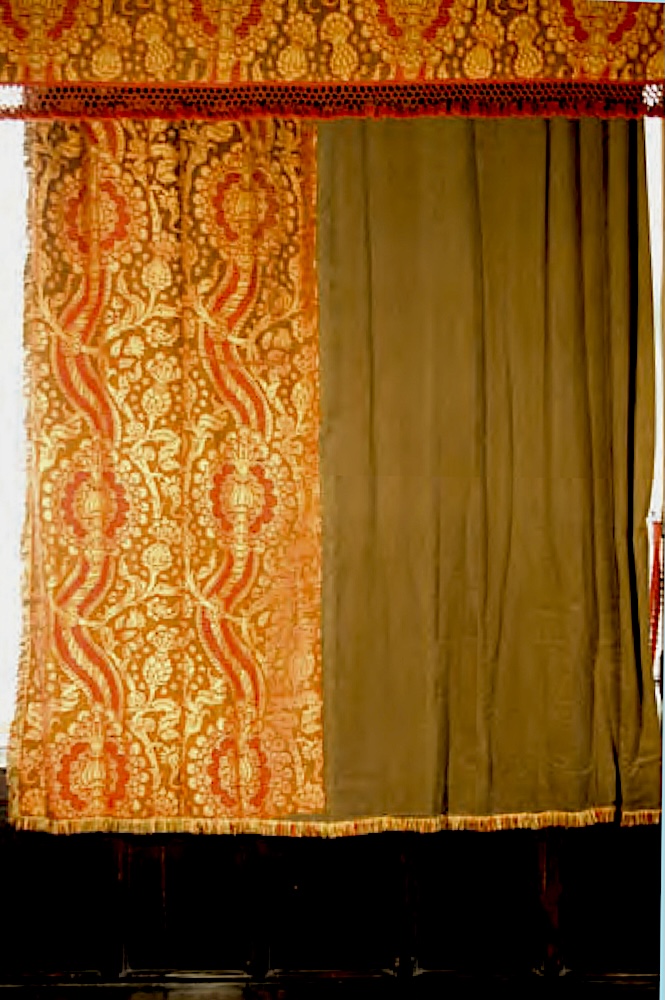
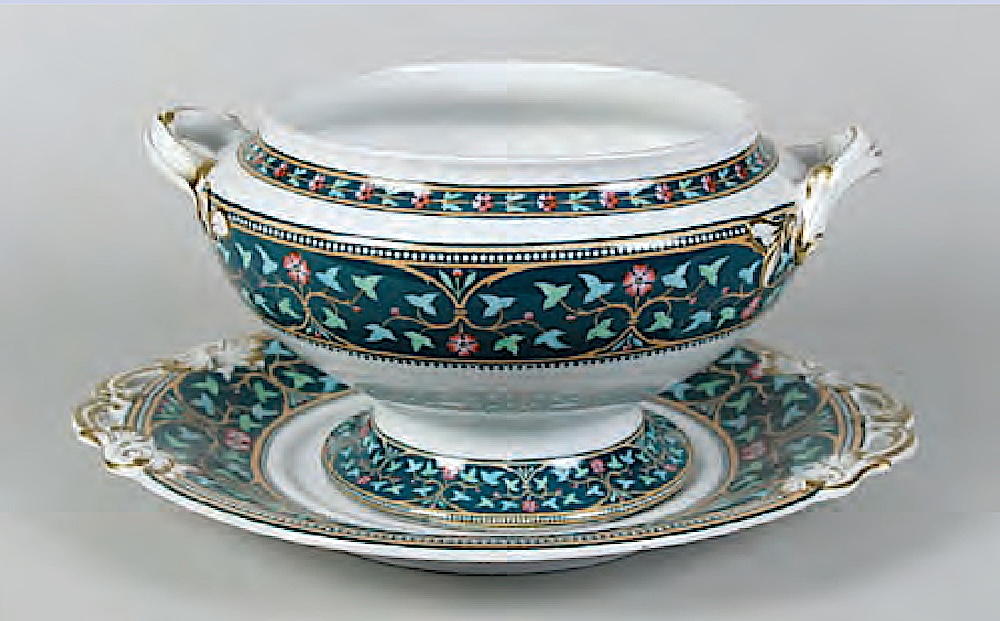
From left to right: (a) Minton tiles. (b) Dining Room curtain. (c) Tureen. Photo credit for all: National Trust.
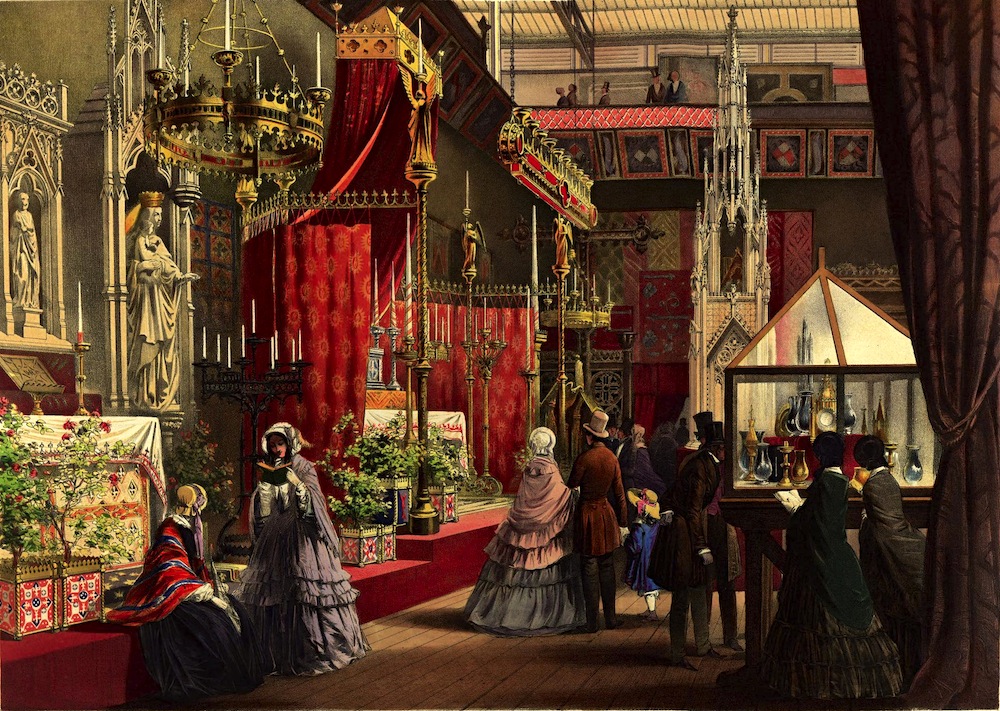
After the success of the mediaeval court at the Great Exhibition of 1851, Crace provided all that Pugin needed for the decorative side of his practice… Whole Pugin interiors were possible when Crace was available to manage the details and manufacture from his designs (see Stanton 169). With a lack of any other evidence it is probable that most, if not all, of the Pugin decorative elements at Gawthorpe Hall came via the Crace route. Support for this is provided by a letter from a Mr Read at Crace in the Hall's records, requesting confirmation of room/carpet colours, and so on.
There remains a second example of Pugin wallpaper in the Long Gallery. It was not until 1852 that Sir James decided to paper this room rather than having it panelled. A Pugin design of rich flock wallpaper was ordered and remained in place until the early twentieth century. Only when renovating the Hall in the 1980s was a fragment found, left hidden behind a door frame. It showed a "bold ogival pattern" of thistles and flowers on a ginger flock with gold leaf details and a maroon flock on a vellum ground (Dean 27), heavily influenced by fifteenth century Italian brocades and velvets. A reproduction paper was handmade using the original woodcut block and rehung in 1987.
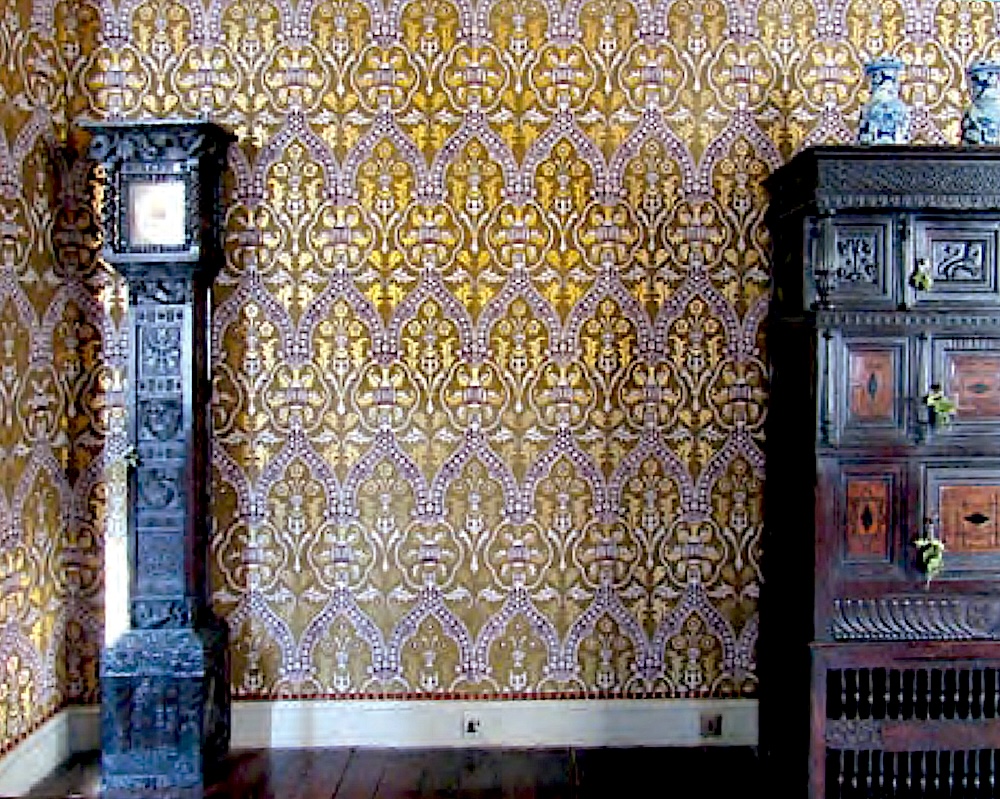
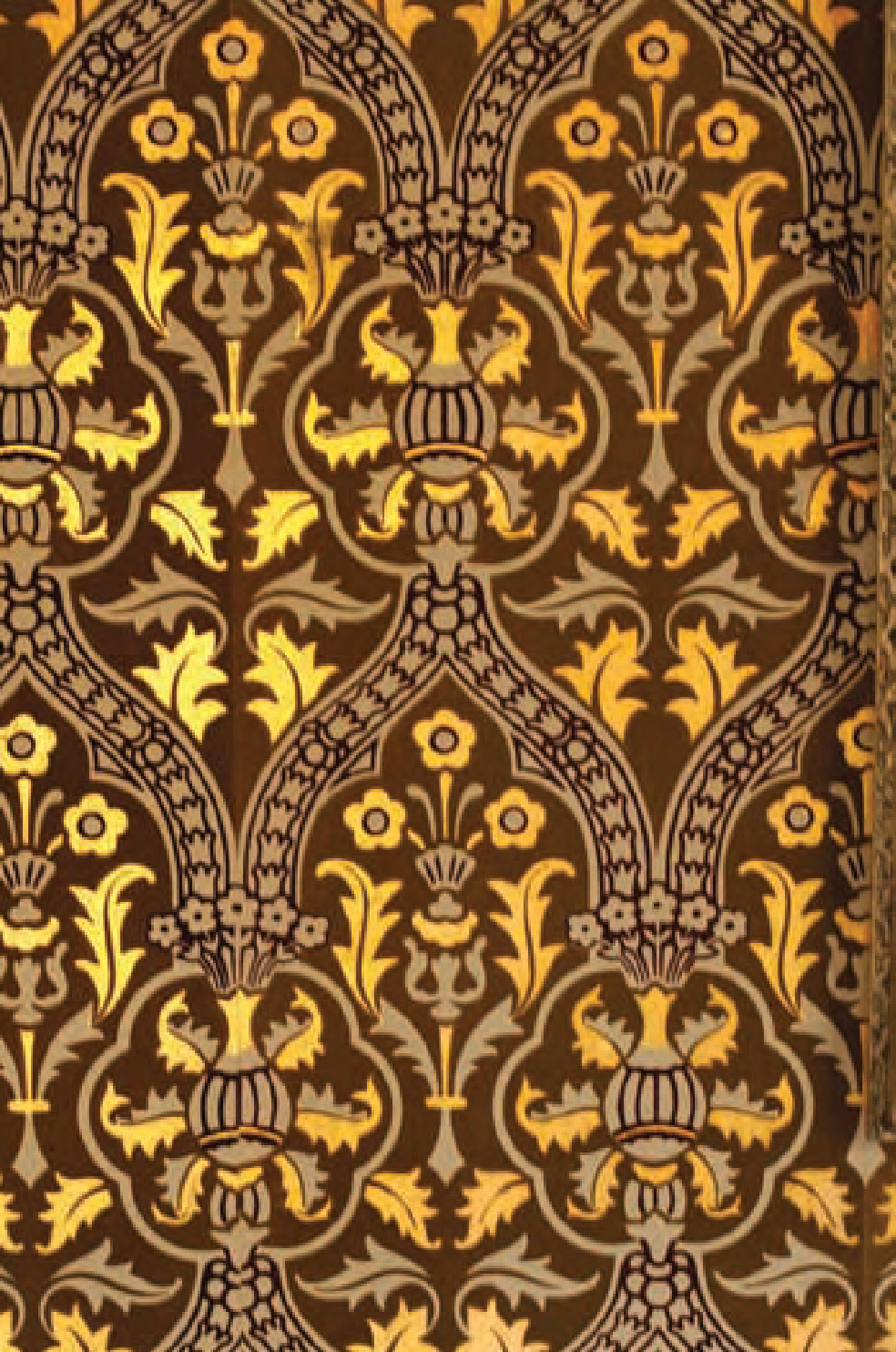
Left: Long Gallery wallpaper. Photo credit: Lancashire County Council Museums Service. Right: Detail of wallpaper here. Photo credit: National Trust.
Sir James also purchased furniture designed by Pugin. A teapoy was commissioned as a gift from James to his wife Janet, her initials gracing the side of the piece designed to look like a church kneeler. The lockable chest containing two lead lined tea caddies, has a burr walnut top and front inlaid with dog roses and flower chains and is seated on rosewood ends.


Left: Teapoy. Right: Octagonal table. Photo credit for both: National Trust.
A very similar design can be found in the V&A archive (see "Unidentified design, tea caddy"). The Teapoy stands in front of an octagonal table by Pugin and Crace, which has an inlaid border of Lancashire roses and holly leaves in a burr walnut top, supported on a carved oak trestle with ogee supports. It is similar to a table made for the Prince's chamber at the House of Lords and to one exhibited at Crystal Palace (Dean 18-19). The inlay in both pieces was chosen to match the seventeenth century inlaid panelling of the room which had been cleaned with soap and water to remove two centuries of soot and grime as part of the renovation. There were also two beds of a linenfold panel design purchased, probably for James and Jane, although they are no longer at the Hall.
Whilst few of the items can be traced back to Pugin with certainty, the furnishing of Gawthorpe Hall bears the hallmarks of his collaboration with J.G. Crace. Research is ongoing to discover more evidence of the links: for instance, since this article was first published, the designs for the wicket plate and door escutcheon have been identified among the hundreds in the recent Hardman Pugin deposit at the V&A (accession numbers E227.2023 and E228.2023). Such finds will add to the interpretation of the decorative elements of the scheme for visitors.
*Rachel Pilling is Site Supervisor at Gawthorpe Hall [offsite link]. She began her research into the Groves letters as part of her Master’s dissertation. Gawthorpe Hall is run by Lancashire County Council Museums Service and is owned by the National Trust. The Museums Service is also custodian of Pugin's work at Scarisbrick Hall, Lancashire.
Bibliography
Dean, Richard. National Trust Guidebook. The National Trust, 2009.
Groves, F.H. (1850-1852) Letters: NT archive held at Gawthorpe Hall.
Lewis, David Frazer Lewis (2021) A.W.N. Pugin. Liverpool: Liverpool University Press on behalf of Historic England, 2021. [Review]
Stanton, Phoebe. Pugin. London: Thames & Hudson, 1971.
"Unidentified design, tea caddy." Victoria and Albert Museum. Web. 17 July 2026.
Created 17 July 2026
Last modified 22 July 2026