
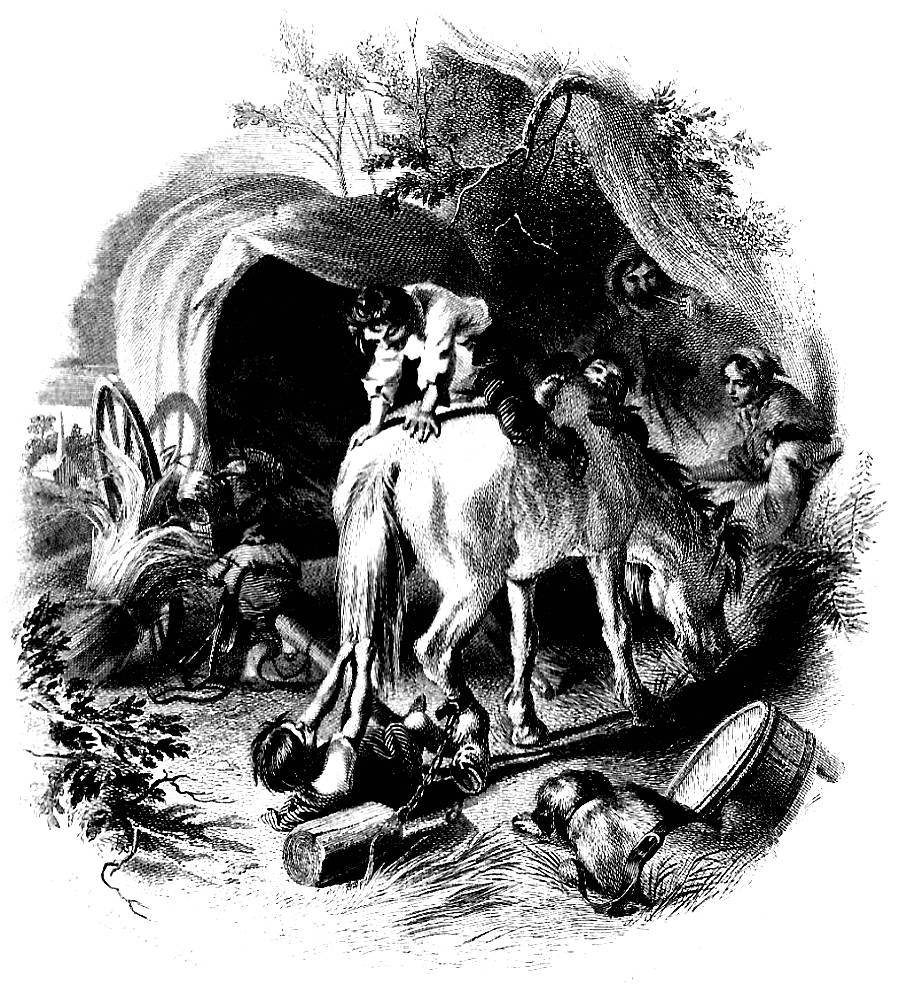
A Tramp Caravan
Felix O. C. Darley
1865
Photogravure
9.7 by 8.4 cm (3 ¾ by 3 ¼ inches) vignetted
Dickens's The Uncommercial Traveller, Household Edition, frontispiece.
Image courtesy of Toronto Dickens collector and bibliophile Dan Calinescu.
[Click on image to enlarge it and mouse over text for links.]
Scanned image and text by Philip V. Allingham.
Passage Illustrated
I have my eye upon a piece of Kentish road, bordered on either side by a wood, and having on one hand, between the road-dust and the trees, a skirting patch of grass. Wild flowers grow in abundance on this spot, and it lies high and airy, with a distant river stealing steadily away to the ocean, like a man’s life. To gain the milestone here, which the moss, primroses, violets, blue-bells, and wild roses, would soon render illegible but for peering travellers pushing them aside with their sticks, you must come up a steep hill, come which way you may. So, all the tramps with carts or caravans — the Gipsy-tramp, the Show-tramp, the Cheap Jack — find it impossible to resist the temptations of the place, and all turn the horse loose when they come to it, and boil the pot. Bless the place, I love the ashes of the vagabond fires that have scorched its grass! What tramp children do I see here, attired in a handful of rags, making a gymnasium of the shafts of the cart, making a feather-bed of the flints and brambles, making a toy of the hobbled old horse who is not much more like a horse than any cheap toy would be! Here, do I encounter the cart of mats and brooms and baskets — with all thoughts of business given to the evening wind — with the stew made and being served out — with Cheap Jack and Dear Jill striking soft music out of the plates that are rattled like warlike cymbals when put up for auction at fairs and markets — their minds so influenced (no doubt) by the melody of the nightingales as they begin to sing in the woods behind them, that if I were to propose to deal, they would sell me anything at cost price. On this hallowed ground has it been my happy privilege (let me whisper it), to behold the White-haired Lady with the pink eyes, eating meat-pie with the Giant: while, by the hedge-side, on the box of blankets which I knew contained the snakes, were set forth the cups and saucers and the teapot. It was on an evening in August, that I chanced upon this ravishing spectacle, and I noticed that, whereas the Giant reclined half concealed beneath the overhanging boughs and seemed indifferent to Nature, the white hair of the gracious Lady streamed free in the breath of evening, and her pink eyes found pleasure in the landscape. [Chapter Eleven, "Tramps," p. 163-164]
Commentary: A Volume of Journalistic Pieces Charmingly Introduced
Although Darley's frontispiece is beautiful as an independent work of art, it also serves to foil some of the less pleasant, "night side" material that Dickens's keen observer of human affairs describes in working class and industrial areas of London. In this respect, "Tramps," set near his Kent estate of Gadshill place, is less representative of the essays in The Uncommercial Traveller. Although the Household Edition of 1877 contains thirty-six separate articles published originally in All the Year Round, concluding with "The Ruffian," the 1865 volume, published in New York, is necessarily missing any article in the series published after "The Italian Prisoner" — which appeared in All the Year Round on 13 October 1860, and which was republished under the same title in the 1868 Charles Dickens Edition in The Uncommercial Traveller by Chapman and Hall. Indeed, the 1865 American "Household Edition" contains only seventeen of the twenty-nine pieces that Michael Slater and John Drew consider belong to the series of articles published in Dickens's new weekly journal between 28 January 1860 and 10 October 1868 ("The Ruffian," the last of the entries in the Chapman and Hall Gadshill Edition of 1898). The 1865 American volume contains these selections, with the original periodical publication dates in All the Year Round noted:
I. "His General Line of Business" [28 January 1860]
II. "The Shipwreck" [28 January 1860]
III. "Wapping Workhouse" [18 February 1860]
IV. "Two Views of a Cheap Theatre" [sic] [2 5 February 1860]
V. "Poor Mercantile Jack" [10 March 1860]
VI. "Refreshments for Travellers" [24 March 1860]
VII. "Travelling Abroad" [7 April 1860]
VIII. "The Great Tasmania's Cargo" [21 April 1860]
IX. "City of London Churches" [5 May 1860]
X. "Shy Neighborhoods" [American spelling applied] [26 May 1860]
XI. "Tramps" [16 June 1860]
XII. "Dullborough Town" [30 June 1860]
XIII. "Night Walks" [21 July 1860]
XIV. "Chambers" [18 August 1860]
XV. "Nurse's Stories" [8 September 1860]
XVI. "Arcadian London" [29 September 1860]
XVII. "The Italian Prisoner" [13 October 1860].
Missing, then, from the 1865 volume but present in the 1877 Household Edition volume published by Chapman and Hall are nineteen post-1860 articles, beginning with "The Calais Night Mail" (2 May 1863) and concluding with "the Ruffian" (10 October 1868). Since the last article that Sheldon and Company, New York, could have considered for inclusion would have been "Titbull's Alms-Houses" (24 October 1863), the twentieth-eighth identified by Slater and Drew, one may assume that the editor of the 1865 volume made the same decision as that of Chapman and Hall and Dickens himself in 1868, a version that the editors of Dickens' Journalism have designated UT 1.
Felix O. C. Darley, then, selected for illustration the least journalistic piece of those in the volume, "Tramps": this was the eleventh chapter, just past the middle of the volume. Although later illustrators have focused on the more disreputable descriptions in the essay, Darley with photographic detail realizes the scene in which Gypsy children play with and round about the horse from the family's caravan, parked in the rear, the family dog positioned in the right foreground to suggest a complete family grouping, with a bearded adult smoking a pipe, right of centre. One could certainly not surmise from this idyllic scene of four children at play and the beautifully executed horse that Dickens had by the time he was resident at Gadshill something of a phobia about tramps, reflected in professional author David Copperfield's remarking in Chapter 13 that "trampers inspired me with a dread that is yet quite fresh in my mind" (cited in Slater and Drew, 126). None of the plates in the 1868 Illustrated Library Edition, featuring eight wood-engravings by Pinwell and "W. M.," represents this particular essay. There is, however, a small-scale wood-engraving by Sol Eytinge, Jr., in the Diamond Edition volume, just one of four for The Uncommercial Traveller, that deals with the confrontation between a disreputable sturdy tramp and an uniformed village beadle, a short, fat, middle-aged official impotently waving his staff of office as the departing young vagrant who clearly is not the least intimidated.
The third significant illustrated edition of Dickens's works, the Charles Dickens Library Edition (1910), contains but one illustration for the collected journalistic pieces. Attempting to show the connection between the narrative voice of Dickens's flaneur in these 1860s articles and Dickens himself in the final decade of his life, Furniss uses an image of the writer dressed as a "commercial" traveller in The Uncommercial Traveller (1910).
Relevant Diamond Edition (1867) and Household Edition (1877) Illustrations
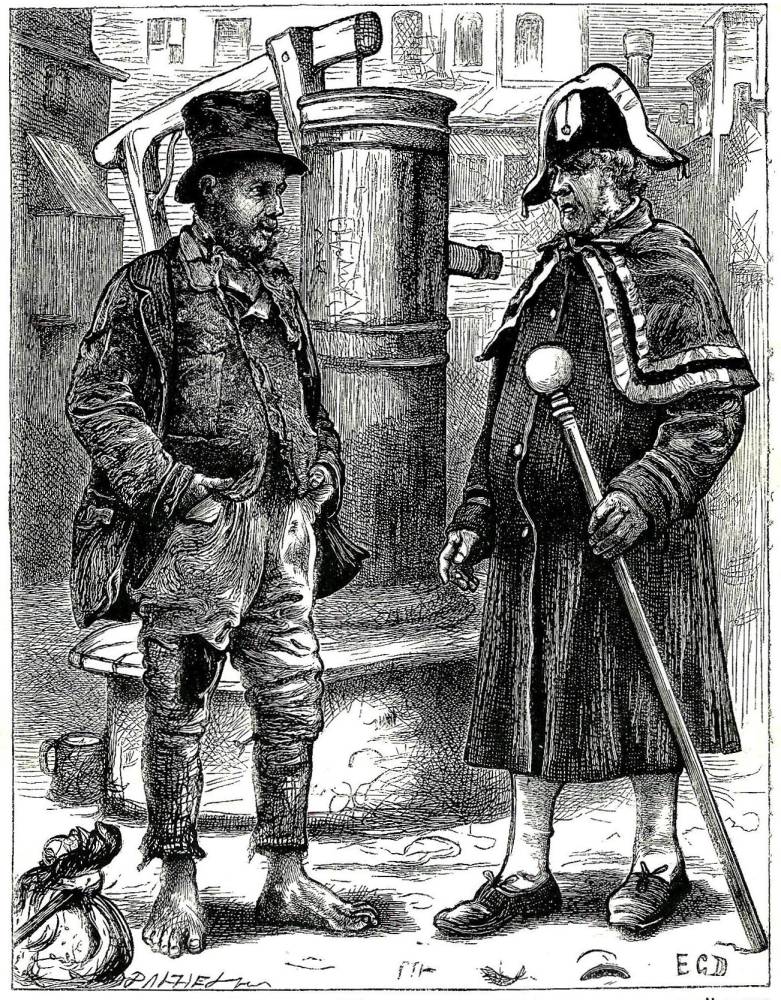
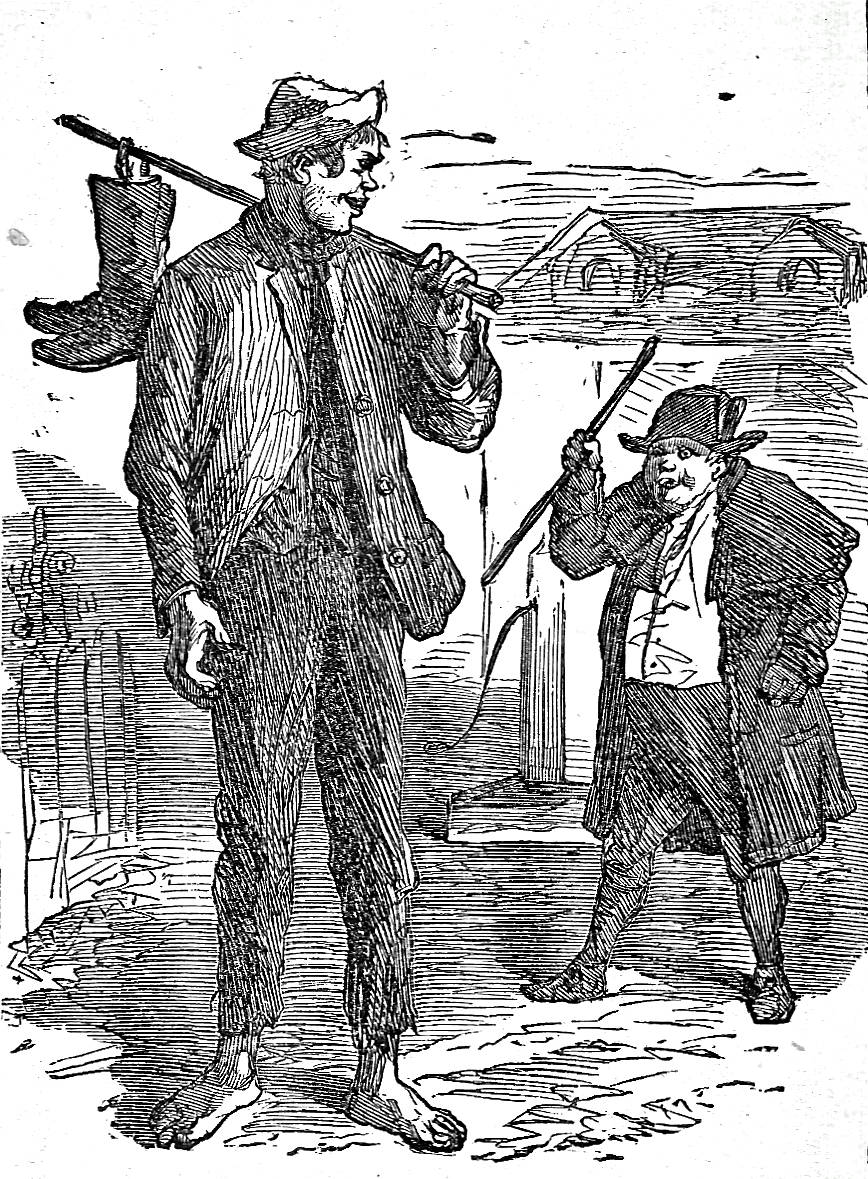
Left: E. G. Dalziel's The Tramp and the Beadle. Right: Sol Eytinge, Jr.'s Tramps (1867). [Click on the images to enlarge them.]
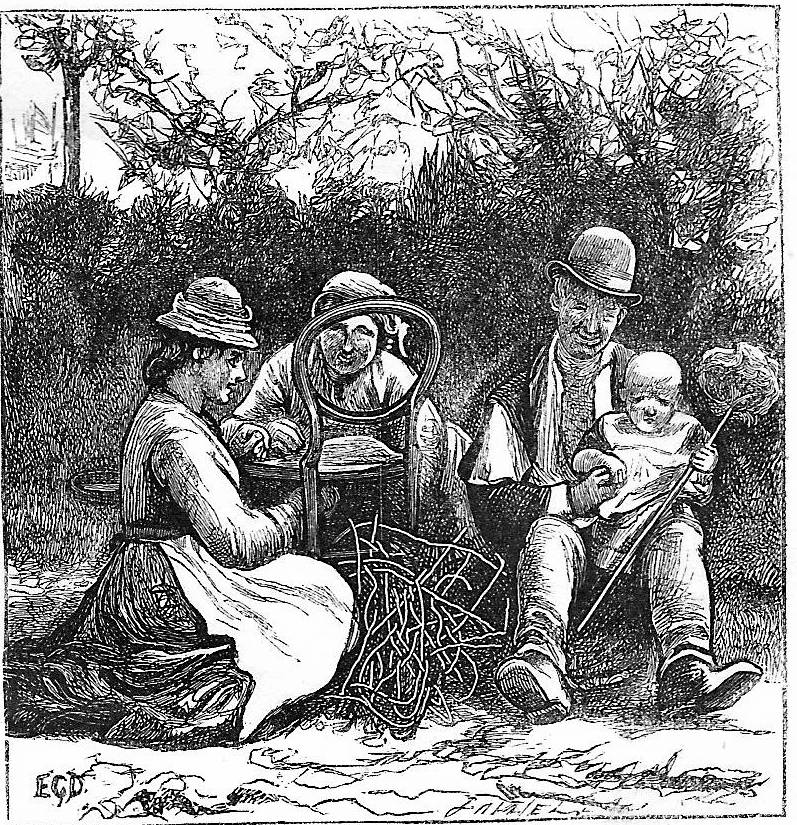
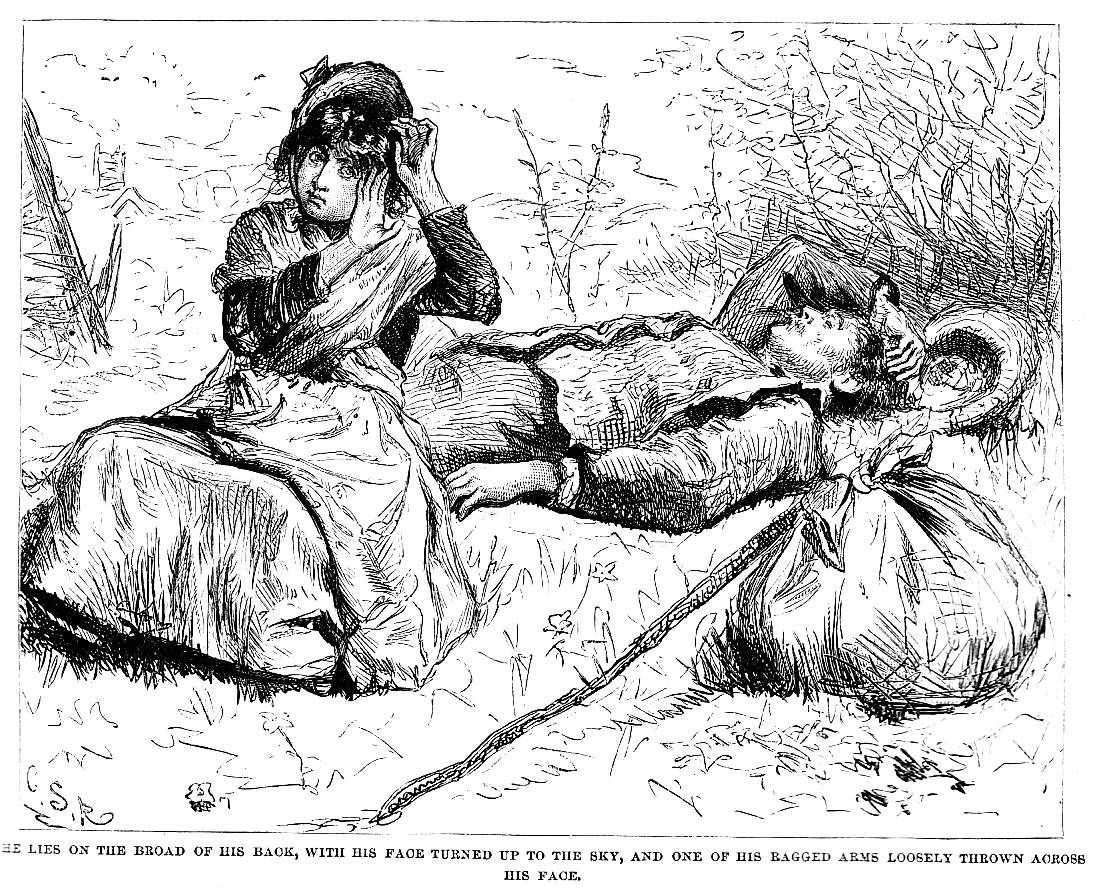
Later Editions. Left: E. G. Dalziel's Title-page Vignette (1877). Right: C. S. Reinhart's He lies on the broad of his back, with his face turned up to the sky, and one of his ragged arms loosely thrown across his face (1878). [Click on the images to enlarge them.]
Bibliography
Bentley, Nicolas, Michael Slater, and Nina Burgis. The Dickens Index. New York and Oxford: Oxford U. P., 1990.
Dickens, Charles. The Uncommercial Traveller. Works of Charles Dickens. Household Edition. 55 vols. Illustrated by F. O. C. Darley and John Gilbert. New York: Sheldon and Co., 1865.
Dickens, Charles. The Uncommercial Traveller. Works of Charles Dickens. Diamond Edition. 18 vols. Illustrated by Sol Eytinge, Jr. Boston: Ticknor and Fields, 1867.
Dickens, Charles. The Uncommercial Traveller, Hard Times, and The Mystery of Edwin Drood. Illustrated by C. S. Reinhart and Luke Fildes. The Household Edition. New York: Harper & Brothers, 1876.
Dickens, Charles. The Uncommercial Traveller. Illustrated by E. G. Dalziel. The Household Edition. 22 vols. London: Chapman and Hall, 1877. Vol. 16.
Dickens, Charles. The Uncommercial Traveller. Illustrated by Harry Furniss. The Charles Dickens Library Edition. 18 vols. London: Educational Book, 1910. Vol. 7.
Slater, Michael, and John Drew, eds. Dickens' Journalism: 'The Uncommercial Traveller' and Other Papers, 1859-70. Vol. 4. London: J. M. Dent, 2000.
Created 17 March 2014 Last updated 18 July 2026