
An earlier version of this review appeared under the title of "An Englishwoman Abroad: The Poet's Literary Florentine Set" in the Times Literary Supplement (30 July 2026: 14; online version). Page numbers, links, illustrations and some extra material have been added here.
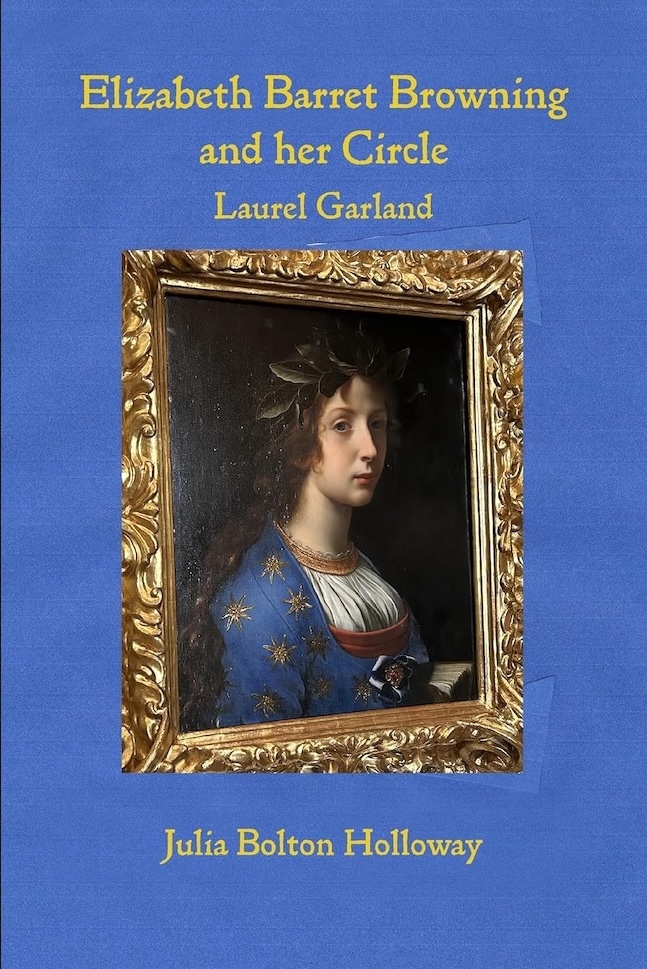
When the Brownings arrived in Florence in April 1847, about seven months after eloping to Italy, it was already home to a cosmopolitan community of expatriates. Among these were the American sculptor Hiram Powers, whose statue of a Greek slave would inspire a sonnet in Elizabeth Barrett Browning's Poems of 1850; and Frances Trollope, resident there since 1843, whose son Thomas (Anthony Trollope's brother) would marry the part-Indian, part-Jewish poet and translator Theodosia Garrow. Elizabeth had already met Theodosia in England, and before too long their children, Pen Browning and little Beatrice Trollope (Bice), would be playing together. A member of the community in earlier days, the poet Walter Savage Landor, had left Florence before the Brownings arrived, but was taken under their wing when he returned in irascible and unpredictable old age.
These and others have attracted much scholarly attention, but no one could have a more intimate knowledge of them than Julia Bolton Holloway. During a distinguished academic career, Holloway spent a year's sabbatical as curator of Casa Guidi, the Brownings' home in Florence. Moreover, for the last twenty-five years, she has been custodian of the English Cemetery in Florence — the last resting place not only of "EBB" herself, but of Powers, Frances and Theodosia Trollope, Landor, and many of their fellow-expatriates. Naturally, Holloway has much to say here about the Brownings, and she paints a disconcerting picture of a "marriage gone sour" (xi), and a husband unable to come to terms with his wife's achievements, quietly administering too much laudanum in her final days: Elizabeth, she suggests, had quite simply "become too famous" (157). But her wider aim is to bring together the various stories of all the members of their circle, with their very different backgrounds — to weave from and for them the laurel garland of her subtitle, without discrimination of gender, class or ethnicity.
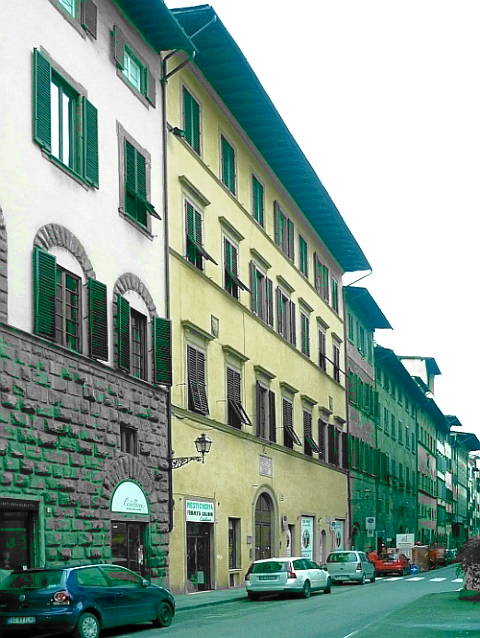
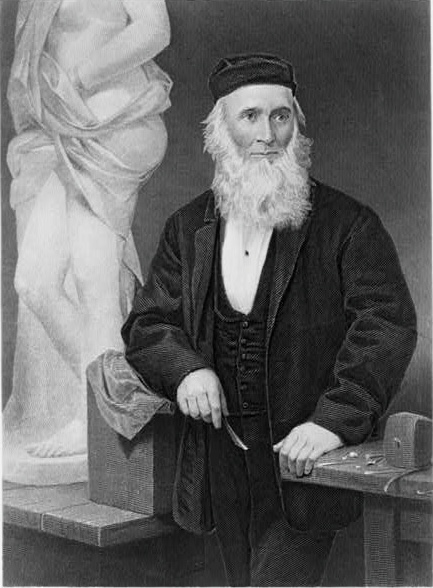
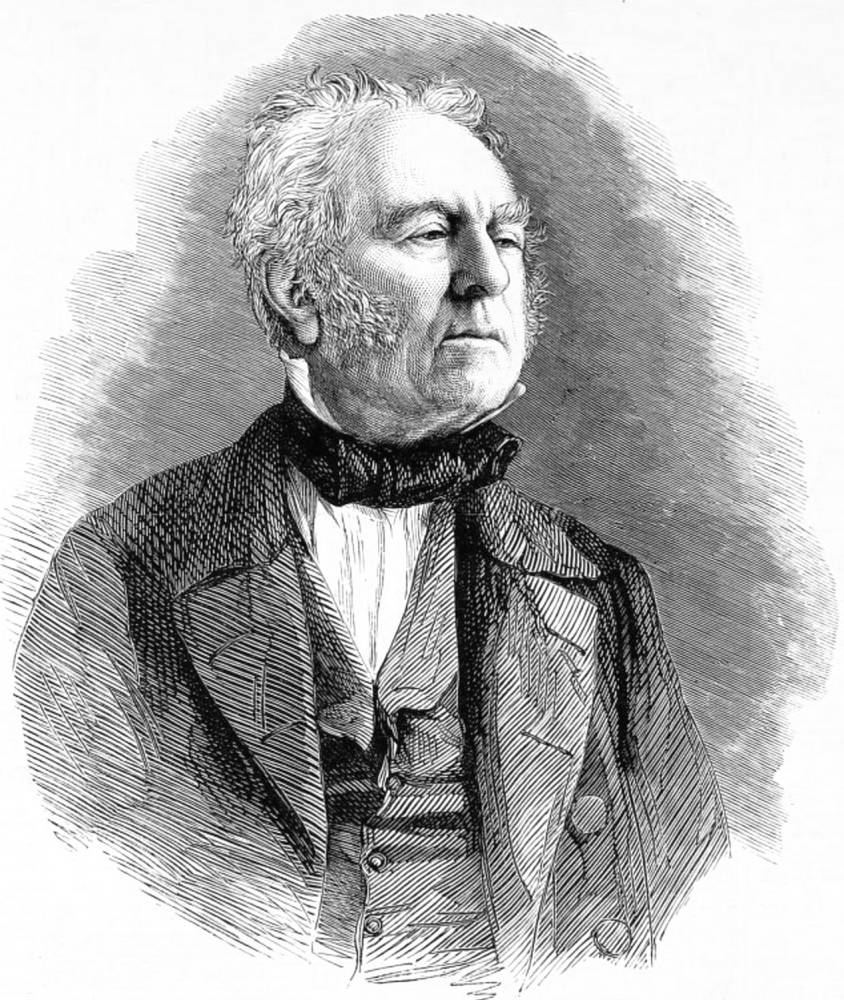
From left to right: (a) Hiram Powers. (b) Walter Savage Landor. (c) Frances Trollope. [Click on all these for larger images and more information.]
In Holloway's hands, their world is not dead and gone, but lives on in works as various as the Brownings' poetry, and the famous bronze of the couple's clasped hands by the sculptor Harriet Hosmer. The Dublin-born art-historian Anna Jameson, who had helped the Brownings during their elopement, and was a "dazzled and enthusiastic" beholder of their early romance (qtd. p.7) is among those who come to life here: at one point she lived next door to them in Florence. The spirit of this Florentine community shines, too, in the life of the red-haired Jessie White Mario, a translator and journalist who often visited Casa Guidi. A firebrand who had met Garibaldi in London, and married an Italian nationalist, Mario became too radical for the Brownings, but not for the Italians: the historian Pasquale Villari hailed her as being "among the saints and heroes of our Revolution" (qtd. 105). She spent her last ten years teaching in Florence, and Holloway gives a touching account of her funeral cortège passing Casa Guidi in March 1906, when it was decorated for the centennial of Elizabeth's birth.

Many others crowd into these vibrant pages, like the mixed-race sculptor Edmonia Lewis, who settled in Rome. Such visitors may have stayed more briefly, and been more tenuously connected to the Brownings — in Lewis's case, through the help she received from Powers on her arrival in Italy; but they add to the general atmosphere of an open, thriving, variously creative community. Lewis has come to prominence lately, with work featured in the Tate's popular 2024 exhibition, Now You See Us: Women Artists in Britain 1520-1920. But some names here are sure to be new even to the best-informed readers. This is largely because their histories and achievements were so diverse. Lewis herself was of African American and Native American heritage, and Holloway introduces another pioneering African American, the abolitionist and medical doctor Sarah Parker Redmond, who did part of her training at Florence's Santa Maria Nuova Hospital. As for those with Indian connections, there were so many of these that Holloway devotes one whole section (Chapter XIV) to them. They included not only Theodosia Trollope (née Garrow), whose father was partly Indian, but others of the Browning's inner circle, such as Isa Blagden, "friend to Henry James, friend to the Brownings, friend to many, who earned her keep by writing novels and taking in paying guests" (192), who was also thought to have Indian blood. The saddest story is that of the adventurous young Maharajah of Kolhapur, who succumbed to a fever and died at his hotel overlooking the Arno on the return leg of a whirlwind tour of Britain — Oscar Wilde admired his monument in the Cascine Park greatly. Holloway is as knowledgeable about all these in print as she is in person when showing visitors round the English Cemetery, now splendidly restored under her custodianship.

Elizabeth Barrett Browning with the Brownings' son, Robert Wiedemann Barrett Browning.
But this is not a guidebook. Nor, despite its chapter abstracts, "study questions/further reading," and extensive bibliography, is it a critical survey. Having promised in her preface to eschew "detached mechanical lifeless prose" (xiv) in favour of a more humanistic approach, Holloway moves back and forth to weave her "garland" from primary materials, shaping her book through a natural, sometimes playful process of telling and retelling. Even in the sections dedicated to individual figures, information emerges conversationally, drawing on and looking forward to what is said elsewhere. The sense of a personal encounter with the author and her subjects, particularly Elizabeth Barrett Browning herself, is supported throughout by reminiscences, illustrations, many of them in colour, and a variety of quotations. A chapter on "Browning and the Artists", for example, includes the whole of Robert Browning's poem, "Andrea del Sarto," with Andrea's resentment of his wife Lucrezia reflecting Browning's jealousy of his own wife's growing reputation. It was clearly a state of mind that Browning understood painfully well.
As if to confirm her sometimes barbed "playfulness," Holloway adds an appendix proposing a nine-part series in which the "Golden Ring" of her intertwined accounts could be performed on screen or over the air from their original locations. It would start with Frances Trollope in Florence reliving her earlier adventures, first in sepia than in technicolour, and end with Virginia Woolf's retelling of Flush, her story about the Brownings' elopement from the point of view of Elizabeth's beloved spaniel. That would, she muses, not at all tongue-in-cheek, require a "brilliant dog actor" (258). Holloway then prompts us to imagine further episodes of our own, and there is certainly plenty of material for them here. This is reading as shared experience, challenging as well as engaging, of a kind increasingly under threat. Long may it prevail.
Bibliography
[Book under Review] Holloway, Julia Bolton. Elizabeth Barret Browning and Her Circle: Laurel Garland. Newcastle-upon-Tyne: Cambridge Scholars Publishing, 2025. 307 + xix pp. Hardback £93.03. ISBN: 978-1-0364-5890-4.
Created 1 September 2025