
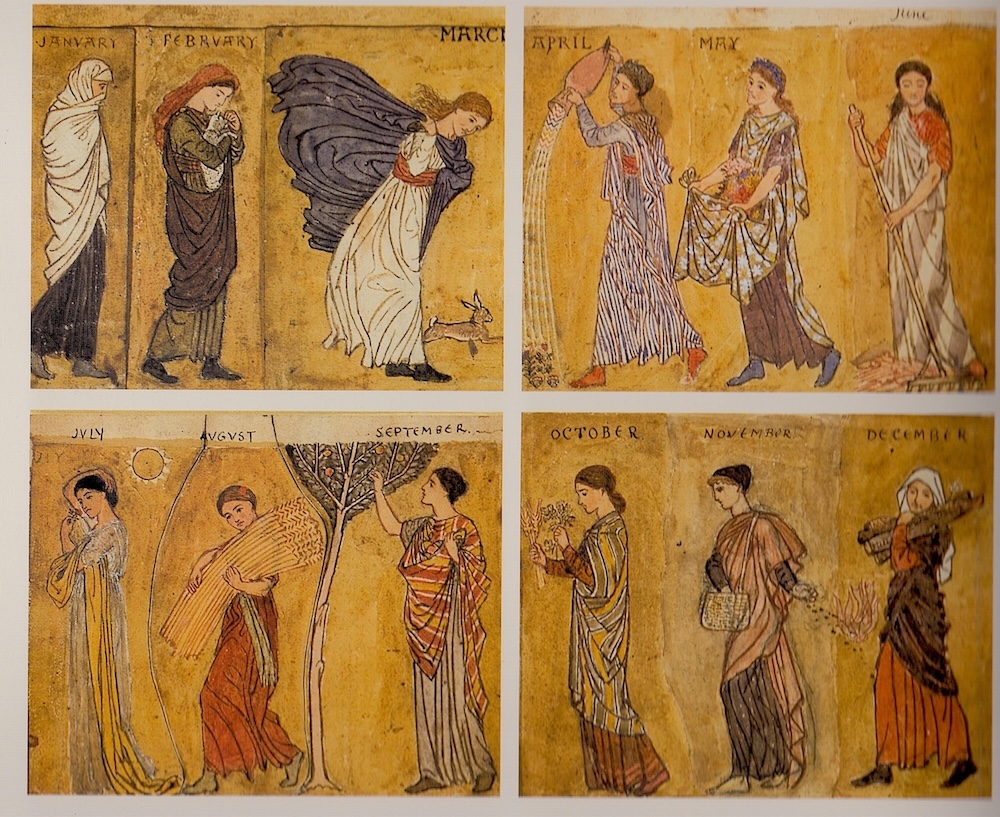
The Months of the Year, designed c. 1862-63. Watercolour and gouache; four squares each measuring 6 x 7 ¼ inches (15.2 x 18.4 cm). Collection of the Victoria and Albert Museum, accession no. 180-1894. Image courtesy of the Victoria and Albert Museum, reproduced for purposes of non-commercial academic research. [Click on the images on this page to enlarge them.]
A.L. Baldry in his book on Moore states that these designs were initially used for a frieze. possibly referring to the frieze of relief sculptures with figures emblematic of the months of the year that Moore designed, and James Forsyth executed, at Cloverley Hall, near Whitchurch, Shropshire. The reliefs are similar, but not identical, to the figures represented in the tiles. The frieze was executed in low-relief stone carvings, nearly two-thirds the size of life.
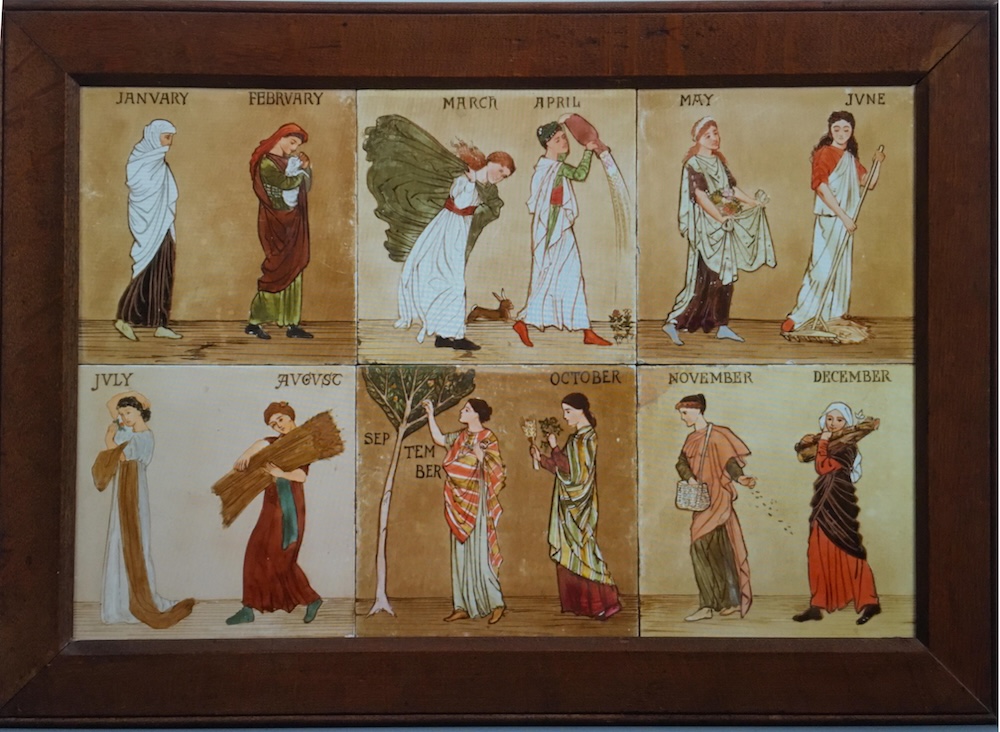
The Months of the Year, designed c. 1862-63. Six Minton, Hollins & Co. Tiles in a Tile Panel. 15 3/4 X 21 3/4 inches (40 X 55.5 cm) including frame; 6 x 6 in. (15.2 x 15.2 cm) – individual tiles. Private collection. Image courtesy of the author.
Cloverley Hall was a sixteenth-century house owned by the prominent Liverpool banker John Pemberton Heywood. Moore's friend, the architect William Eden Nesfield, carried out alterations and new building at Cloverley Hall between 1865 and 1870 and had likely suggested Moore for the commission. Moore had previously designed twelve different panels of the Months of the Year for the painted ceiling of the model dairy that Nesfield designed in 1860-1861 for William Philip Molyneux, 4th Earl Sefton, at Croxteth Hall near Liverpool. These designs were also later adapted for tiles. Design drawings for both these sets of the Months of the Year are in the collection of the Victoria and Albert Museum.
If one compares Moore's watercolour designs to the tiles themselves, the figures of April, May, and June are reversed to make them work better as two-figure tiles. The painting by the Minton tile painters is far simpler than Moore has done in his watercolour designs, with the draughtsmanship being far looser and less rigorous. Most of the female figures in the tiles engage in appropriate agricultural activities, while others show the figures responding to the weather. The figures are in Moore's quaint linear naïve early style and no attempt is made at spatial illusion. Despite their stiff-mannered angularity, the pose and the actions of the figures are highly appropriate to the months they represent.
Few examples of these sets of tiles are known to exist and they would appear to be very rare. There is a set of these tiles employed as a fireplace overmantel in the entrance hall at Coll Earn House in Auchterarder, Perthshire, Scotland. The fireplace was designed by J. Bruce Talbert. If one compares the two sets of tiles, the colouring chosen by the tile painters differs significantly between this set and the set illustrated here, suggesting that the tile painters could choose which colours to employ. The same holds true for a single tile of September/October in the collection of the York City Art Gallery. In the case of this particular tile, the lettering of September differs markedly in its arrangement between the other two known examples. It is uncertain when Moore's designs began to be employed by Mintons, Hollins & Co. for tiles and over how many years they were in production. Coll Earn House, however, was built for the industrialist Alexander Stuart Mackintosh by the architect William Leiper between 1869-1870. Cottier & Co. was largely responsible for the interior decoration, which was completed by 1872. This suggests these tiles were being used by the late 1860s, very early 1870s, at the least. Daniel Cottier and Albert Moore were certainly acquainted.
Related Material
Bibliography
An Aesthetic Odyssey. The Peter Rose and Albert Gallichan Collection. London: Christie's (September 30, 2021): lot 208, 202.
Asleson, Robyn. Albert Moore. London: Phaidon, 2000. 51-52.
Hartnoll, Julian. The Moore Family Pictures. York: York City Art Gallery, 1980, cat 89, 78.
Created 10 October 2026