
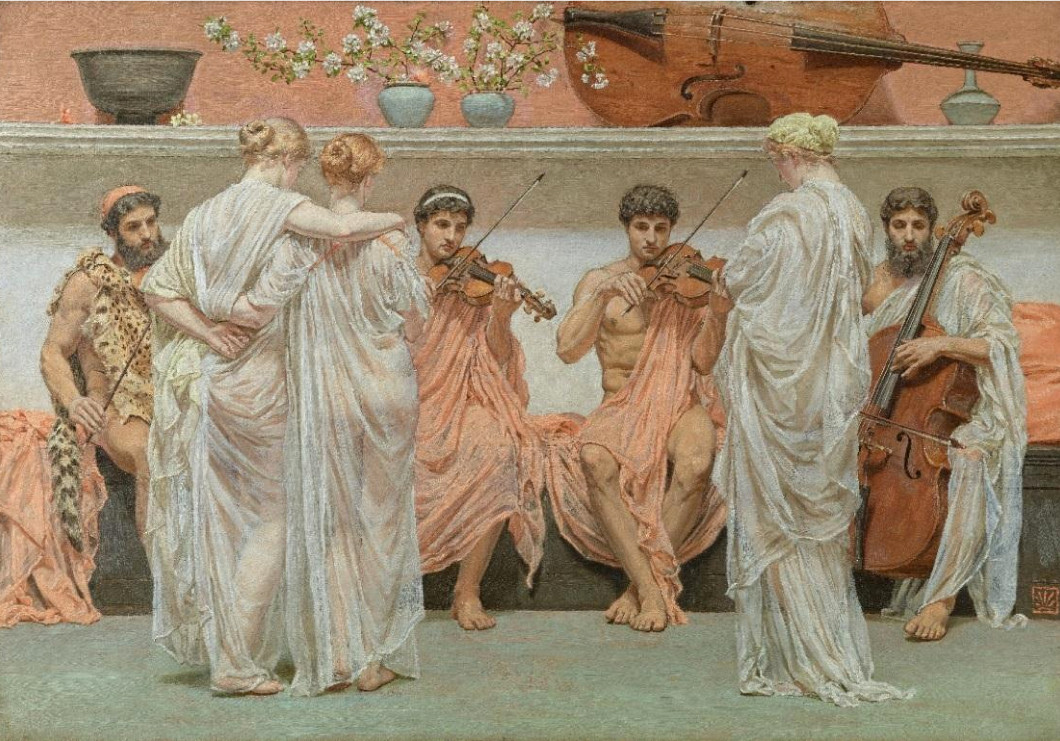
A Quartet: A Painter's Tribute to the Art of Music, A.D. 1868 [A Quartet] by Albert Joseph Moore, ARWS (1841-1893). Oil on canvas. 24 3/8 x 34 1/4 inches (61.8 x 88.7 cm.). Source: Pérez Simón Collection, Mexico. Photograph © Studio Sébert Photographes reproduced here by kind permission of the Leighton House Museum. [Click on the image to enlarge it.]
Moore exhibited A Quartet at the Royal Academy in 1869, no. 483. It features four young men seated on a charcoal grey stone bench and playing stringed instruments, two violins, a viola, and a cello. Two are clothed in peach-coloured draperies, one in white, while the fourth wears only a leopard skin. The three young women standing in the foreground, with their backs turned towards the viewer, are clad in white semi-transparent costumes that clearly reveal the shapes of their underlying anatomy. Two of the young women are together, the one on the left having her arm around the neck of the other, who clasps her companion around the waist. The third woman, wearing a pale-yellow cap, stands off to the right. Behind the musicians is a white panelled wall with a shelf on top on which are various pots and vases, including two pots with white flowering shrubs, and a bass fiddle. Above the shelf is a peach-coloured wall that matches the costumes of the musicians. The floor is of a grey-green colour. The picture is thus a colour harmony of peach, white, and grey tones. At first glance the composition must have appeared jarring to Victorian viewers. As Stephen Calloway has remarked: "At first thought the modern date in Moore's title, and the modern musical instruments depicted in the painting, might seem the clumsiest of Aestheticism's deliberate anachronisms. With unmannerly abruptness they block any attempt to interpret the painting as a scene or event from classical antiquity, leaving the viewer with no alternative but to enjoy the painting for its lovely colours and forms alone" (73). Moore was not the first Victorian painter to introduce such an anachronism in his art. Frederic Leighton had been savaged by the critics for having Orpheus play a violin rather than a lyre in his The Triumph of Music: "Orpheus, by the Power of his Art, Redeems his Wife from Hades" that he exhibited at the Royal Academy in 1856. At the time, for instance, the critic for The Athenaeum considered it one of the worst pictures in the Exhibition: "Mr. Leighton's Triumph of Music(508) is anything but a triumph of Art … absurd in thought, dismal in colour, and ridiculous in composition" (591).
Moore's work is another attempt at this time by artists associated with the early Aesthetic Movement, including D. G. Rossetti in works like The Blue Closet of 1857, James Whistler in his Symphony in White, No. III of 1865-67, or Frederic Leighton in his Greek Girl Dancing of 1867, to show the correspondences between the arts of music and painting. As Allen Staley points out, however, "In no other work apart from Moore's does painting present itself as so strictly limited to its own decorative or formal concerns" (133-34). He goes on to add: "While the combination of modern musical instruments and togas may seem like a glaring and even ridiculous anachronism, it is made anachronistic only by our instinctive expectation that the picture is supposed to show something that might actually have taken place at a given time. The point of the picture, as implied in the title, is that it is about something else: the celebration of modes of expression, not bound by the requirement of representational consistency" (134-35).
Moore was the only Victorian artist, however, who chose to arrange his pictures along a geometric grid, as in this early example. Liz Preetejohn has explained how this was intended to emphasize the correspondences between the sister arts of painting and music:
The composition expresses this "tribute" by setting up antiphonal relationships among each of its visible elements. The line set up two rhythms: a complex sequence of diagonals, oriented in both directions, and a bouncing set of horizontals. The colour harmony is based on an alternation between white and pale orange or peach-coloured hue, with carefully placed accents of yellow and brown. The figures form two complementary groups: female listeners, standing, draped in white and seen from the back, and playing males, seated, and seen from the front. The idea of antiphony thus extends to every aspect of the visual planning, and in each anti-phonal pair the two elements (diagonal/horizontal, white/orange, standing/seated, back view/front view, female/male) are kept in equilibrium, so that neither predominates visually over the other. [118]
A. L. Baldry also elaborated on Moore's conception of this work:
Explained by its subtitle the work is obviously symbolical, a decoration in which the painter renders his tribute to the Art of Music. To the four players, he has assigned a violoncello and three violins, probably as being, out of the whole range of musical instruments, those most capable of producing the finest qualities of sound and the greatest charm of expression. He has given to the figures the draperies and accessories of an imaginary world, wisely refusing to limit ideal music by any restrictions of period or place. He has expanded on the picture all possible care in matters of draughtsmanship, colour, and composition, so that his avowal of respect for a sister art should lack nothing of completeness. He has, in fact, done all that lay in his power to make his offering one that would be worthy of the recipient, and be credible to himself. [37]
A study in black and white chalks on brown paper for the two female figures to the left of the composition is in the collection of the British Museum (museum no. 1888,1123.17).
Contemporary Reviews of the Painting
A critic for The Art Journal felt that Moore had been unduly influenced by ancient Roman wall frescoes: "The classic style affected by Mr. A. Moore in A Quartet — a Painter's Tribute to the Art of Music, A.D, 1868 (483), is wholly different from the manner of Mr. Leighton, and less agreeable. The painter seems to assume the bearing of independence, yet does he owe more to the pictures of Pompeii than either to nature or to his own creative powers. He belongs to a period of historic decadence; his method is that of tempera rather than of oil" (199).
F. G. Stephens in The Athenaeum tried to explain how Moore's composition related to music:
Next comes No. 483, A Quartet, a Painter's Tribute to the Art of Music, A.D, 1868, by Mr. A. Moore, which seems saturated with melody, and is entirely apt to express what the fanciful title indicates as the artist's purpose. To this aim colour and composition are in accord and unchallengeable. In these the competent recognize a marvellous merit and quality of the rarest kind in Art…. The latter has had his will in painting four players on stringed instruments, who are seated on a stone bench that is backed by flowers and foliage, among which rest those great viols which have been for the time laid by. Three ladies, who are robed in the Greek manner, stand listening before the harmonists, and, by the grace of their noble forms, the varied, flowing and broken lines of their diversely-textured draperies, render to the eye of the student in loveliness the suave, long-sustained and fluttering harmonies of the lighter order in music, as the graver, more sedate and powerful poses of the men offer to the same judgment apt suggestions of the more serious elements of melody. [707]
The critic of The Spectator understood Moore's motives in painting this picture despite musicians who criticized Moore's lack of, or indifference to, archeological knowledge: "A Quartet (483), by the same artist, is a beautiful study of human form and drapery. Musicians are much exercised by the action of the violoncello-player on the right, who is represented as executing what is technically called a thumb-passage. This, say they, was a method of execution unknown at the period (say 1800 years ago), and argues a reprehensible lack of archaeological knowledge. Let the musicians say what they will, it is a beautiful picture" (706).
The reviewer for The Saturday Review found the work a strange tribute and imitative of Roman wall painting:
By the same artist, A Quartet, or A Painter's Tribute to the Art of Music, A.D. 1868, deserves notice as a further and ultra sign of the times. This assuredly is a "tribute" passing strange; the first violin is all but nude, and the protection sought by another performer to his unclad torso and extremities is not the prescriptive and somewhat scanty fig-leaf, but an ample violoncello of noblest dimensions. Such draperies as seem permitted to this choice assembly are eminently diaphanous, with the strange disadvantage of revealing charms disagreeable to discover. Yet at least one figure may be extolled for classic symmetry and dignity. The artist, in common with certain of his brethren, has caught the merits with the attendant defects of the late Roman manner, as seen in Pompeii. The perversity is strange which often drives painters, not to the simple and pure, but to the most ultra and corrupt manifestation of the school they happen to affect. The classic mania which has set in has not yet reached its height; more alarming examples may be looked for. [744]
Related Material
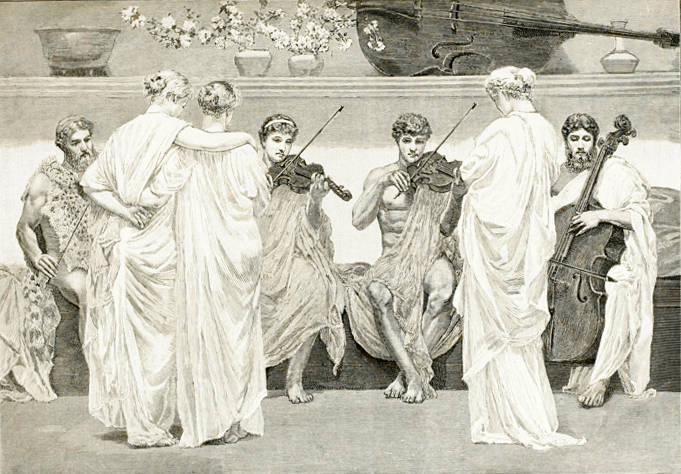
- Reproduction in the 1885 Magazine of Art
- Review of the Peréz Simón Collection at the Leighton House Museum
Bibliography
"Art. The Royal Academy." The Spectator XLII (12 June 1869): 705-06.
Asleson, Robyn. Albert Moore. London: Phaidon, 2000. 100-04.
Baldry, Alfred Lys. Albert Moore: His Life and Works. London: George Bell and Sons, 1894. 36-37.
Calloway, Stephen. The Cult of Beauty: The Aesthetic Movement 1860-1900. London: V&A Publishing, 2011. 67 & 73.
"Fine Arts. Royal Academy." The Athenaeum No. 1489 (10 May 1856): 589-91.
"Fine Arts. The Royal Academy". The Illustrated London News LIV (22 May 1869): 526.
Green, Richard. Albert Moore and his Contemporaries. Newcastle Upon Tyne: Laing Art Gallery, 1972, cat. 22, 16.
Monkhouse, Cosmo. "Albert Moore." Magazine of Art. VIII (December 1884-November 1885): 191-96. Internet Archive version of a copy in the University of Toronto Library. Web. 7 September 2013.
Monkhouse, Cosmo. "Albert Moore." Magazine of Art VIII (1885): 191-96.
Prettejohn, Elizabeth. Art for Art's Sake. Aestheticism in Victorian Painting. New Haven and London: Yale University Press, 2007. 118-20.
"The Royal Academy." The Art Journal New Series VIII (1 July 1869): 197-204.
"The Royal Academy." The Saturday Review XXVII (5 June 1869): 743-45.
Staley, Allen. The New Painting of the 1860s, Between the Pre-Raphaelites and the Aesthetic Movement. New Haven, CT: Yale University Press, 2011, 133-35 &147-48.
Stephens, Frederic George. "Fine Arts. Royal Academy." The Athenaeum No. 2169 (22 May 1869): 706-07.
Taylor, Tom. "Exhibition of the Royal Academy." The Times (11 June 1869): 12.
Tomory, P.A. British Taste in the Nineteenth Century. Auckland: Auckland City Art Gallery, May 1862, cat. 49, 15.
Created 7 December 2014
Last modified 25 August 2026