
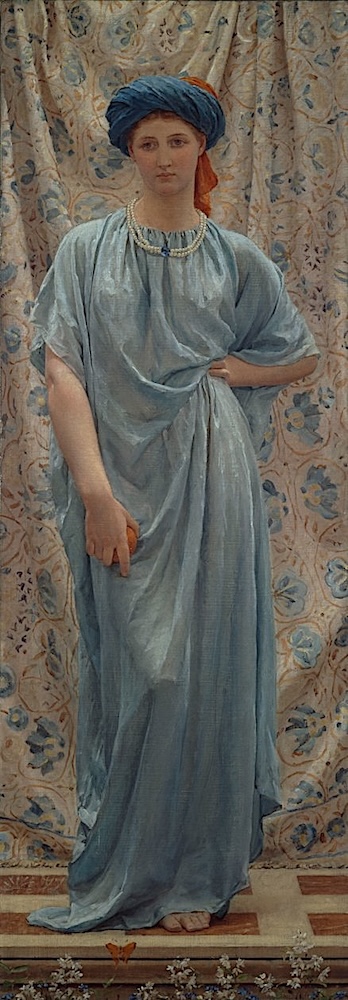
Sapphires by Albert Joseph Moore, ARWS (1841-1893). 1877. Oil on canvas. 61 1/2 x 21 3/4 inches (156.4 x 55.2 cm)>. Collection of the Birmingham Museum and Art Gallery, accession no. 1914P228. Image via Art UK, courtesy of Birmingham Museums Trust. [Click on the image to enlarge it.]
Moore exhibited Sapphires, surely one of the most beautiful and successful of his full-length standing female figures, at the inaugural Grosvenor Gallery exhibition of 1877, no. 50. Moore exhibited another important, although slightly smaller work, The End of the Story at the same exhibition. The model in this picture was in a similar general pose and arrangement of her limbs, but her head was tilted to the right, her draperies were quite dissimilar, and the picture is in a completely different colour scheme. Baldry has described the composition of Sapphires as being of a "contemplative maiden" in a "thick blue robe and a curious twisted turban of blue and orange. The curtain behind her is grey with a Persian conventional embroidery of blue and lighter orange; her feet are set on a step inlaid in squares of orange, red, and grey, and in front of the step are some blue and white flowers. Around her neck are strings of white beads, and in her right hand she holds an orange " (47). An orange butterfly can be seen in front of the steps below her right foot, balancing the orange in her turban and the orange in her hand. The turban the model wears appears to be unique in Moore's paintings of standing female figures and is reminiscent of those seen worn by male figures in some of his friend Simeon Solomon's early biblical watercolours like Ruth and Boaz of 1862 or Isaac and Rebekah of 1863.
In c.1877-78 Moore executed a smaller version of this composition, not more than a quarter the size of the original, entitled Poppies. He treated this version as an arrangement in red and white. Baldry described it as follows: "The girl's drapery and turban are red, the background red embroidery on white, the floor grey and cream, and the flowers in front are red poppies. In her hand she has a red apple instead of an orange" (47).
Contemporary Reviews of the Painting
Considering the beauty of this work, it is strange that many of the major periodicals like The Art Journal and The Athenaeum merely mentioned Moore's work in passing without going into detail about it. W.M. Rossetti in The Spectator preferred Moore's The End of the Story: "Albert Moore is only represented by single figures, of which by far the best is No. 52, The End of the Story, - a tall woman in a yellow garment, with a transparent white robe draped round her. Mr. Moore is, as far as we know, the only artist of the present day who has thoroughly mastered the folds of drapery, particularly those of thin materials, and some of his draped figures are as beautiful in this respect as ancient Greek statues" (632).
Sidney Colvin in The Fortnightly Review provided one of the most extensive reviews of Moore's contributions to the Grosvenor Gallery, comparing his work to that of James Whistler:
Another painter who carries out kindred aims with different materials and in a more classical spirit, so as to provoke less challenge, is Mr. Albert Moore. The materials for Mr. Albert Moore's combinations in form and colour have always been figures, single or many, more or less classical and ideal in type and drapery, with such furniture and accessories as were needed to complete the scheme. He, too, avoids realisation and stops at mere suggestion, in the matters of light, shadow, and relief; but in the matter of line and contour he defines completely: his design has the large dignity of the Greeks and is carried out to perfect finish. And his instinct for decorative colour, at least for a certain decorative scale of clear and delicate tints, is quite faultless. Sometimes the adjustments and balancings of his lines and tints have had a look just a little too calculated, mechanical, and set; but this year I think his work both at this gallery and at the Academy is singularly happy. The large single figure called Sapphires is not only a lovely vision of shimmering sea blue relieved among delicate patterns and flowers of more positive blue and white, and thrown up by two touches of orange headgear and orange butterfly; it is a stately figure of a woman of fair countenance, with the flesh and modellings perfectly rendered so far as the rendering goes. [382]
Bibliography
Asleson, Robyn. Albert Moore. London: Phaidon, 2000. 138 140.
Baldry, Alfred Lys. Albert Moore: His Life and Works. London: George Bell and Sons, 1894. 47.
Colvin, Sidney. "The Grosvenor Gallery." The Fortnightly Review XXI (June 1877): 820-33.
Cruise, Colin. Love Revealed. Simeon Solomon and the Pre-Raphaelites. London: Merrell, 2005. cat. nos. 44 & 45, 94-95.
Green, Richard. Albert Moore and his Contemporaries. Newcastle Upon Tyne: Laing Art Gallery, 1972, cat. 53, 23-24.
Rossetti, William Michael. "Art. The Grosvenor Gallery." The Spectator (19 May 1877): 631-32.
Sapphires. Art UK. Web. 31 August 2026.
Stephens, Frederic George. "Fine Arts. The Grosvenor Gallery Exhibition." The Athenaeum No. 2584 (5 May 1877): 583.
Created 31 August 2026