
Biography
Thomas Earp (1828-1893) was an architectural sculptor whose best-known work is the Eleanor Cross (1863), outside Charing Cross Station in London. Born in Nottingham, Earp studied at the Nottingham School of Art and Design before coming to work for the builder George Myers (A. W. N. Pugin's favourite contractor) in London in the early 1850s. The young craftsman was soon running his own firm. So successful was he that his marble and alabaster reredos, pulpit and font for St John the Baptist, Huntley, were exhibited at the Great Exhibition of 1862 (Jones 80). By 1864 he was established at 1 Kennington Road, Lambeth, where he had two dozen men working for him. In the same year he went into partnership with Edwin Hobbs Senior (c.1841-1904), and opened another workshop in Manchester, and in the following year the London firm started appearing in the London trade directory not simply as "cabinet carvers" but as "sculptors" — then in 1871 only as "sculptors" (see "Thomas Earp").
As Benedict Read says, such was the demand for high-quality ecclesiastical stone-carving, in particular, that examples of the firm's craftsmanship can be found all over the country (246). Earp's Annunciation on the exterior wall of St Marie's Cathedral Church, Sheffield (1879) is particularly prized. But he is perhaps best known for his work with G. E. Street, who employed him regularly during the 1860s and 70s. It is always hard to know who to credit for architectural carving, especially where several stone-carvers were at work on the same building, and individual work goes unattributed. But where Earp is known to have been responsible, it seems he was trusted to carry out the details of the composition and design to his own satisfaction (see Read 250). On one occasion, Sir George Gilbert Scott calls him Street's "handpiece" (215).
In 1904, just over ten years after Earp died, Hobbs also died, and a few months later a notice appeared in the London Gazette, showing that Hobbs had taken a partner, and that the firm would continue to operate under him, still under the three partners' names, in both Manchester and Liverpool (London is not mentioned):
NOTICE is hereby given, that the Partnership heretofore subsisting between Edwin Hobbs and Harry Malcolm Miller, carrying on business as Architectural Sculptors, at 63, Lower Mosley-street, Manchester, and at 15, Back Colquitt-street, Liverpool, under the style or firm of EARP, HOBBS AND MILLER, has been dissolved by reason of the death of the said Edwin Hobbs, as and from the 20th day of November, 1904. All debts due to and owing by the said late firm will be received and paid by the said Harry Malcolm Miller, who will continue to carry on the said business at the same addresses under the said style or firm of Earp, Hobbs and Miller. — Dated this 31st day of March, 1905.
HANNAH MARIA HOBBS.
Executrix of the late Edwin Hobbs.
HARRY MALCOLM MILLER. [2660]
The self-effacing Miller (1871-1941) was every bit as skilful a sculptor as Earp and Hobbs, a good example of his work being the relief carving of overmantel in the Banqueting Hall of Bradford's showpiece Town Hall. — Jacqueline Banerjee
Works
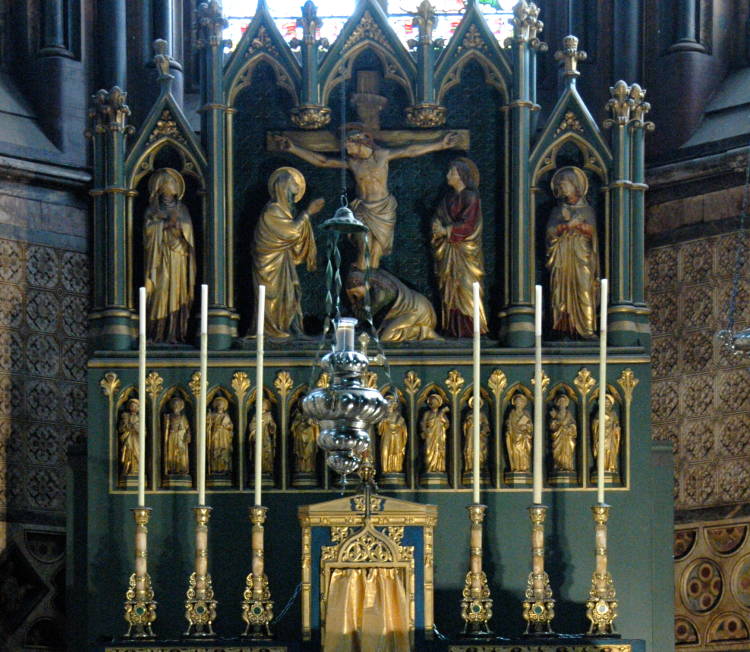
- Pulpit in St James the Less
- Reredos at St Mary Magdalen in Paddington
- The Eleanor Cross, London
- Annunciation Scene at the Cathedral Church of St Marie, Sheffield (see last picture)
- Reredos at St Peter, Kirkgate, Leeds (see fourth picture)
- Monument to Archdeacon Hodson (c.1787-1855), Lichfield
- Monument to Major Hodson (1821-58), Lichfield
- Font, pulpit and other fittings at St Edward the Confessor, Leek
- Progress and other architectural sculpture at the former Victorian Terminus, Mumbai
- West door tympanum and flanking statues, Inverness Cathedral
- Reredos, Inverness Cathedral
- Pulpit in St Leonard’s Church, Bridgnorth
- Font, pulpit and other stone-carvings at St Peter's, Bournemouth
- The High Altar at St Francis of Assisi, Notting Hill, London
- The Overmantel at Bradford Town Hall (by Miller)

Bibliography
"(Harry) Malcolm Miller." Architects of Greater Manchester 1800 - 1940. Dictionary of Greater Manchester Architects (DGMA) (this reprints Miller's obituary in the Manchester Guardian of 8 January 1941, p. 8). Web. 13 July 2026.
Jones, Nigel R. Architecture of England, Scotland, and Wales. Westport, CT.: Greenwood, 2005.
The London Gazette for the year 1905. Google Books, free to read. Web. 13 July 2026.
Mitchell, Anthony and Olive. Thomas Earp: Eminent Victorian Sculptor. Buckingham: Baron, 2002.
Read, Benedict. Victorian Sculpture. New Haven & London: Yale University Press, 1982.
Scott, Sir George Gilbert, R.A. Personal and Professional Recollections, edited by his son, G. Gilbert Scott, F.S.A. London: Sampson Low, Marston, Searle, & Rivington, 1879. Internet Archive. Web. 9 March 2012.
"Short Biography." Glasgow — City of Sculpture. Web. 9 March 2012.
"Thomas Earp." Mapping the Practice and Profession of Sculpture in Britain and Ireland, 1851-1951. Web. 13 July 2026.
Created 22 June 2013
Last modified 13 July 2026