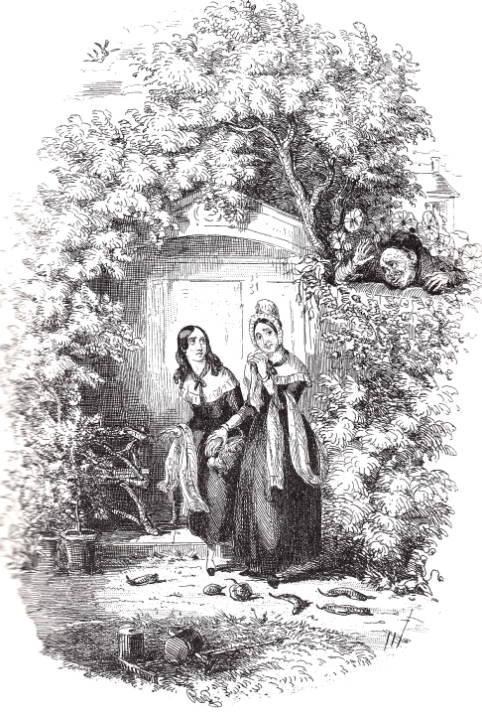
The Gentleman Next Door Declares His Passion for Mrs. Nickleby
Phiz (Hablot K. Browne)
Dickens's Nicholas Nickleby
April 1839
Etching
Source: J. A. Hammerton, The Dickens Picture-Book, p. 163.
Image scan and text by Philip V. Allingham.
1839
Wood engraving
Source: J. A. Hammerton, The Dickens Picture-Book, p. 163.
Image scan and text by Philip V. Allingham.
[You may use this image without prior permission for any scholarly or educational purpose as long as you (1) credit the person who scanned the image and (2) link your document to this URL.]
Contrasting the "love-at-first-sight" romance of Nicholas and Madeline Bray, among the most realistically proportioned characters in Phiz's plates for this novel, in the previous illustration (for chapter 40), this first illustration for April 1839 involves a distinctly odd couple ill-suited by virtue of their age for the youthful rhetoric of passion, despite the physical "Pyramus and Thisbe" situation of the courtship scene. The garden interlude is all the more delightful in that Dickens bursts the idyllic bubble, first by having him shower the object of his affections with vegetables and then by having the elderly gentleman's "keepers" arrive in the nick of time to cut short the hyperbolic protestations of Mrs. Nickleby's lunatic suitor "in small clothes" (i. e., the fashion of the previous century). That the suitor is not to be taken seriously is signalled by his presence as merely an oversized head in Phiz's illustration:
As Kate rose from her seat in some alarm [at the vegetables just discharged from the other side of the garden wall], and caught her mother's hand to run with her into the house, she felt herself rather retarded than assisted in her intention; and following the direction of Mrs. Nickleby's eyes, was quite terrified by the apparition of an old black velvet cap, which, by slow degrees, as if its wearer were ascending a ladder or pair of steps, rose above the wall dividing their garden from that of the next cottage (which, like their own, was a detached building), and was gradually followed by a very large head, and an old face in which were a pair of most extraordinary grey eyes: very wild, very wide open, and rolling in their sockets, with a dull languishing leering look, most ugly to behold.
"Mama!" cried Kate, really terrified for a moment, "why do you stop, why do you lose an instant? Mama, pray come in!" . . . .
"Queen of my soul," replied the stranger, folding his hands together, "this goblet sip!"
Nonsense, sir," said Mrs. Nickleby. "Kate, my love, pray be quiet."
"Won't you sip the goblet?" urged the stranger, with his head imploringly on one side, and his right hand on his breat. "Oh, do sip the goblet!"[ch. 41, "Containing some Romantic Passages Between Mrs. Nickleby and thew Gentleman in the Small-Clothes next Door," Part 13, April 1839]
References
Hammerton, J. A. The Dickens Picture-Book. London: Educational Book, 1910.
Last modified 4 May 2009