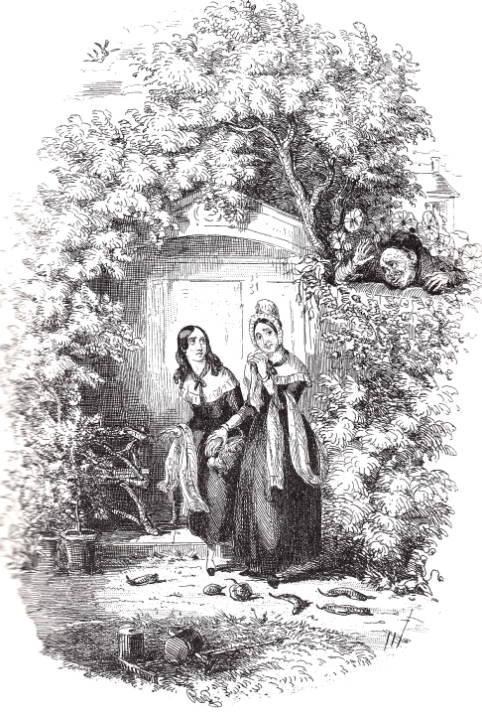
Mysterious Appearance of the Gentleman in Small-Clothes
Phiz (Hablot K. Browne)
Dickens's Nicholas Nickleby
July 1839
steel engraving
Source: J. A. Hammerton, The Dickens Picture-Book, p. 166.
Image scan and text by Philip V. Allingham.
[You may use this image without prior permission for any scholarly or educational purpose as long as you (1) credit the person who scanned the image and (2) link your document to this URL.]
Although the oral tale may well be much older, the tale of the three little pigs it first appeared in print in 1849, in James Orchard Halliwell's Nursery Rhymes and Nursery Tales. Consequently, Dickens and Phiz are not necessarily alluding to the children's story of the braggadocio wolf caught in the chimney in this forty-ninth chapter, "Chronicles the further proceedings of the Nickleby family, and the sequel of the adventure of the gentleman in the small-clothes" (Part 16, July 1839). The subplot involving Mrs. Nickleby's demented suitor offers suitable comic counterpoint to the more serious, "business" aspect of marriage (Ralph Nickleby's plotting with Arthur Gride against the Brays to acquire Madeline's inheritance). The identification of a uni-dimensional character by some detail of costume, facial distinction, or habitual phrase had been a standard "short-hand" method of characterization for Dickens ever since The Pickwick Papers. A secondary comedic feature is Mrs. Nickleby's chagrin that her "suitor" seems to have shifted his attention to Miss Le Creevy. The figures in the illustration, set in the Nicklebys' cottage, are Mrs. Nickleby (left); Kate Nickleby and Frank Cheeryble, nephew of the merchant brothers; their clerk, Tim Linkwater (centre), holding thetongs as he pinches the stranger's ankles to ascertain that they are real and not the appendages of a dummy; and the lower extremities of the lunatic neighbour (in the fireplace, the disembodied head having appeared already in plate 26):
Advancing to the door of the mysterious apartment, they were not a little surprised to hear a human voice, chaunting with a highly elaborated expression of melancholy, and in tones of suffocation which a human voice might have produced from under five or six feather-beds of the best quality, the once popular air of '"Has she then failed in her truth, the beautiful maid I adore!" Nor, on bursting into the room without demanding a parley, was their astonishment lessened by the discovery that these romantic sounds certainly proceeded from the throat of some.man up the chimney, of whom nothing was visible but pair of legs, which were dangling above the grate; apparently feeling, with extreme anxiety, for the top bar whereon to effect a landing.
A sight so unusual and unbusiness-like as this, paralysed Tim Linkinwater, who after one or two gentle pinches at the stranger's ankles, which were productive of no effect, stood clapping the tongs together, as if he were sharpening them for another assault, and did nothing else.
"This must be some drunken fellow," said Frank. "No thief would announce his presence thus."
As he said this, with great indignation, he raised the candle to obtain a better view of the legs, and was darting forward to pull them down with very little ceremony, when Mrs. Nickleby, clasping her hands, uttered a sharp sound, something between a scream and an exclamation, and demanded to know whether the mysterious limbs were not clad in small clothes and worsted stockings, or whether her eyes had deceived her?
"Yes," cried Frank, looking a little closer. "Small-clothes certainly, and — and — rough grey stockings, too. Do you him, ma'am?"
Reference
Hammerton, J. A. The Dickens Picture-Book. London: Educational Book, 1910.
Last modified 9 May 2009