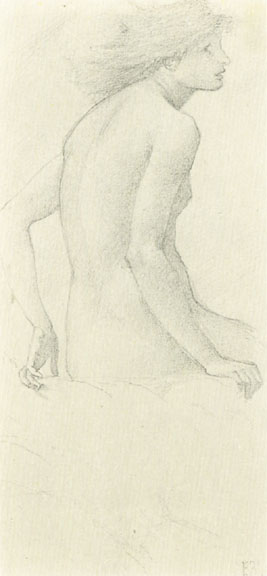
Studies for a Hill Fairy (recto)
Sir Edward Coley Burne-Jones, Bt ARA (1833-1898)
Signed with initials 'EBJ'
Pencil on white paper
10 3/4 x 5 inches, 27.3 x 12.7 cm
Study for the painting The Hill Faeries for the intended triptych Arthur in Avalon.

Peter Nahum Ltd, London has most generously given its permission to use in the Victorian Web information, images, and text from its catalogues, and this generosity has led to the creation of hundreds of the site's most valuable documents on painting, drawing, and sculpture. The copyright on text and images from their catalogues remains, of course, with Peter Nahum Ltd. Readers should consult the website of Peter Nahum at the Leicester Galleries to obtain information about recent exhibitions and to order their catalogues. [GPL]
Commentary by Hilary Morgan
The scheme of Arthur in Avalon went through many modifications. Graham Robertson, a great admirer of the artist, described the stage to which this drawing relates:
When I saw it (i.e. Arthur in Avalon) in the painter's memorial exhibition, framed and hung amongst his other works, I was again able to appreciate its beauties, but I have always regretted the removal of two outer panels, part of the original design, which formed the picture into a great triptych. These panels represented the Hill Faeries, the echoes lurking in clefts of the rocks and waiting to prolong and repeat the trumpet blare that would proclaim the waking of Arthur to the world. These little watching figures, their eyes fixed upon the still form of the sleeping king, conveyed the idea that all nature waited breathless for a sign, for the long silenceto be rent by a mighty sound.
I always mourned the Hill Faeries, rejected at an early stage of the picture's development, and tried to "keep up" with them after their banishment to an upper chamber at the Grange, and afterwards, when they passed into the possession of the Artist's grand daughter. [Robertson, 1931]
Burne-Jones's conception of 'fairies' in this work owes more to classical notions of naiads and dryads, than to traditional Victorian images of fairies. The present drawing does not relate directly to any figures in the existing panels.
References
Morgan, Hilary and Nahum, Peter. Burne-Jones, The Pre-Raphaelites and Their Century. London: Peter Nahum, 1989. Catalogue number 74.
Robertson, W. Graham. Time Was. London: Hamish Hamilton, 1931.