
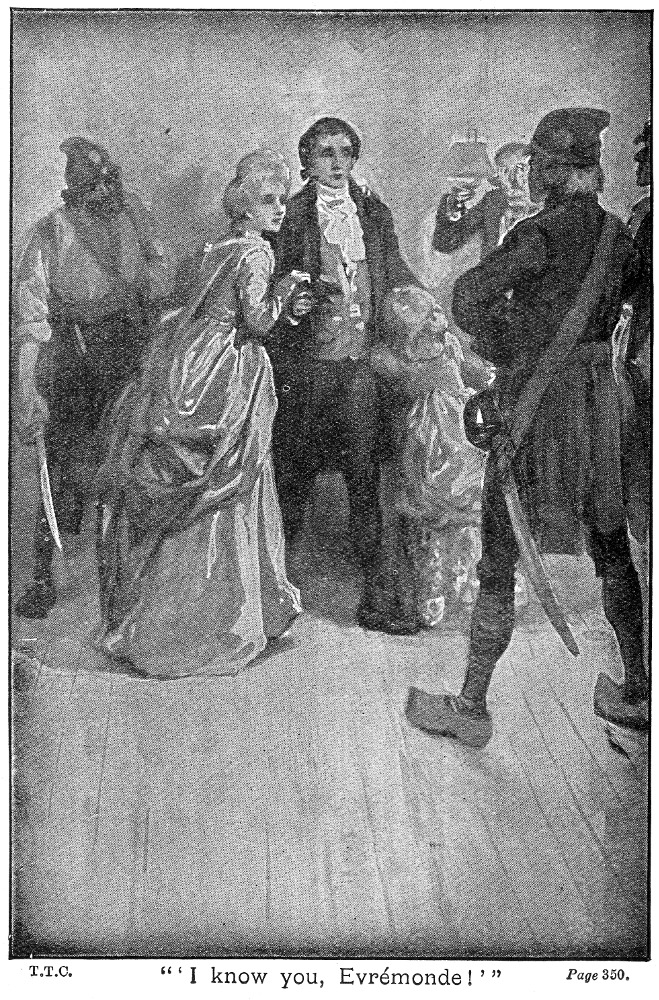
“I know you, Evremonde!”
Arthur A. Dixon
1905
Watercolour as lithograph
4 ⅝ inches high by 3 ⅛ inches wide (11.9 cm by 8.1 cm), framed
Tenth illustration for Collins edition, facing p. 352.
Book III, “The Track of a Storm,” Ch. 7, “A Knock at the Door,” p. 350. Penguin edition p. 320. Oxford World's Classics edition p. 360. Darnay is re-arrested.
Scanned image and text by Philip V. Allingham.

Passage Realised: Charles Darnay apprehended as “The Marquis de Evrémonde”
He took the lamp in his hand, crossed the two intervening outer rooms, and opened it. A rude clattering of feet over the floor, and four rough men in red caps, armed with sabres and pistols, entered the room.
“The Citizen Evrémonde, called Darnay,” said the first.
“Who seeks him?” answered Darnay.
“I seek him. We seek him. I know you, Evrémonde; I saw you before the Tribunal to-day. You are again the prisoner of the Republic.”
The four surrounded him, where he stood with his wife and child clinging to him.
“Tell me how and why am I again a prisoner?”
“It is enough that you return straight to the Conciergerie, and will know to-morrow. You are summoned for to-morrow.”
Doctor Manette, whom this visitation had so turned into stone, that he stood with the lamp in his hand, as if he were a statue made to hold it, moved after these words were spoken, put the lamp down, and confronting the speaker, and taking him, not ungently, by the loose front of his red woollen shirt, said:
“You know him, you have said. Do you know me?” [Book the Third, “The Track of a Storm,” “Ch. 7, “A Knock at the Door,” p. 350]
Commentary: The Well-intentioned, Liberal Aristocrat Re-Arrested
Ironically, it is not the enforcement of the new edicts against emigrés that results in Darnay's rearrest. The timing of the functionaries is particularly bad for the Darnays since Jerry Cruncher and Miss Pross have just gone out to shop for the wine and food the family needs for its quiet celebration of Charles's recent exoneration. Apparently the Defarges have once again denounced Charles, but have fresh evidence to support their claim that he is an enemy of the Revolution. Fortunately Dickens has another plot twist that will facilitate a prison break: Miss Pross's brother Solomon is none other John Barsad, now "The Sheep of the Prisons" for the new regime.
The cliff-hanger at the end of Book III, Chapter 7, is that Ernest Defarge is but one of two who have denounced Darnay as “Evrémonde.” The other accusers will be revealed tomorrow, that is, in Chapter 8, "A Hand at Cards." In fact, Dickens des not reveal until the tribunal scene in Chapter 9, "The Game Made," that the third accuser is in fact “Alexandre Manette, physician” (380), via the medium of his journal, which Ernest Defarge retrieved from One-Hundred Five, North Tower, upon the storming of the Bastille.
Dixon's lithograph depicts Darnay with great sympathy: on the arm of his beautiful young wife, his pretty daughter hugging him, Darnay stands aghast, surrounded by Phrygian-capped, sword-wielding revolutionaries, the wooden shoes of the leader foregrounded to underscore his thoroughly plebeian origins.
Relevant Illustrations of the Defarges from Other Editions: 1859 and 1874
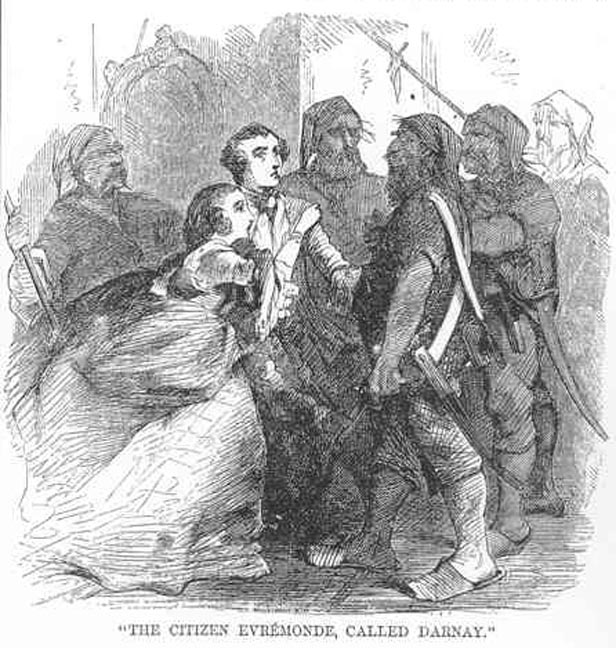
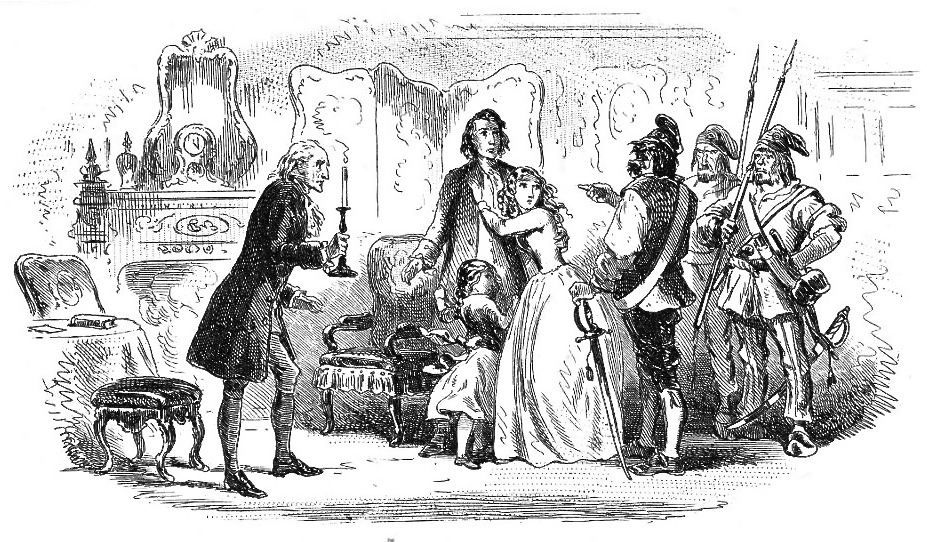
Left: John McLenan's American serial's representation of the re-arrest of Darnay in the 8 October 1859 instalment for Harper's Weekly. Right: An equally dramatic but less violent realisation of the arrest: The Knock at the Door in Book Two, "The Golden Thread," Chapter VII, "The Knock at the Door" (Nov. 1859 number).
Related Material
- A Tale of Two Cities 1859 — the last Dickens's novel "Phiz" Illustrated
- How did Victorian critics define the historical novel?
- Images of the French Revolution
- A Tale of Two Cities (1859): A Model of the Integration of History and Literature
- Costume Notes on A Tale of Two Cities
Bibliography
Allingham, Philip V. "Charles Dickens's A Tale of Two Cities (1859) Illustrated: A Critical Reassessment of Hablot Knight Browne's Accompanying Plates." Dickens Studies. 33 (2003): 109-158.
Dickens, Charles. A Tale of Two Cities. Illustrated by John McLenan. Harper's Weekly: A Journal of Civilization, 7 May through 3 December 1859.
Dickens, Charles. A Tale of Two Cities. Ilustrated by Hablot Knight Browne. London: Chapman and Hall, 1859.
Dickens, Charles. A Tale of Two Cities and Great Expectations. Diamond Edition. Illustrated by Sol Eytinge, Junior. Boston: Ticknor and Fields, 1867.
Dickens, Charles. A Tale of Two Cities. Illustrated by Fred Barnard. The Household Edition, 22 vols. London: Chapman and Hall, 1874. Vol. VIII.
Dickens, Charles. A Tale of Two Cities. Illustrated by A. A. Dixon with an engraved title by Harry Furniss. London: Collins, 1905. (From the personal collection of George Gorniak, Editor of The Dickens Magazine.)
Dickens, Charles. A Tale of Two Cities, American Notes, and Pictures from Italy. Illustrated by Harry Furniss. Charles Dickens Library Edition. 18 vols. London: Educational Book Company, 1910. Vol. XIII.
Created 2 November 2013
Last updated 31 August 2026