
Science fiction has long been the subject of visual interpretation. In the twentieth century, the fantastical tales in American pulp magazines such as Amazing Stories were routinely illustrated, and the genre has always formed a significant part of cinema – appearing, first of all, in Georges Méliès’s A Trip to the Moon (1902) and finding its most provocative expression in films such as Fritz Lang’s Metropolis and Stanley Kubrick’s 2001: A Space Odyssey (1968). For sure, the showing of the fantastic is an integral part of modern visual culture and is a significant means of imagining the future. Victorian science fiction was pictured as well, and early pieces forged a connection between speculative writing and graphic imagery as the genre developed in the 1890s.
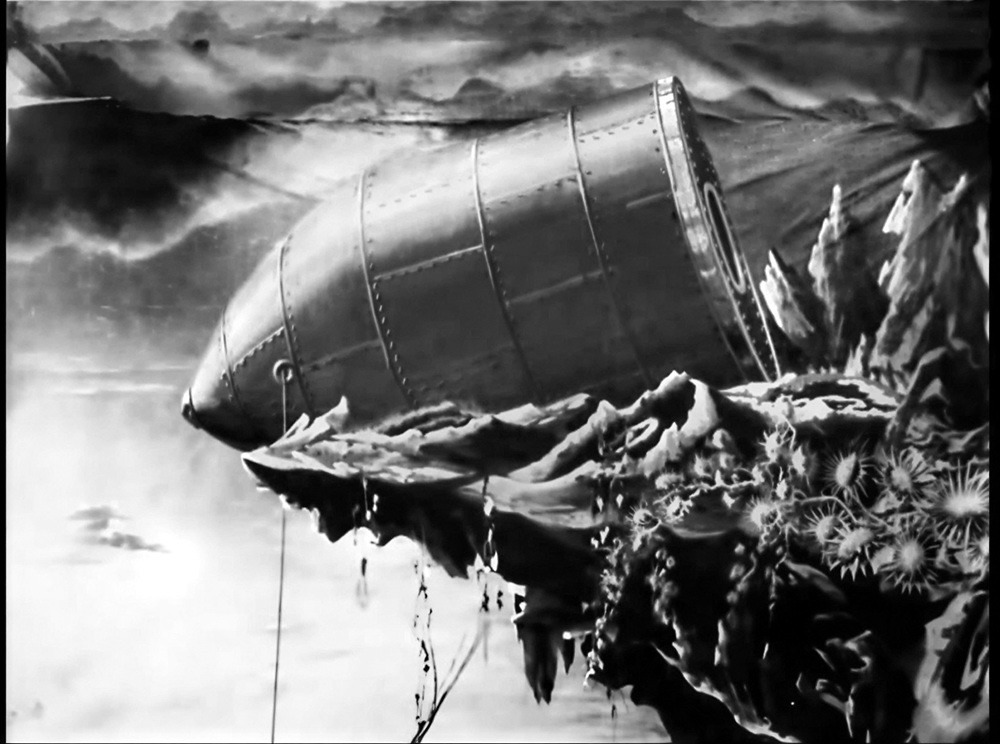
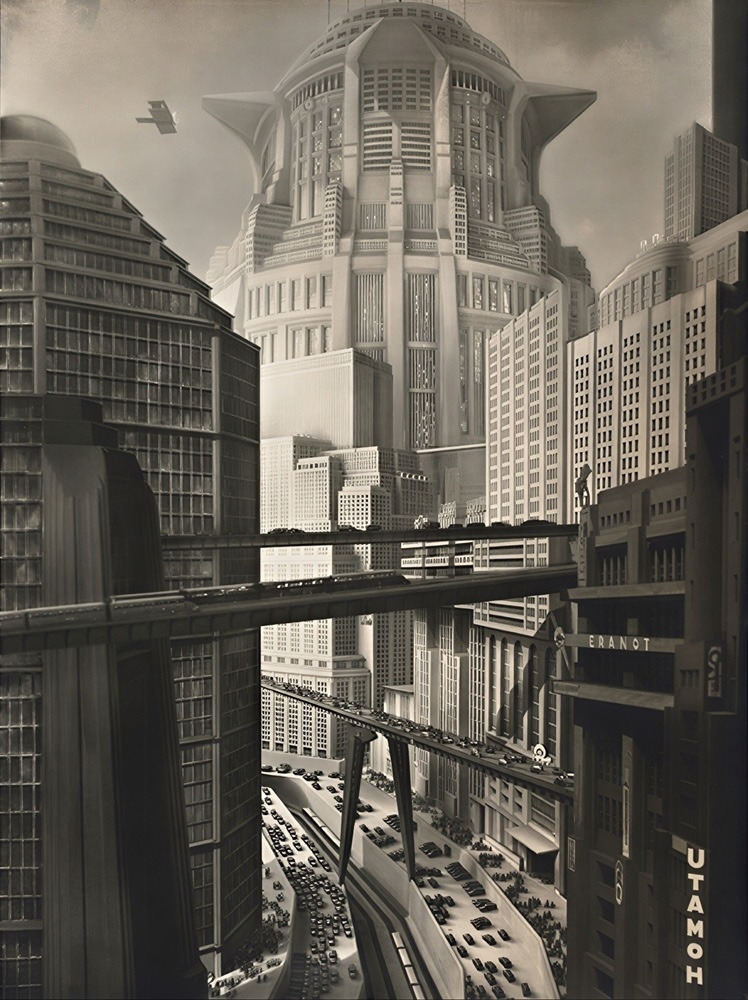
Science fiction in the early days of cinema: Left: Méliès’s Trip to the Moon (1902). The film closely reflects the author’s interest in magic and theatre. Right: Fritz Lang’s German Expressionist treatment of a dystopic metropolitan future in Metropolis (1927). The two films are at the polarities of Science Fiction – one a matter of discovery, treated in a humorous way, the other a piece of grotesque social observation.
Yet the bitextuality of this writing has not been the subject of sustained critical inquiry. Unlike modern illustrated Science Fiction, Victorian pictorialized texts – many of which only appear in periodicals – remain obscure or have only been judged on the basis of their words. It is surprising to find that in his apparently exhaustive bibliography of early formations, Victorian Science Fiction in the Nineteenth Century (1983), Darko Suvin provides no details of the illustrations and does not even acknowledge that many of the texts were visualized; and others have similarly fallen short or provided a partial view. For example, Anthony Frewin (1974) offers some general information on Victorian illustrators, but is mainly concerned with modern treatments of fantasy.
Victorian illustration of speculative prose is nevertheless a rich and complex field that demands systematic scrutiny, and much detailed research remains to be done. The aim here is to provide an introduction to these intermedial texts by focusing on the work of a small representative group of artists: Warwick Goble, Claude Shepperson, and Fred T. Jane. I also touch upon some other practitioners, in every case providing an analysis of the role and purpose of this distinctive form of illustration. The best place to start these investigations is by placing the texts and producers in their Victorian contexts.
Scientific Romance and Pictorialism in the 1890s
The Decadence of the Nineties, or fin-de-siècle, was a period of cultural anxiety and change. As the old century gave way to the new, commentators looked back over the long years of Victoria’s reign, evaluated what had been achieved, assessed what was best consigned to the history of failures, and anticipated what the future might bring. In the words of Holbrook Jackson, the 90s could be characterized as both ‘a death-bed repentance’ and as a ‘renascent period’ (18) when new potentialities seemed to emerge.
That Janus-headed perspective informed all aspects of social attitudes and cultural production: on the one hand, Darwinist theory promised an endless evolutionary improvement, but, on the other, Max Nadau theorized the notion of degeneracy in Entartung (1892), suggesting that humankind might devolve rather than evolve, with civilization slipping backwards into destruction and chaos. This dialectic informed many texts of the time, which operated as fables or Gothic fantasies to articulate both positive and negative speculations about the future. William Morris’s News from Nowhere (1890) anticipated a money-less, utopian society freed from capitalism in which there was no longer conflict between the classes, but others were concerned with slippage into bestiality. Bram Stoker’s Dracula (1897) symbolized man’s corruption in the form of the shapeshifting vampire, a monster capable of turning into a wolf or bat, and parallel territory was explored by Richard Marsh in The Beetle (1897) and by Arthur Machen in The Great God Pan (1894); degeneracy was also the central theme of Oscar Wilde’s Picture of Dorian Gray(1891).
But speculations about the shape of things to come were mainly the concern of what we would call ‘Science Fiction,’ a type of writing that had its roots in the 1860s and 70s and emerged as a prominent form in the 90s. Its character is difficult to pin down, and critics such as Adam Roberts (1–24), among others, have struggled to find a singular definition. However, the idiom’s negotiation of the future might be understood in terms of its names. ‘Scientifiction’ and ‘Science Fiction’ were labels coined by the author Hugo Gernsback in 1916 and 1929, both of which convey the texts’ focus on scientific content (Wythoff). But more telling is the oxymoronic Victorian name, ‘science romance,’ which suggests how nineteenth century writers framed their speculative writing as a mixture of fact and fantasy, adventure storytelling and the implications of science both known and imagined. The most important theme was the testing of science and its impact on humankind, an approach that grew naturally out of the Victorian fascination with the potential of new technologies and the study of new areas of concern such as genetics. As Roger Luckhurst remarks, ‘science romance’ closely reflected the ‘scientizing mania’ (22) of the 90s, when scientific knowledge was being popularized with ever wider audiences through the medium of periodicals and textbooks.
Science romance contributed to these understandings and offered technologically-based narratives (Roberts 19) as a mode of exploration, imaginative spaces in which to explore attitudes to the unknown years to come as the ‘modern’ began to emerge. Jules Verne had already established the form as a type of prediction in France in the middle-part of the century, and in Britain H. G. Wells wrote a series of seemingly prescient texts which balanced the potentialities of discovery with the possibility of unanticipated problems and tragic results. The promise and dangers of science are explored, for instance, in The Invisible Man (1897), in which a brilliant discovery is given applications both crass and criminal in the hands of its unhinged protagonist – a prototype of the ‘mad scientist’; and in The Island of Dr Moreau. (1896) the new understandings of biology and genetics are turned to experiments that reconnect mankind with animal kind in an explicit statement of the dangers of degeneracy. Wells especially favoured cautionary tales that combine within a single text the forward and backward movement of speculation, of optimism and pessimism. In The Time Machine (1895) he advocates a technological advance that takes us to the future utopia of the Eloi, only to find its true nature as a dystopia where the enfeebled people of the time yet to come are preyed upon by the bestial Morlocks in a new configuration of the class system. Such fable-like stories, with their speculations on the intertwining of technology and degeneracy, science and society, are grim portends. But Wells’s fictions are more than futurology: profoundly, they provide a satirical and moral commentary on the Victorian present as much as on its possible developments. The same could be said of most scientific romances of the period – establishing a trope that was to run through the genre as a whole.
In analysing these anxious dualities many Victorian writers were assisted by the provision of illustrative series that helped readers to negotiate the stories’ messages. Typically appearing in instalments in illustrated magazines and directed at science-reading middle-brow audiences rather than the elite readerships of Oscar Wilde and Henry James, these bimodal fictions generated their meanings – in line with a long-standing Victorian tradition – in and through the interaction of the written word and its accompanying graphic imagery. Of special interest were the texts featuring in The Strand, an illustrated magazine that was well-known, as Emma Liggins has demonstrated in her pioneering research, for its outré selection of supernatural and fantasy stories; Pearson’s Magazine, The Graphic, The English Illustrated Magazine The Harmondsworth Magazine and The Pall Mall Gazette were likewise primary sites for the publication of science romances. Each of these tales routinely provided the reader/viewer with richly pictorialized material, while some other fictions appeared in book-form.
Visualizing Victorian Scientific Romance
Like all illustration, pictorial representations of science fiction texts were designed to elucidate the literary source-material, a process that involved visualizing the characters, narratives, situations and themes. Materialization, the giving of a graphic reality to re-inscribe and project the texts’ content is as central to science romance illustration as it is to all other types of Victorian book-art: the reader reads, looks, and is given an insight into how the writer’s imaginings might appear in a concrete form. In science romance, however, this notion of pictorial validation is given a special emphasis. Presented with hugely improbable scenes, artists were required to assist the reader/viewers’ attempts to visualize the fantastic. In so doing they interpreted the literary material in terms that would support the writers’ conceits, facilitate the process of imaginative reconstruction in the reader’s mind’s eye, and uphold the authors’ plausibility; the writers positioned themselves as observers who adopt what is supposed to be a ‘scientific’ reportage of the facts, and the illustrators worked to confirm and expand their epistemological stance. Nancy Rose Marshall notes how, in the nineteenth century, ‘artists and scientists both invested heavily in the faculty of sight’ (Marshall), and this fusion of artistic interpretation and supposedly objective writing, manifested in the pictures and in the act of seeing, is central to the relationship of image and word in Victorian scientific adventures. If the authors described what they could see, the illustrators provided the visual proof as if presenting the lab-findings, we might say, to support the writers’ theorizing.
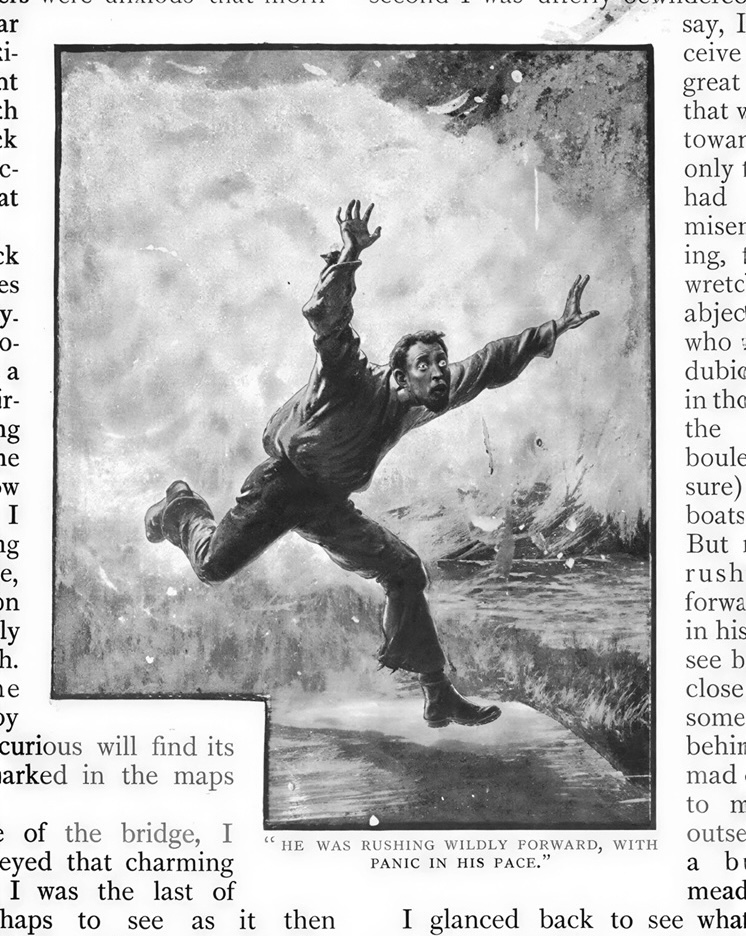
This provision of evidence, a visual sign to reinforce a verbal trace, can be tracked in some detail. A recurrent image is one of weightlessness. In Claude Shepperson’s illustrations for Wells’s ‘The First Men in the Moon’ (The Strand, 1900–1901), the artist provides an extremely dynamic and physical representation of Bedford and Cavor’s ascension as the anti-gravity Cavorite takes hold.
Instantly my coat tails were over my head, and I was progressing in great leaps and bounds, and quite against my will … Cavor, kicking and flapping, came down again, rolled over and over on the ground for a space, struggled up and was lifted and borne forward at an enormous velocity, vanishing at last among the labouring, lashing trees that writhed about his house. [20, 537]
Starting with this description, Shepperson stresses the ungainliness of being released from gravity and facilitates understanding of a situation that would not be experienced in real life until the first space travel in 1960 – a situation the artist anticipates in another illustration in which he shows the two unlikely astronauts with weightless, billowing clothes as they journey to the moon.
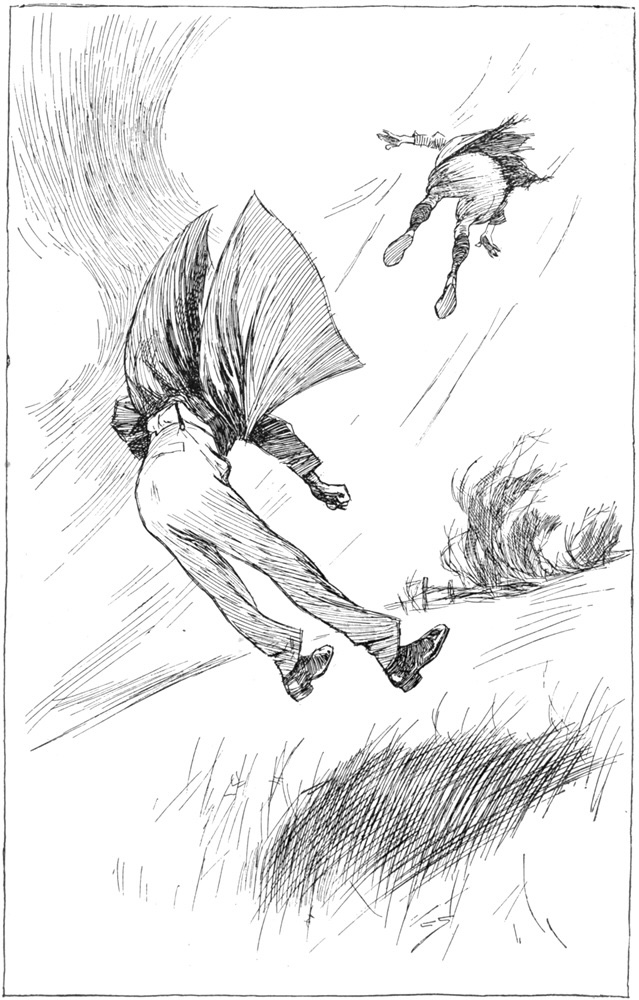
Shepperson’s comedic take on weightlessness in ‘The First Men in the Moon’
These types of designs amplify the writers’ effects. Moreover, it is often the case that the illustrations are used to visualize what lies well beyond the scope of what might be imagined and lies outside any known experience. In this connection picturing is an essential means of helping the reader to (re)imagine the details given in a text. In practice, this means that the artist had to invent a challenging imagery to match the writers’ experimental visions. Science fiction illustrations are thus by necessity radical and imposing, stretching the language of Victorian book-art to postulate new ways of representation as they chart a dislocated reality. Edmund Sullivan’s (circa 1900) picturing of the transformation scene in R.L. Stevenson’s Strange Case of Dr Jekyll and Mr Hyde (1886) is a prime example of this sort of visual re-orientation. Sullivan responds to Stevenson’s account, as voiced by Jekyll, which only specifies the character’s ‘racking pangs’ and ‘deadly nausea’ (1886, ed., 111), but does not explain how his flesh is transmogrified. Sullivan, by contrast, shows the very moment when the visage is in the process of change: depicting the features in flux – an approach that must have been influenced by Utterson’s dream of Jekyll’s face as it ‘melted’ (20) – Sullivan also shows a change in the hair, from white to black, a physical change that has profound metaphorical implications. The illustration therein provides a tangible representation of the impossible. Stevenson leaves the grisly process to suggestion, but the artist assists the reader/viewer’s attempts to gain a conceptual grasp on the event.
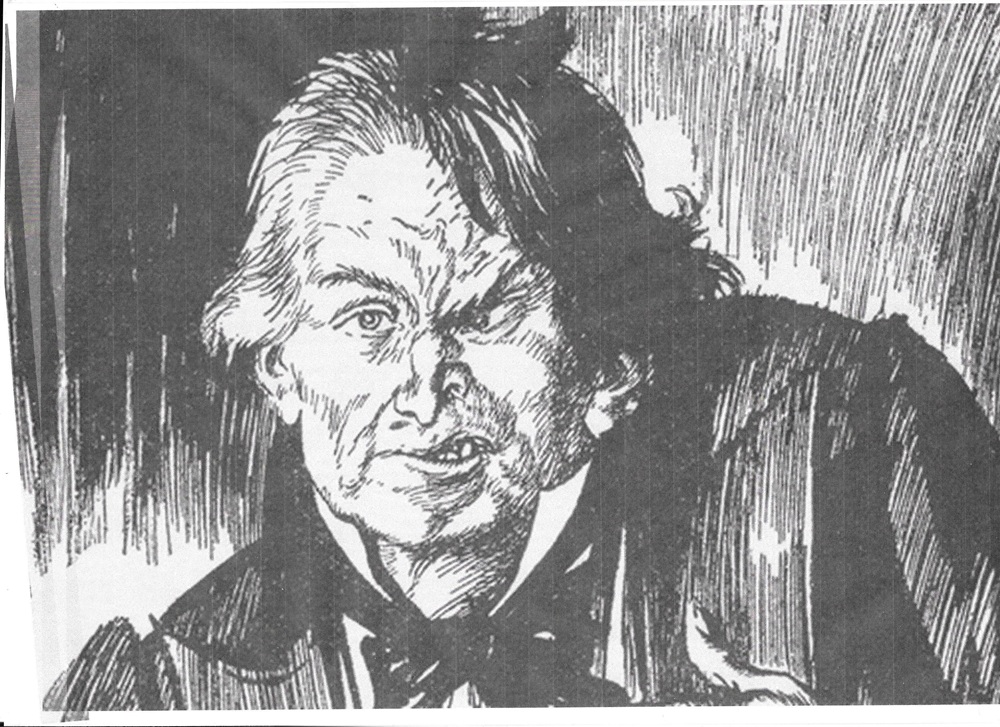
Edmund Sullivan’s attempt to visualize Jekyll’s fluid transformation into Hyde in the form of a grotesque and unsettling image.
This type of interpretive illustration works, in other words, as an enriching enhancement, a making real of the unreal. Of course, it could be argued that such picturing is restrictive, rather than expansive, closing rather than opening the imagination by replacing the reader’s inner vision with the artist’s. This debate was current in the nineteenth century as it applied to all illustration – and we can see how it might be restrictive insofar as it replaces the dynamic openness of the writer’s description with a static, plastic image.
Nevertheless, in the case of science fiction design there can be little doubt that, for the original audience at least, illustrative readings were an asset for the reader and contributed to a general ‘quickening of the imagination’ which, according to Jackson, was a key feature of the Nineties (18). Indeed, fantasy visuals promoted fanciful thinking and encouraged viewers to imagine subjects and scenes that might seem entirely implausible. In the years before the invention of flight, it must have been difficult to understand how, except in the form of a balloon or a kite, a craft could rise into the air, bearing in mind how trains and ships were powered by steam and made of iron; or how a vehicle might go to the Moon; or how aliens from another world might appear. Working in conjunction with their authors and texts, illustrators clarified these speculations.
Indeed, all of the illustrations of the nineties act, as it were, to pragmatize the impossible and so immerse the reader in worlds both strange and recognizable, menacing and ordinary, mind-bendingly odd but rooted in the experience of the middle-class readers of the periodicals. Wells was praised for his combination of science and the mundane, creating ‘an atmosphere of actuality’ (Unsigned review of ‘War of the Worlds,’ 71), but illustration is particularly privileged as a means to convert ‘fancy’ into ‘fact.’ Unlike other Victorian fantasy, such as fairy-art, science romance design does not (generally) deploy a whimsical or comedic style but shows fantastical scenes in journalistic imagery which mixes closely-observed details of the contemporary milieu – clothes, hairstyles, interiors and architecture – with the literally outlandish. Even the mode of publication adds to this documentary-like approach, with almost all of the illustrations being printed in the form of grisaille half-tone photogravures, the dominant mode of the magazines; this technique is applied to images of real phenomena, and the sharing of this medium elides the difference between the tangible and the imaginative.
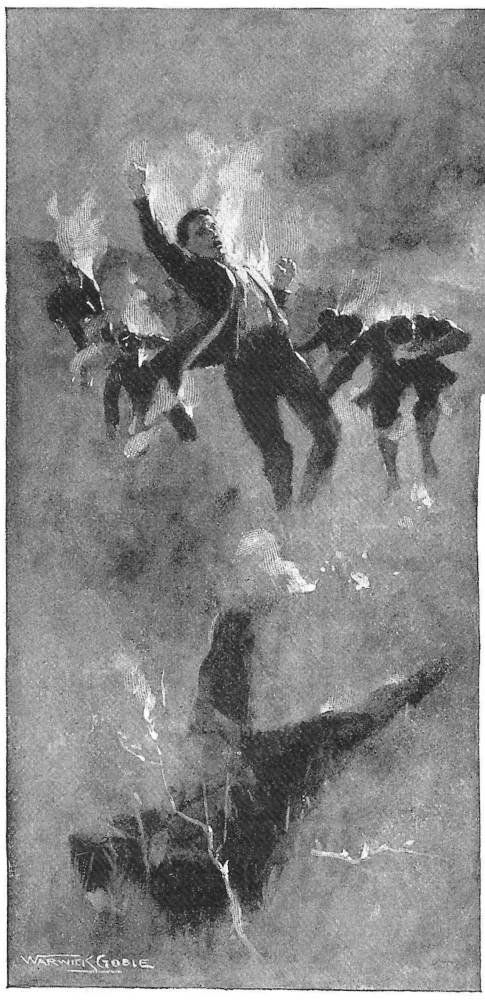
Goble’s horrible contemplation of the agonizing death-ray inEach was on fire, with ordinary Victorians being cut down by the Martian invaders.
Goble especially manipulates this realist approach, with its emphasis on black and white, in his designs for Wells’s ‘The War of the Worlds’ (Pearson’s Magazine, 1897): though he shows the Martians in their weird otherness, he also shows the collision of the familiar and unfamiliar in images such as Each one was on fire, which pictures well-dressed gentlemen being torn apart by an extraterrestrial death-ray. The message is clear: the imagined can occupy the same domain as the real; it could happen to you. If the fairies belong to the dream worlds of children, the visualized aliens and foreign worlds of Victorian scientific romance are absolutely of the here-and-now, the moment in which ‘marvels’ sensationally fuse ‘into the realistic plane’ (Unsigned 71).
Imagining New Technologies and New Worlds: Transport, Exploration, the Alien
The nineteenth century was an age of rapid advances in transport engineering, and historians such as Michael Freedman and Wolfgang Schivelbusch have explained how the railways had a huge impact on all aspects of Victorian culture. Established in the 1830s and 40s, steam-power changed understandings of time and travel as much as it revolutionized the development of trade and the dissemination of knowledge. Yet the hegemony of steam did not change over the span of the Victorian age, and by the end of the century there was a growing expectation that new, more flexible technologies would emerge as discoveries related to electricity came to the fore.
These speculations found popular expression in scientific romance, with many texts presenting new, theoretical modes of transport as if they already existed. In E. Douglas Fawcett’s Hartmann the Anarchist (1893), the eponymous character flies in a gigantic airship and in Wells’s ‘In the Abyss’ (Pearson’s Magazine, 1896) the protagonist descends to a submarine empire in a bathysphere. Wells’s ‘The First Men in the Moon’ (The Strand, 1901) involves a journey achieved by travelling in a space capsule, and in George Chetwynd Griffith’s ‘Stories of Other Worlds’ (Pearson’s, 1900) the characters travel in a spaceship. Such tales stretch understandings of what the mechanical might do, with Wells’s Time Machine (1896), a concoction of levers and a saddle, somehow allowing him to conquer the temporal. What they all do is reconfigure the colonial experience as all corners of the world were being explored, conquered, and possessed, postulating the idea that colonization might one day extend to territories in space.
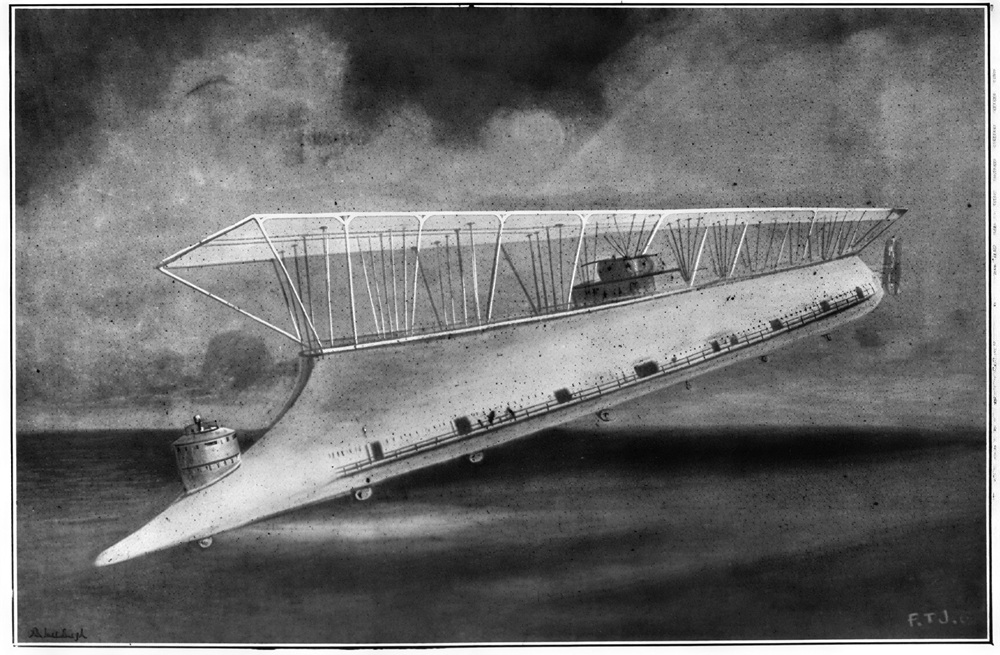
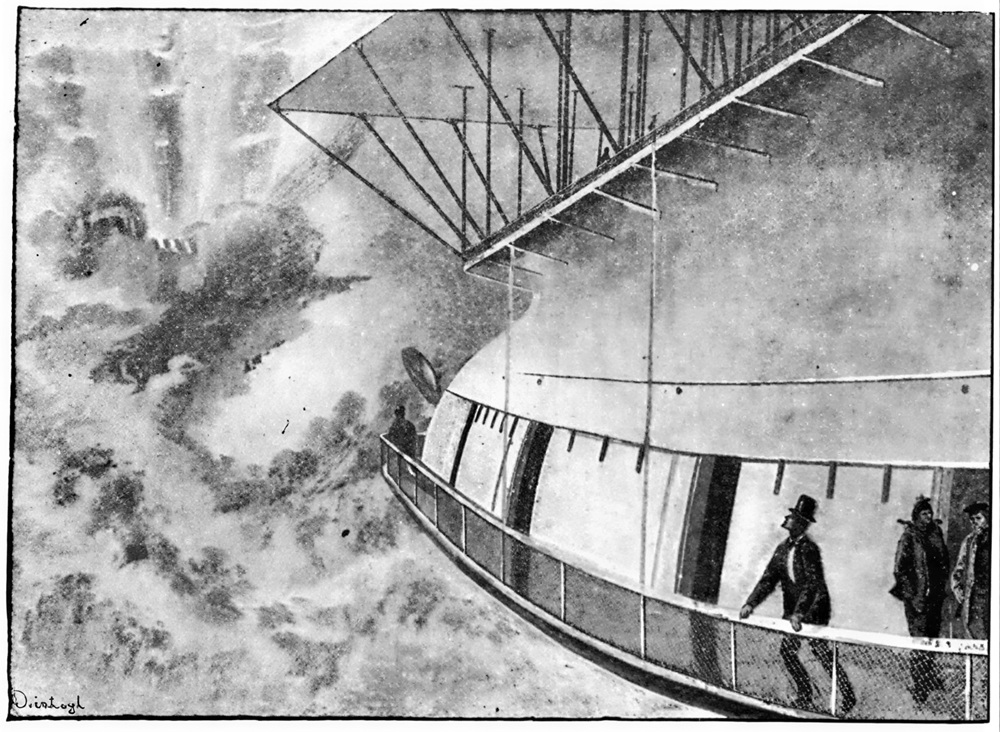
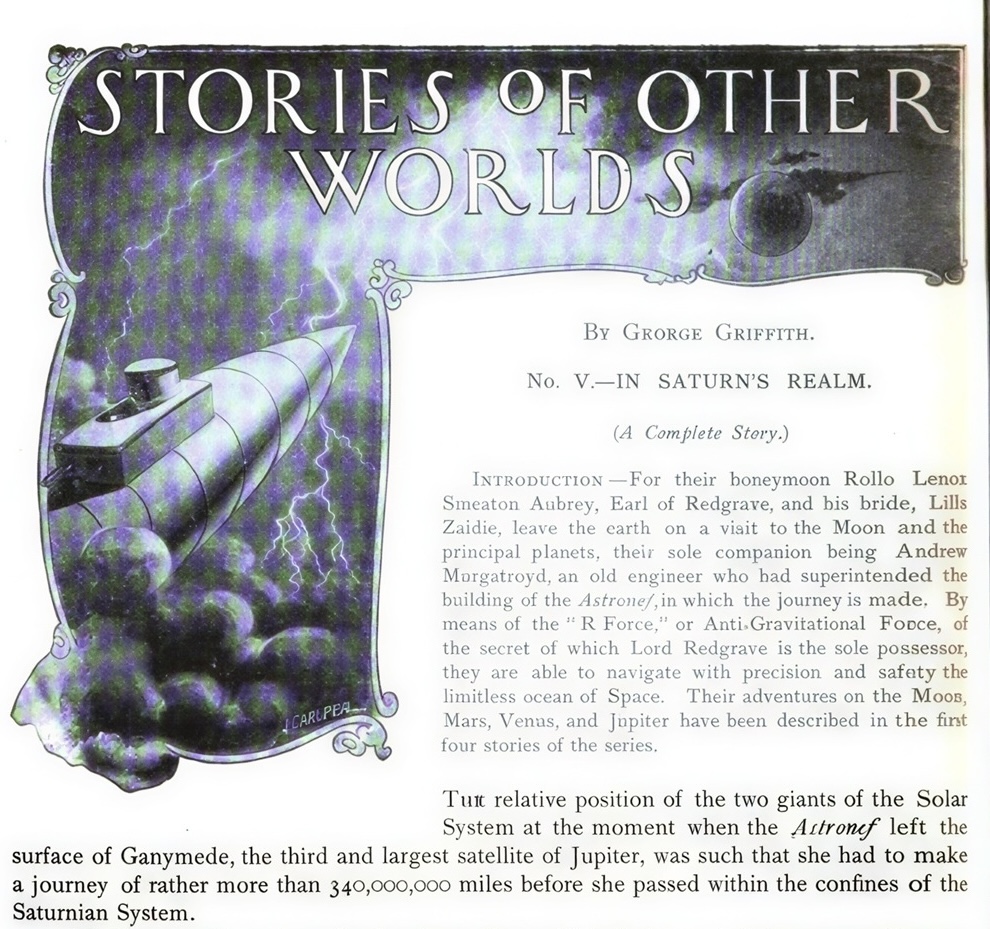
Technological wonders. Left: Fred T. Jane’s airship in Hartmann the Anarchist. Middle: Another view of the wondrous ship. Right: Stanley Wood’s spaceship in ‘Stories of Other World’.
In many cases, the new technologies of exploration were supported by illustrations which filled in details that were otherwise strategically obfuscated in the texts. Goble visualizes the sphere for Wells’s submarine journeying and Shepperson depicts the moon-capsule in ‘The First Men.’ Wells rarely specifies his machines in detail and, as noted earlier, illustration had a vital function to present his notions as if they were objectively real. In Shepperson’s design the capsule, which Wells describes only as a polyhedral with retractable blinds, is visualized as a robust panelled vehicle with rivets or bolts featuring on the outside, and seems very much the product of a Victorian iron-based technology (Cooke, ‘Illustrating H. G. Wells,’ 653). Many other examples could be given, in each case offering the original readers tangible embodiments of the writers’ ideas.
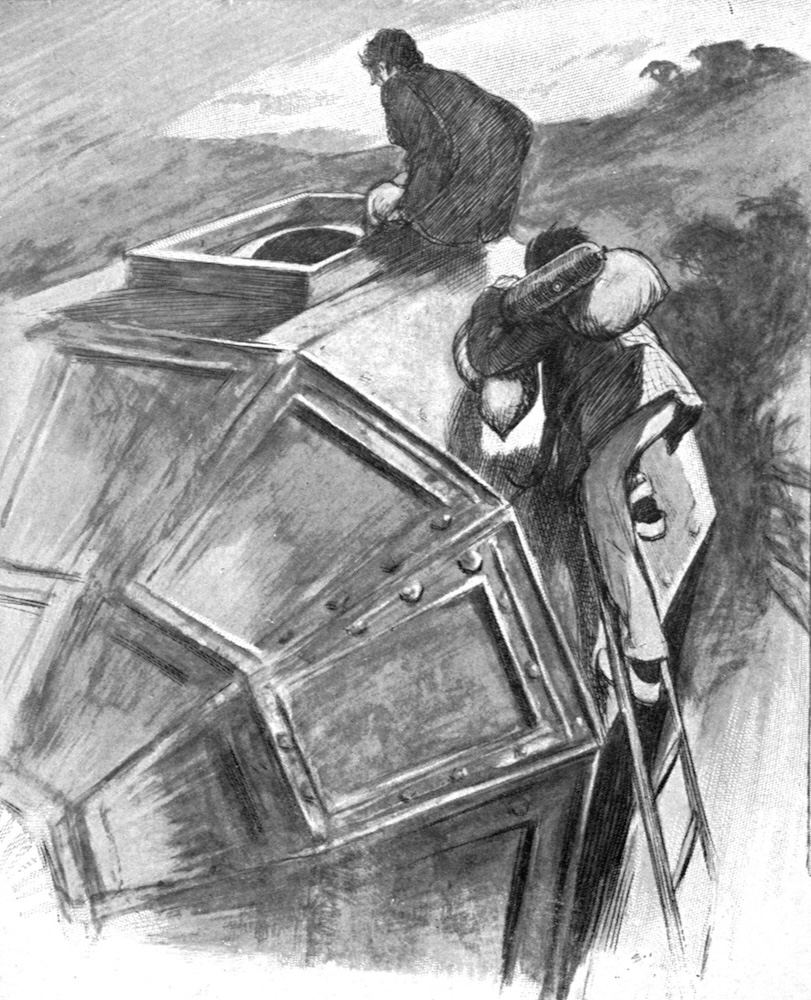
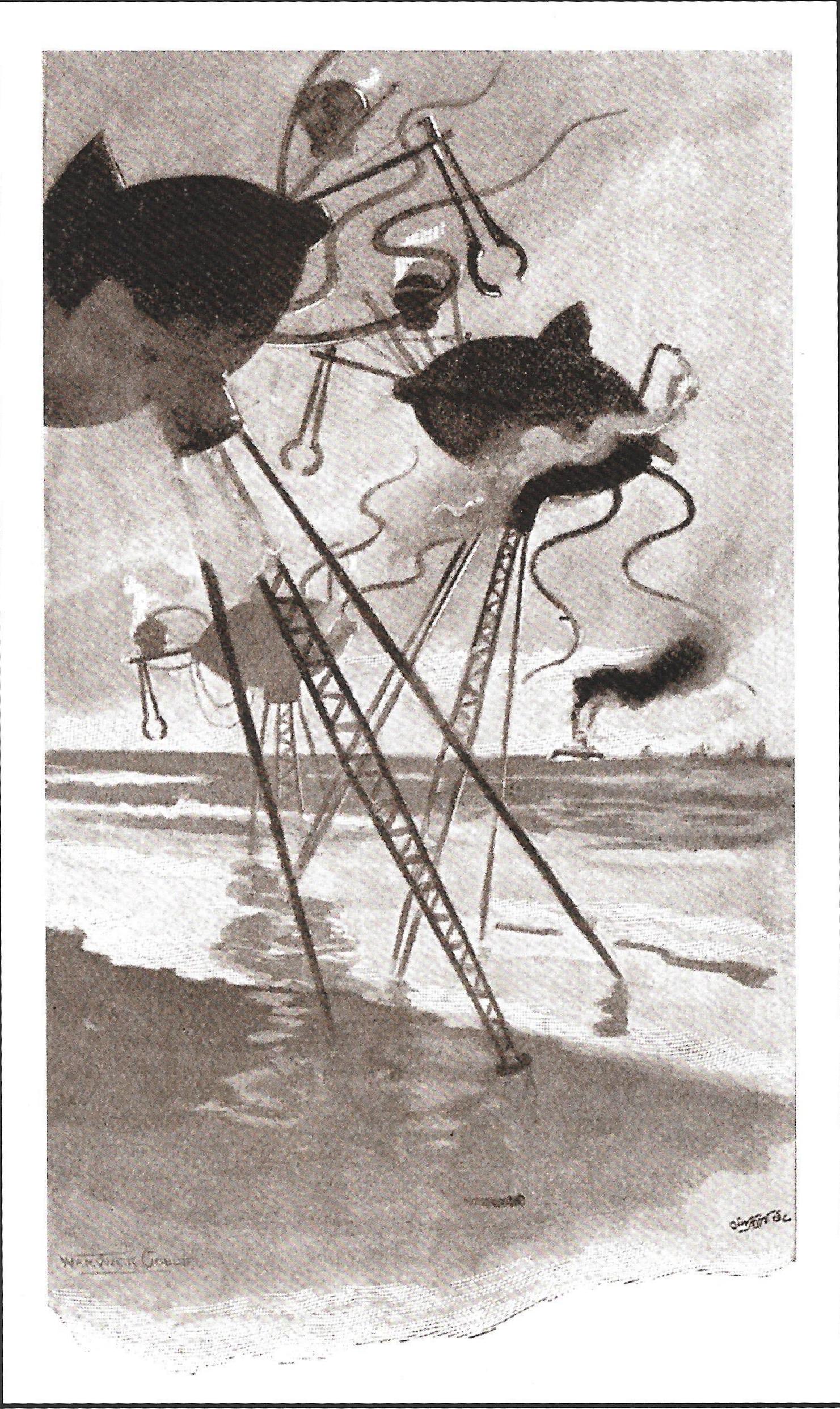
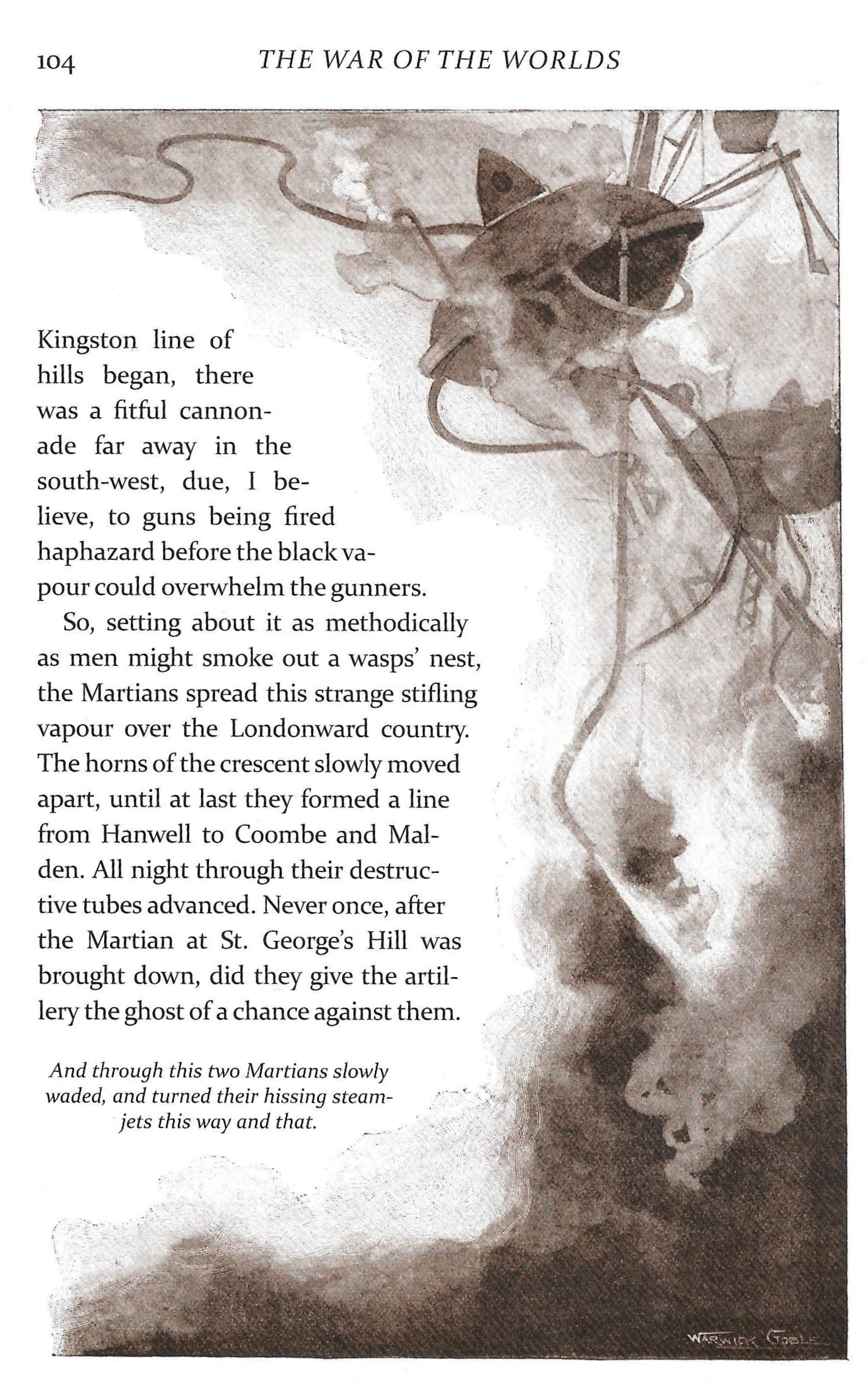
Left: Shepperson’s imagining of Cavor’s sphere in ‘The First Men in the Moon.’ Middle and right: Two of Goble’s visualizations of the Martian war-machines: blank, implacable, unreadable.
Such inventive representations are important insofar as they were often the original conception of futuristic vehicles which were later the subject of diverse interpretations. Goble’s tripods for Wells’s The War of the Worlds (1897) are a case in point: much visualized in later illustrative series and films – notably in Henrique Alvim-Corrêa’s designs of 1906 and Steven Spielberg’s film of 2005 – Goble was nevertheless the prime creator, offering weird and discordant images; Wells invented his fiction, but Goble devised a distinctive iconography to match (Cooke, ‘Visualizing the Alien(s),’ 83).
The new modes of transport imagined by British artists of the 90s were undoubtedly influenced by French models. Jules Verne’s fictions of the earlier part of the century were routinely illustrated with many suggestive prototypes, from submarines to flying warships and space craft. Édouard Riou provided journalistic imagery for parts of 20,000 Leagues Under the Sea, which was co-illustrated by Alphonse de Neuville (1870, English version 1872), and Henri de Montaut illustrated From the Earth to the Moon (1865, English, 1867). The same visionariness could be traced, moreover, in Albert Robida’s technological images as they appeared in The Twentieth Century (1880), a speculative, surreal book in which the author imagines a future of flying cars and electronic screens. All of these fictions were available in translation in Great Britain, and while it is difficult to establish a direct stylistic linkage, there is no doubt that French illustrators cleared new ground for their British counterparts.
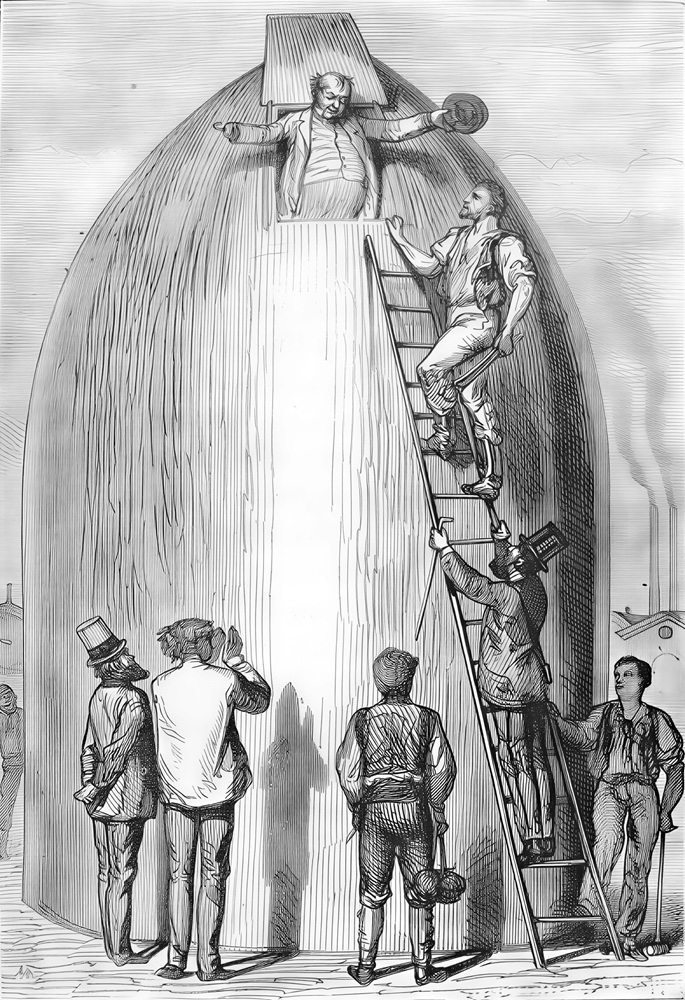
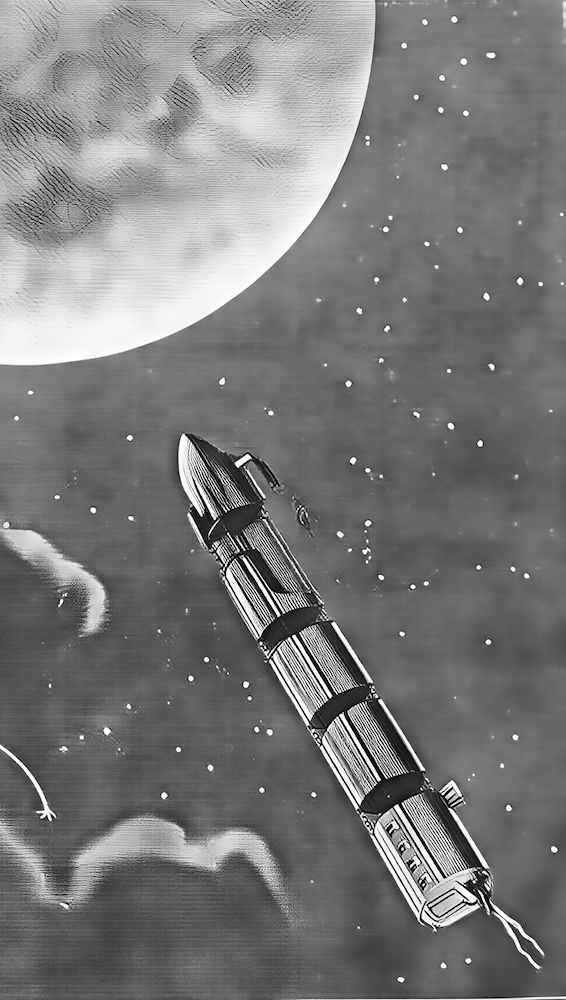
Glimpses of the future. Left: Montaut’s space-craft/projectile which is shot at the Moon (as in the film by Méliès). Right: The space craft in parts, a detail that curiously prefigures the rocket’s division into parts in the Apollo moon shots.
Equally important were interpretive approaches which privileged certain aspects of the theme of travel and technology. In ‘The First Men in the Moon’ Shepperson not only materializes the sphere but adds another layer of meaning in his emphasis on its robust physicality. In so doing he foregrounds the author’s notion of the vehicle as a place of safety: his focus on its iron plates highlights its apparent invulnerability – even when it is shown on fire during flight – and in another illustration he shows Bedford and Cavor peering out through a porthole in what appears to be a womb-like space, creating an absolute division between the familiar inside and the threatening outside. The functioning of the sphere as both an object and an idea is further stressed by the image of Bedford’s struggling to escape as he toils through the lunar snow; expressionistic in effect, the illustration contrasts the swirling whiteness with the reassuringly solid shape of the black craft.
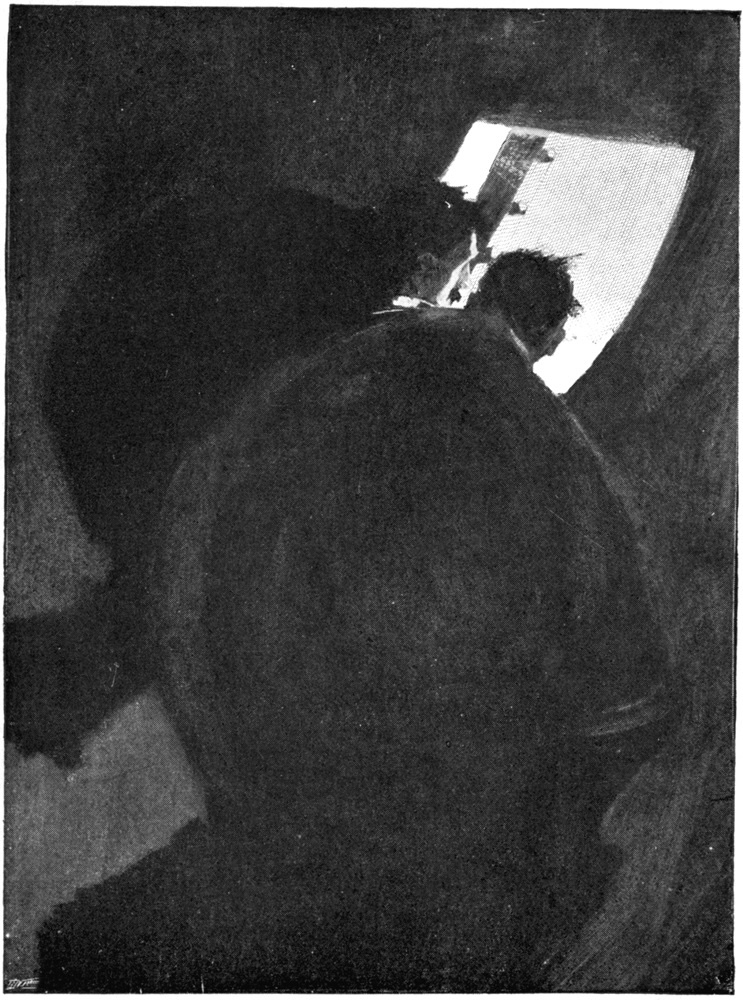
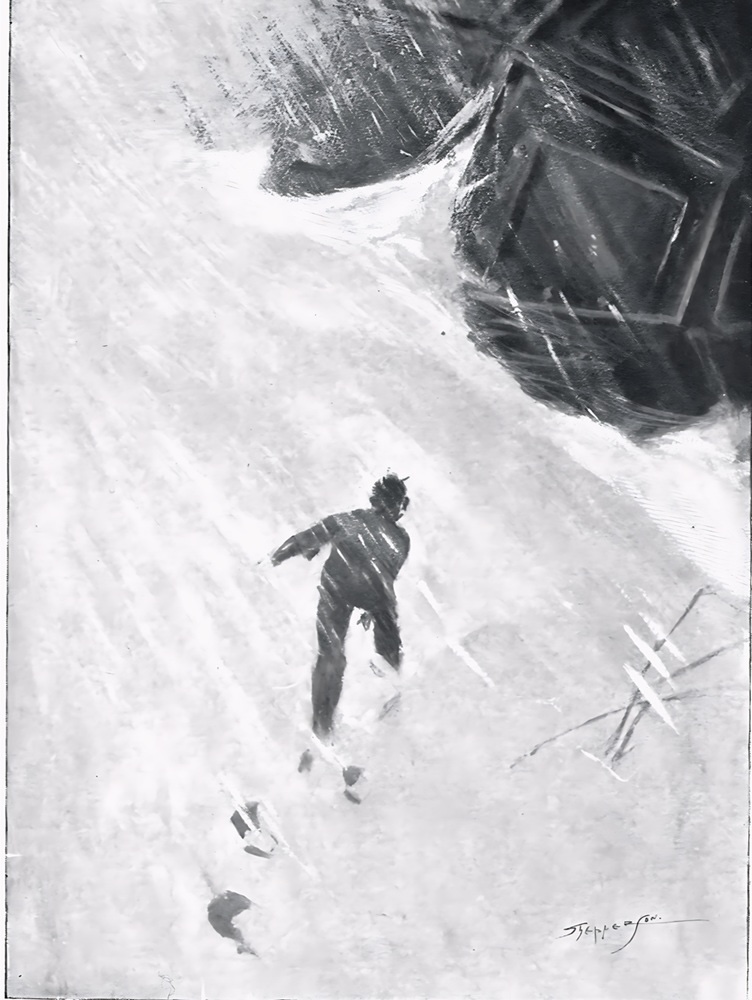
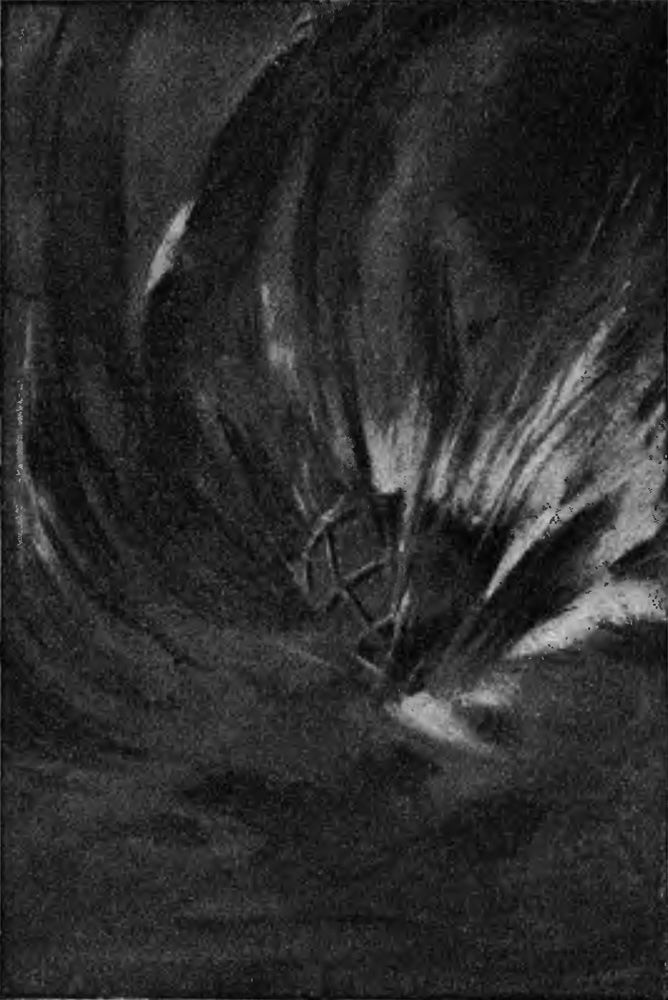
The space-craft as sanctuary in ‘The First Men’: Left: the sphere as womb; Middle: as home, invulnerable to the elements; and Right: the provider of safe transition as it re-enters Earth’s atmosphere. The ‘burn-up’ remarkably anticipates the heat effects witnessed on real space craft as they re-entered the Earth’s atmosphere.
The notion of the sanctuary-craft also informs the illustrations for Griffith’s ‘Stories from Other Worlds,’ later retitled A Honeymoon in Space (1900). The frontispiece for the book version by Harold H. Piffard shows the newly-weds Zaidie and Redgrave looking out of a window at the cosmos – but the interior, with its elegant padded furniture and table-telescope, could easily be a comfortable lounge in a metropolitan apartment.
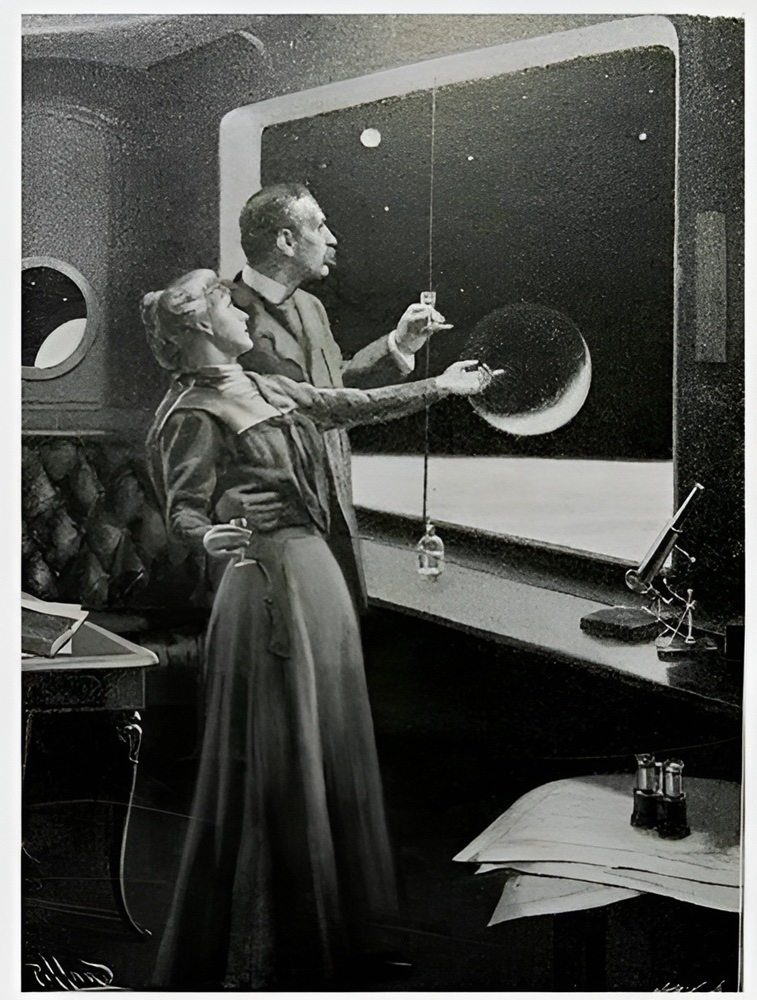
Space travel as luxury for the louche and privileged: Piffard’s concept of a more-than-comfortable cabin in a sea-liner of the stars.
Such picturing stresses one of the emerging tropes of Science Fiction: the notion of the comfortable, reliable craft, the means of return that never fails to serve the protagonists. It also helped to establish the idea that outlandish travels – to the Moon, to distant planets, to the future – could plausibly be conducted. If steam-trains could only run on rails and steamships on the sea, the imagined technology, it seems, could conquer vast unimaginable distances and places with no inherent danger to its explorers. It is, of course, an optimistic, utopian view of future technologies and their relationship with exploration. In an age when large tracts of the world were still unexplored and many animals were yet to be classified, the concept of convenient discovery had an obvious appeal: the Amazonian forests and the Antarctic might have been a blank, but unfettered travel to outer space implied that one day even the most inaccessible territories would be brought within reach (and colonized) through the application of an advanced technology.
Far more troubling, however, are representations of another classic trope: aliens and encounters with inexplicable cultures. In modern Science Fiction this concern is often stereotypical and hackneyed, but in Victorian writing and illustration the meeting with otherworldly creatures was usually deployed not only as speculation about the future but also, and more tellingly, as a mode of anxious engagement about the present-day issues of colonialization, the foreign Other, and notions of degeneration. As noted earlier, Wells often used the genre as a mode of political and social commentary, deploying monstrosity and the alien to dramatize his critiques in an allegorical form, and his effects were both matched and extended by illustrative series.
Foremost among his illustrated texts is Goble’s version of ‘The War of the Worlds’ (Pearson’s Magazine, 1897). In Wells’s tale the Martians could be said to represent a fearful response to the foreign, and Goble very much accentuates the notion of their cultural dissonance as creatures who are not only inhuman but contradict the rules of ‘normality.’ His visual starting point is Wells’s description of a Martian as it emerges from its capsule:
I think everyone expected to see a man emerge – possibly something a little unlike us terrestrial men, but in all essentials a man. I know I did. But, looking, I presently saw something stirring within the shadow: greyish billowy movements, one above another, and then two luminous disks-like eyes. Then something resembling a little grey snake, about the thickness of a walking stick, coiled up out of the writhing middle, and wriggled in the air towards me – and then another.... Those who have never seen a living Martian can scarcely imagine the strange horror of its appearance. The peculiar V-shaped mouth with its pointed upper lip, the absence of brow ridges, the absence of a chin beneath the wedgelike lower lip, the incessant quivering of this mouth, the Gorgon groups of tentacles, the tumultuous breathing of the lungs in a strange atmosphere, the evident heaviness and painfulness of movement due to the greater gravitational energy of the earth – above all, the extraordinary intensity of the immense eyes – were at once vital, intense, inhuman, crippled and monstrous. There was something fungoid in the oily brown skin, something in the clumsy deliberation of the tedious movements unspeakably nasty. Even at this first encounter, this first glimpse, I was overcome with disgust and dread. [3: 372]
Goble captures the strangeness of the creature partly by recreating Wells’s description and also by accentuating its seemingly indeterminate, ‘Gorgon groups of tentacles,’ which are beyond any earthly notion of what an octopoid animal would possess. In Goble’s hand, as in Wells’s, the Martians are of the earth – seemingly to be like a celphalopod – but uncannily not quite like one, something that is confusingly ‘at once, vital, intense, inhuman, crippled and monstrous’; such inexplicability figures the defamiliarized puzzlement of those facing the foreign.
At the same time, the hideous Martians are a coded representation of the disgust that British colonizers were said to experience as they contemplated non-White bodies. It was commonplace in the nineteenth century to speak of non-European people as physically repulsive and strange (Malchow 18), and Goble enshrines that attitude in his treatment of the otherworldly creatures, which symbolize the alien in the form, literally, of aliens. That approach links Goble and Wells to other texts concerned with colonial anxiety, notably to Rudyard Kipling’s horror stories (Cooke, ‘Visualizing,’ 97–106), in which supernaturalism provides an allegorical language to match the symbolism of scientific fantasy and romance.
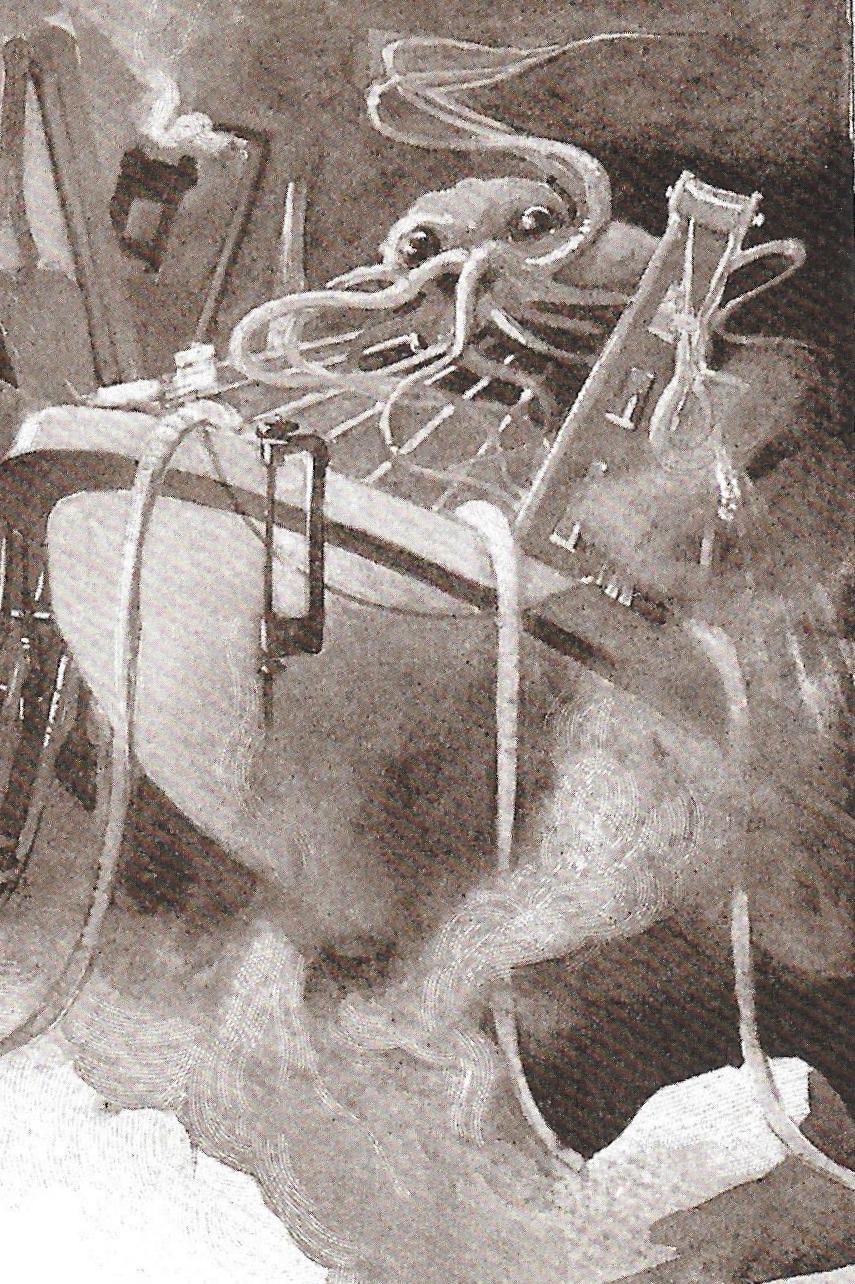
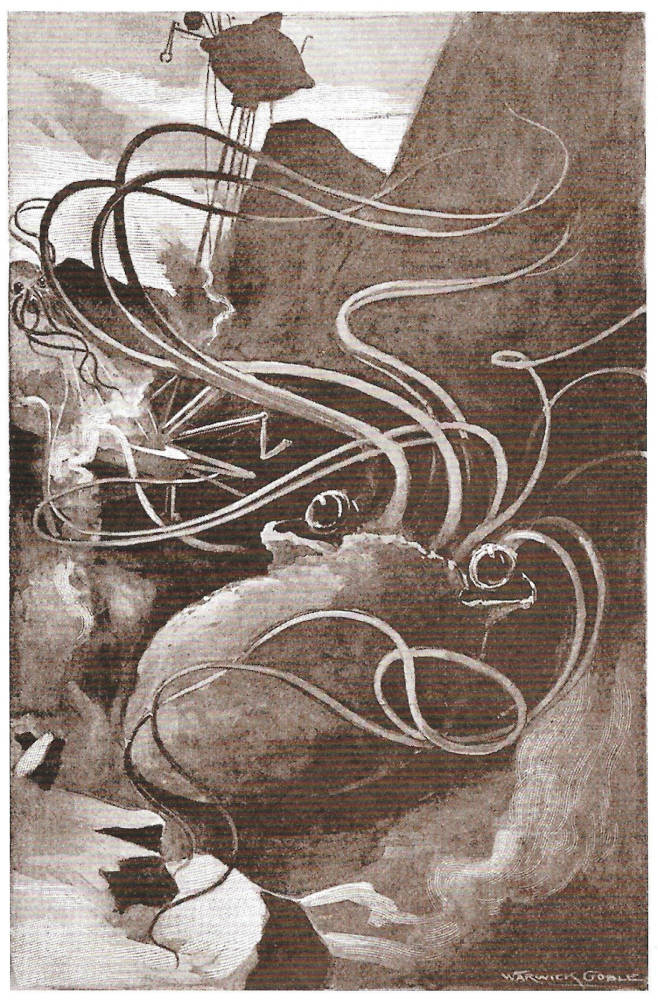
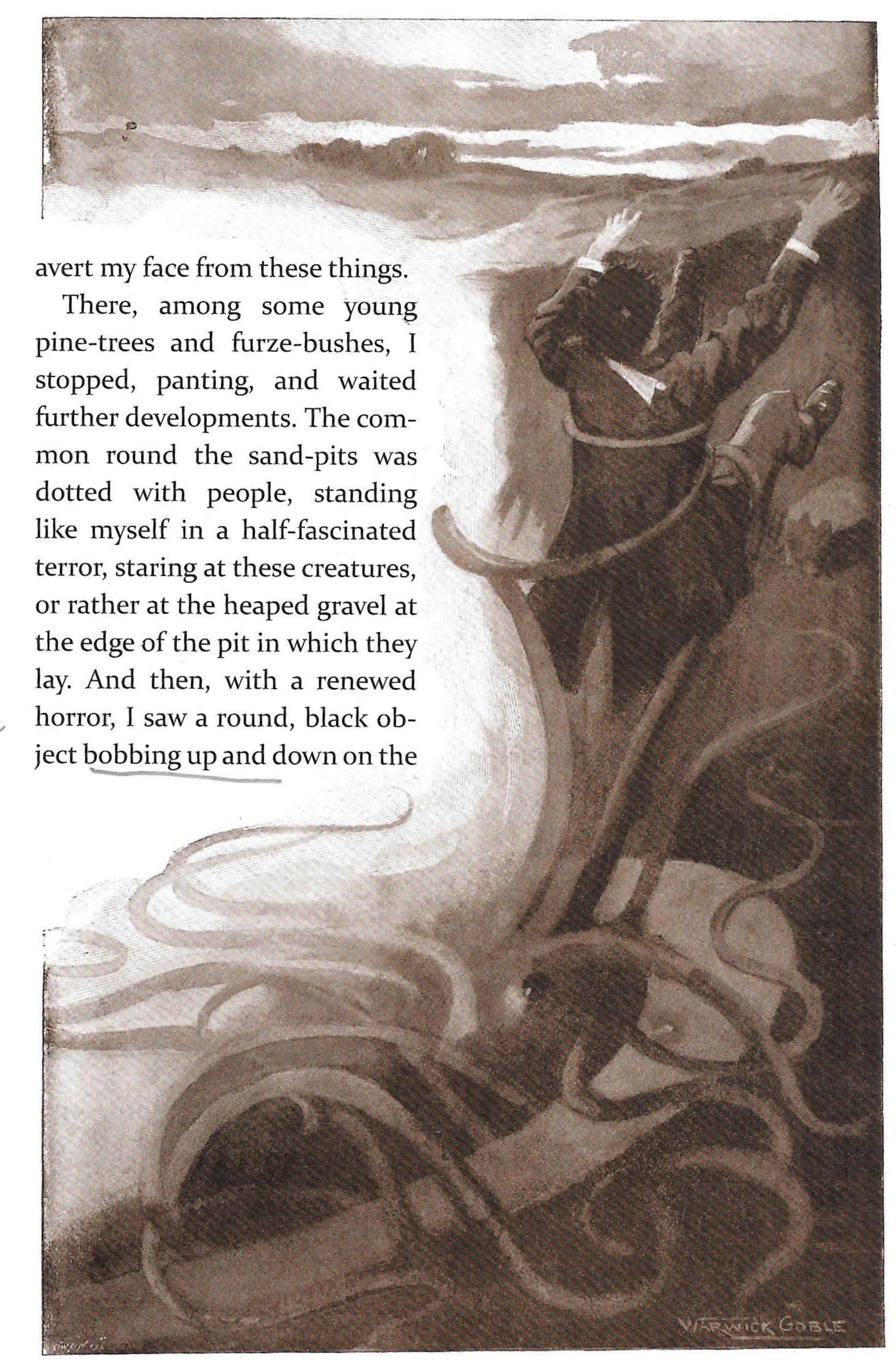
Goble’s Martians. Left: as it emerges from the sphere. Middle and right: The horrors of wormy tentacles.
Goble adds other dimensions to this racial fearfulness in his treatment of the war machines, which not only totter on three legs (itself a contradiction of the bilateral symmetry of all earthly nature), but have no legible features; unlike Alvim-Corrêa’s war-machines, which are given cartoon eyes and depicted as puppets, Goble’s machines are smooth, expressionless lozenges. This appearance, the artist implies, is another sign of the colonial experience: the foreign Other not as strange or disgusting, but as an illegible blank. In Kipling’s words in ‘The Mark of the Beast,’ ‘East of Suez’ the (white) man is handed over to the power of Gods and Devils’ outside the ‘supervision … of Englishmen’ (3), and cannot make sense of the world. In Wells’s and Goble’s text English power does not extend as far as Mars – a surrogate for India and all colonial properties – but the British are faced with a sort of cultural short-circuit in which the aliens make no attempt to communicate and cannot be decoded.
However, the power of the text and illustrations lie in their duality. If the Martians represent the incomprehensibility of the Other, they also point to late Victorian anxieties about ‘reverse colonization’ (Arata 623) with foreigners taking control of the British colonies or even, as here, invading England. Essentially, Wells and Goble turn the tables so that the British experience the confusion of dealing with an enemy that is incomprehensible and uses an advanced military technology to take control. Britain’s colonial subjects could not read the invaders’ purposes, and the British are forced to experience the dislocating experience of those upon whom they imposed colonial rule: the colonizer is colonized.
Such reverse-colonization was predicated on the belief that white culture might degrade, and the notion of degeneration is specifically addressed in Wells and Goble’s bimodal text. Goble’s visualization of the Martians’ tentacles is privileged as a sign of primitive life, a worminess that connotes a return to primal simplicity rather than evolution. Indeed, the Martians are figured as mirror images of humankind, appearing as apparently advanced beings who are nevertheless threatened by a reverse-trend towards bestial degeneration: such was the fear of those who imagined that Darwinist theory might be inverted instead of offering an endless ascent into perfection. As one contemporary critic worriedly observes, the ‘Martians are … like mankind’ or near enough to be ‘terrible’ in their implications (‘Unsigned’ 71). Like Jekyll, who releases his primitive self, Goble’s animal-aliens are emblems of the degenerate beings within the ‘advanced’ human self.
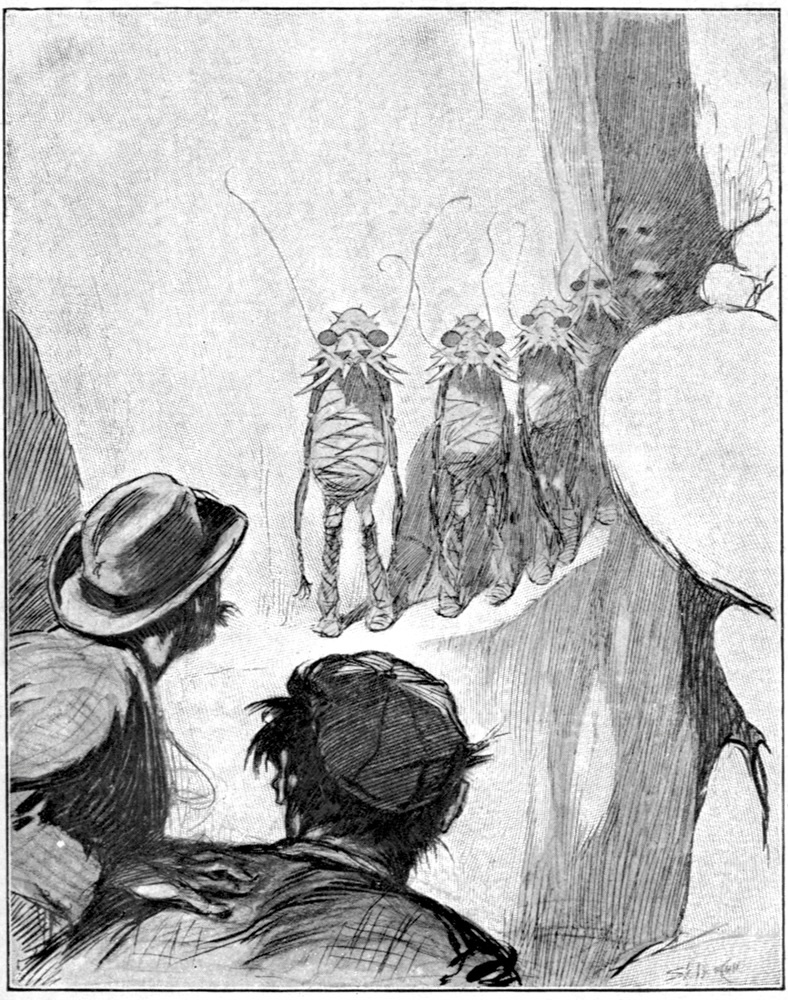
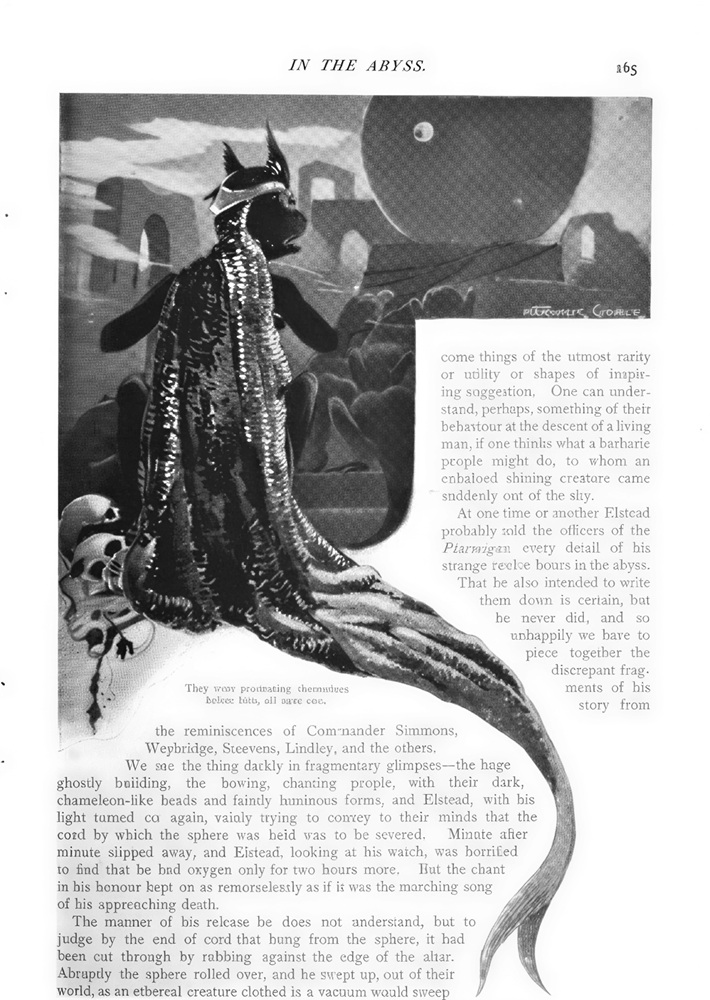
Aliens and monstrosity. Left: Shepperson’s images of the Selenites. Right: Goble’s treatment of the fish people of the abyss.
That might also be said of the various other aliens appearing in Victorian scientific romance, most of which are positioned in civilized cultures but whose inner backwardness is symbolized, again, by their monstrosity. Goble’s illustrations for Wells’s ‘In the Abyss’ and Shepperson’s for ‘The First Men in the Moon’ exemplify this approach. For ‘In the Abyss,’ Goble visualized the fish-people as a bizarre hybrid, grotesque aberrations of nature which echo his treatment of the Martians; and in ‘The First Men’ Shepperson plays on the author’s description of the lunar-people as insects – an analogy that simultaneously acts to suggest their primitive nature and to satirize the Victorian working classes. Paradoxically concerned with the future, all such texts concern themselves with the horror of retrogression. The primitive creatures witnessed by Wells’ Time Traveller at the end of time are perhaps mankind’s ultimate condition. Mere fantasies are haunted by that possibility.
Warfare and Apocalypse
These fantastic illustrations might thus be said to visualize late nineteenth century anxieties about race, imperialism, human identity, and the development of the future.
Closely linked to doubts about the potency of the Empire were questions about the rise of militarism in Europe – especially in Germany in the period before the Great War – and the impact of technology on weapons development. Writers contemplated a fantastic destructiveness in the emerging world order as the Empire unravelled, and illustrators responded with iconographies of weaponry and chaos.
In ‘The Land Ironclads’ (The Strand, 1903) Wells speculates on future warfare and offers a remarkably prescient vision of the way in which cavalries might be both armoured and mechanized. Produced at the turn of the Victorian and Edwardian periods, Wells anticipated the development of tanks that would feature in the final years of the Great War, but provides only sketchy and confusing details, describing his machines as a ‘large and clumsy black beetle’ or ‘a giant’s dish-cover’ (755). Yet Shepperson provides a tangible vision, picturing the ‘Ironclads’ as smoothly-contoured vehicles. Once again, the ill-defined future is given immediacy in a single, resonant image – even if Wells and Shepperson’s concept bears little relationship to how the tanks of 1917 would look.
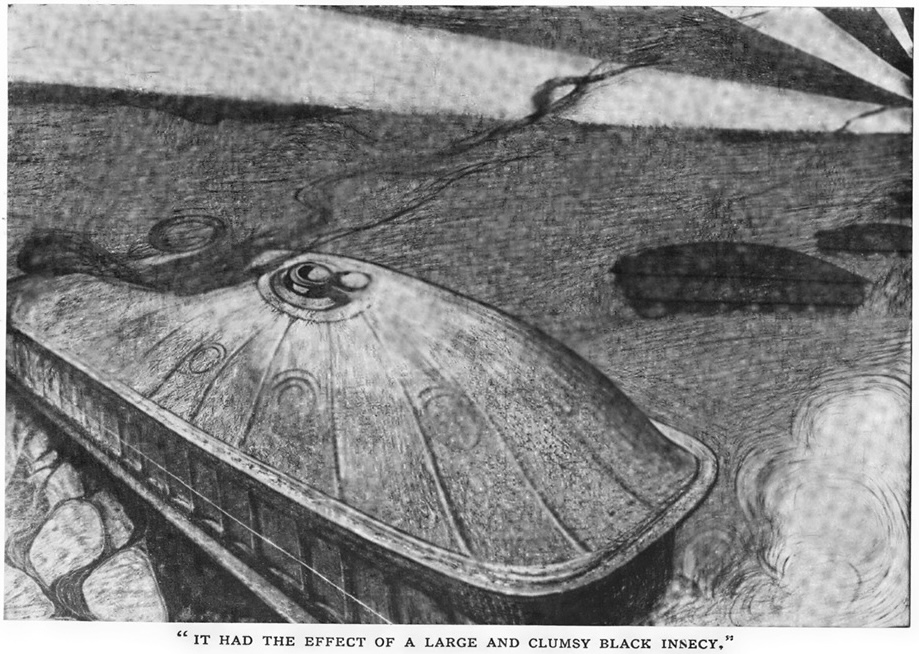
Shepperson’s version of Wells’s ‘Land Ironclads.’
Shepperson’s design is nevertheless a powerful representation of how technology would transform warfare from the horse-drawn into the mechanical, and how the destructiveness of conflict would be converted into an impersonal exchange. Wells’s fearful anticipation of an all-destroying weaponry is given its most powerful expression, however, in ‘The War of the Worlds’ (1897). Wells describes the horror as England and its people are ripped apart, and Goble focuses on the fantastic, annihilating force of the Martians’ death-ray. In Wiped Out! he contrasts the power of the alien technology with the British army gun it destroys: the Martians’ weapon is essentially a prototype for a ray-gun, while the field device is presented as if it were toy. The dynamic diagonals and emanating force-lines emphasise explosive destruction, as if the image is testing the limits of its margins, and the overall effect is one of apocalyptic collapse into fragmented disorder. Jane provides a parallel imagery in Fawcett’s Hartmann the Anarchist (1893) and here, once again, it is England itself that is reduced to rubble by preternaturally powerful weapons.
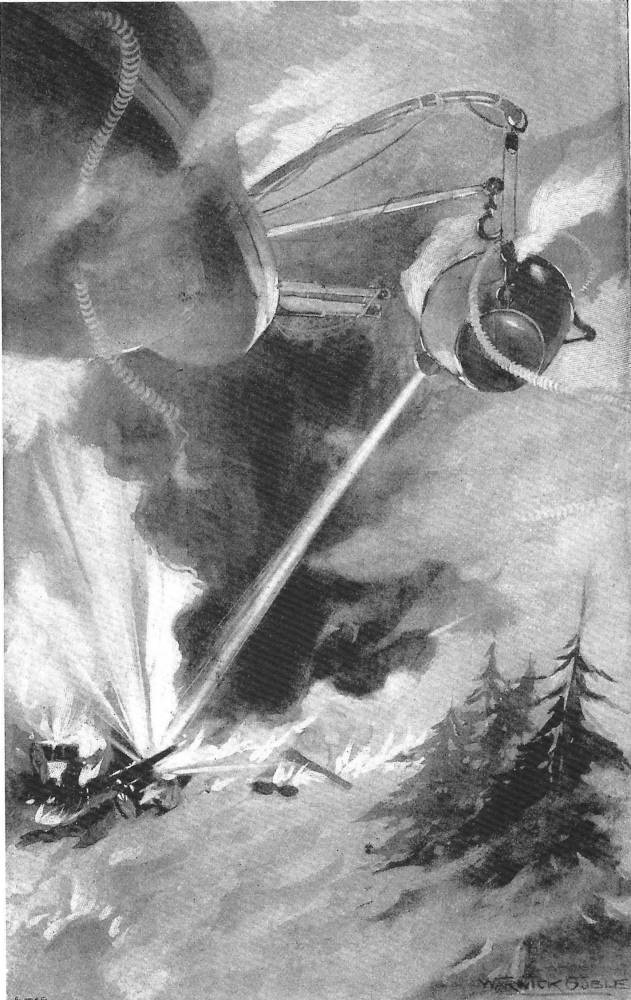
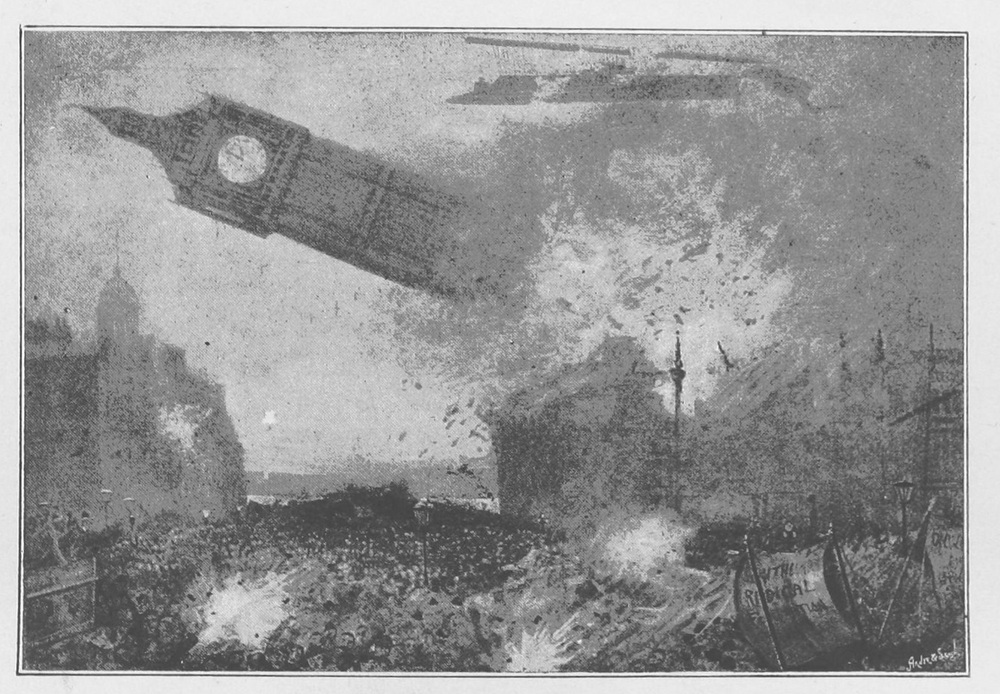
Images of destruction: Left: Goble’s picturing of the death-ray; Right: Jane’s rays striking England in Fawcett’s apocalyptic tale.
Indeed, a major theme in Victorian romance is destruction of the homeland and especially the Home Countries, either through invasion or as a result of some natural disaster. George Tomkyn Chesney had anticipated Wells’s ‘The War of the Worlds’ (1897) in The Battle of Dorking (1871), the story of a take-over by a German speaking adversary, and there were several other texts projecting the same apocalyptic despair. In After London (1885) Richard Jefferies offers a gloomy contemplation of a wrecked capital – again establishing a well-known trope – and the same situation prevails in Frederick Merrick White’s ‘The Doom of London’ (Pearson’s Magazine, 1903). In some of these texts, illustration plays a vital role. Goble embellishes White’s tale in images redolent of those in Wells’s Martian story, and in his work for Grant Allen’s ‘The Thames Vallery Catastrophe’ (The Strand, 1897) Alfred Pearse visualizes the irresistible power of earthquake and flooding in a series of dynamic and unsettling designs.
Pearse’s vision of the homeland assaulted by a natural disaster.
In short, the picturing of Victorian Science Fiction was an important part of the original readers’ experience: if the texts told about the future, the illustrations showed how it might look and how it might be experienced. There were, of course, some missed opportunities. Wells’s The Time Machine was issued ‘blind,’ and it is interesting to speculate what a contemporary artist would have made of the craft, the Eloi and the Morlocks. Taken as a whole, though, Victorian illustration established a visual semiology of fantastical forms and situations that established a tradition of picturing which was taken up in the twentieth century and led to a huge proliferation of images in comic books, in illustrated editions, and in television and film. As was fitting in a genre concerned with the future, Victorian illustrators provided models for an art yet to come.
Related Material
- William Delisle Hay's The Doom of the Great City as an early modern tale of urban apocalypse
- Darwin in Utopia
- Edward Bulwer-Lytton's The Coming Race
- Richard Jefferies and Victorian Science Fiction
- "O! Realist of the Fantastic": H.G. Wells and The War of the Worlds
Bibliography
Primary
Allen, Grant. ‘The Thames Valley Catastrophe.’ Illustrated by Alfred Pearse. The Strand 14 (December 1897): 674–684.
Cherney, George Tomkyn. The Battle of Dorking. London: Blackwood, 1871.
Fawcett, E. Doulgas. Hartmann the Anarchist; or, the Doom of a Great City. Illustrated by Fred Jane. London: Edward Arnold, 1893. [online edition, Project Gutenberg].
Griffith, George Chetwynd. ‘Stories from Other Worlds.’ Illustrated by Stanley L. Wood. Pearson’s Magazine 9–10 (Jan–Jul 1900). Reissued in a revised and extended form as A Honeymoon in Space. London: Pearson, 1900.
Jefferies, Richard. After London. London: Cassell, 1885.
Kipling, Rudyard. Strange Tales. Ware: Wordsworth, 2006.
Kubrick, Stanley. 2001: A Space Odyssey. Stanley Kubrick Productions, 1968.
Lang, Fitz. Metropolis. Berlin: UFA, 1927.
Machen, Arthur. The Great God Pan. London: John Lane, 1894.
Marsh, Richard. The Beetle. London: Skeffington, 1897.
Méliès, George. Le Voyage dans la Lune (A Trip to the Moon). Paris: Star Films, 1902.
Morris, William. News from Nowhere.1890; rev. ed. London: Reeves & Turner, 1891.
Nadau, Max. Entartung (Degeneration), 1892; New York: Appleton, 1900.
Robida, Albert. The Twentieth Century.Paris; Libraire Illustrée, 1880.
Spielberg, Steven. War of the Worlds. Dreamworks Pictures, 2005.
Stevenson, R. L. Strange Case of Dr Jekyll and Mr Hyde. Illustrated by Edmund Sullivan. London: The Amalgamated Press, 1901.
Stevenson, R. L. Strange Case of Dr Jekyll and Mr Hyde. London: Longmans, Green, 1888.
Stoker, Bram. Dracula. London: Constable, 1897.
Verne, Jules. From the Earth to the Moon. Illustrated by Henri de Montaut. Paris: Hetzel, 1865.
_____.20,000 Leagues Under the Sea. Illustrated by Édouard Riou and Alphonse de Neuville. Paris: Hetzel, 1870.
Wells, H. G. ‘In the Abyss.’ Illustrated by Warwick Goble. Pearson’s Magazine 2 (August 1896): 155–165.
_____. ‘The First Men in the Moon.’ Illustrated by Claude Shepperson. The Strand 20–21 (1900–1901).
_____. The Invisible Man. London: Pearson, 1897.
_____. The Island of Dr Moreau. London: Heinemann, 1896.
_____. ‘The Land Ironclads.’ Illustrated by Claude Shepperson. The Strand 26 (July–December 1903): 751–64.
_____.The Time Machine. London: Heinemann, 1895.
_____. ‘The War of the Worlds.’ Illustrated by Warwick Goble Pearson’s Magazine. 3–4 (1897).
_____. The War of the Worlds. Illustrated by Henrique Alvim-Corrêa. Brussels: Vandamme. 1906.
White, Frederick Merrick. ‘Doom of London.’ Illustrated by Warwick Goble. Pearson’s Magazine 15–16 (1903).
Wilde, Oscar. The Picture of Dorian Gray. London: Ward & Lock, 1891.
Secondary
Arata, Stephen D. ‘The Occidental Tourist: Dracula and the Anxiety of Reverse Colonization.’ Victorian Studies 33, no. 4 (Summer 1990): 45–62.
Cooke, Simon. ‘Illustrating H. G. Wells: The First Men in the Moon and The War of the Worlds.’ The Book Collector. 74, no. 4 (Winter 2025): 651–64.
_____. ‘Visualizing the Alien (s): Warwick Goble’s Illustrations for H. G. Wells’s The War of the Worlds.’ Victorians Institute Journal 45 (2017): 81–118.
Freeman, Michael. Railways and the Victorian Imagination. New Haven: Yale University Press, 1999.
Frewin, Anthony. One Hundred Years of Science Fiction Illustration, 1840–1940. London: Jupiter, 1974.
Jackson, Holbrook. The 1890s: a Review of Art and Ideas at the Close of the Nineteenth Century. London: Grant Richards, 1922.
Liggins, Emma. ‘Visualizing the Unseen: Supernatural Stories and Illustrations in The Strand.’ Victorian Periodicals Review 52, no. 2 (2019) (online version).
Luckhurst, Roger. Science Fiction: a Literary History. London: The British Library, 2018.
Malchow, Howard. Gothic Images of race in Nineteenth Century Britain. Stamford, CA: Stamford University Press, 1996,
Marshal, Nancy Rose, Ed. Science and Imagery: Representation and Knowledge in Nineteenth Century Visual Culture. Pittsburgh: University of Pittsburgh Press, 2021 (online edition).
Roberts, Adam. The History of Science Fiction. London: Palgrave Macmillan, 2016.
Schivelbusch, Wolfgang. The Railway Journey: Travel and Trains in the Nineteenth Century. Oxford: Wiley-Blackwell, 1980.
Suvin, Darko. Victorian Science Fiction in the United Kingdom. Boston: Hall, 1983.
’Unsigned Review’ (The War of the Worlds).The Academy, rep. in Parrinder, Patrick, Ed. H. G. Wells: The Critical Heritage. London: Routledge & Kegan Paul, 1972.
Wythoff, Grant, Ed. The Perversity of Things: Hugo Gernsback on Tinkering, Media, and Scientifiction. Minneapolis: University of Minnesota Press, 2016.
Created 15 March 2026