
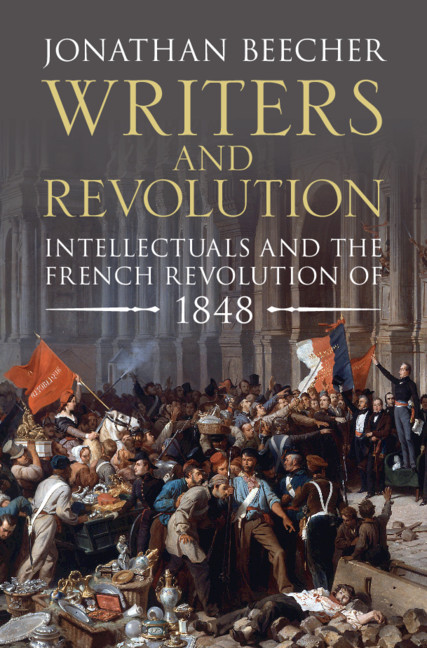

onathan Beecher's valuable Writers and Revolution, though dealing with the revolutionary action that seized France in the 1840s, indirectly makes a basic contribution to studies of Victorian Britain. Many in Britain peered with alarm at the events in France following the February Revolution of 1848. The British response to similar domestic turmoil was the Third Chartist Petition, presented to Parliament soon afterward, in April of that year. With this book, Beecher offers a detailed account of how a group of writers, well selected by Beecher and facing actual revolt as they worked in France, struggled with their own feelings of alarm even while encouraging the same aspirations that so appalled their British counterparts.
The French drive for reform erupted in a fierce and bewildering sequence of events that began with the dethroning of Louis-Philippe (commonly known as the "Citizen King") in 1848 and, in a near reversal of course less than a decade later, created an emperor out of Louis Napoleon, a political mediocrity despite his name. Meanwhile, Britain moved from Chartism to what W. L. Burn has, properly, called The Age of Equipoise. Seeing one of these historic developments from the perspective of the other has long been instructive. One of the best aspects of Beecher's book is how aptly it serves this juxtaposition of perspectives by making available a shrewd, well-written, and balanced account of the way key French writers worked out their own perspectives, variously penetrating, impassioned, and disillusioned, on the tumult of their times. It makes an illuminating exercise, for example, to have the carefully woven community of Middlemarch (1872) in mind while reading Beecher's incisive discussion of social fragmentation in Flaubert's Sentimental Education (1869).
I stress this juxtaposition here for the sake of interested Victorianists, but Beecher, of course, has his own agenda. He maps the participation and writings of nine French authors and intellectuals as they confronted events from 1848 to 1852 while analyzing major texts in which each of them attempted to take the measure of the revolution and its aftermath. Some of their writings about 1848 are very well known. Tocqueville's Recollections (1893), Flaubert's novel, and Marx's two crucial pamphlets, The Class Struggles in France (1850) and The Eighteenth Brumaire of Louis Bonaparte (1852) have always been recognized as classic commentaries on 1848. Somewhat shaded by these legendary texts are the formal histories of 1848 by Alphonse de Lamartine (1849) and Marie d'Agoult (three volumes, 1850-53). Writers and Revolution also features separate chapters devoted to the anarchist Pierre-Joseph Proudhon and to the radical Russian émigré Alexander Herzen. Finally, and indispensably, there are the writings of Victor Hugo and George Sand. Hugo wrote two polemical essays and a volume of poetry alternately ridiculing and chastising "Napoléon le petit," a mocking term that ultimately became the title for his culminating work on the period (1852). George Sand features prominently in the book both with respect to her influential "Bulletins" (1848) but even more particularly her correspondence which Beecher reveals as a magnificent guide to the hopes and disappointments of those who celebrated the February Revolution as the coming of new age.
The chapters on each of the included writers can be read independently with profit. Yet the book also has a set of binding themes and topics. Beecher's paramount purpose is to situate each of his subjects in the history of the Second French Republic (1848-1852), always differentiating one writer from another as shifting priorities and factional allegiances caught them up in multiple ideological displacements. A second, more subtle aim is to recover the sense of possibility and fraught optimism felt by contemporaries at a time when hopes were high and when the Republic seemed actually revolutionary. This emphasis becomes, in turn, a framing for narratives of disappointment and dilemma which persistently emerge in most of the chapters. Even though Beecher is not writing a consecutive narrative about the events that engulfed his writers, a very dramatic portrait of a momentous period is indirectly available in this book.
The book makes two other important contributions to our understanding of the historical realities and the formidable figures who together constitute its focus. Both points are incised more in the grain of the events recounted and the expressive styles of the writers studied than in any overt analyses. There are, first, the many fascinating entwinements of hectic participation and heady reflection. Though British writers like Carlyle and Dickens brought the full force of their genius to the task of understanding the whirligig of the revolutionary process, neither was ever personally tugged at the sleeve by the menace of revolutionary action. But in the case of figures like Lamartine, George Sand, Herzen or Tocqueville we get, so to speak, the inside scoop.
Next there is in the texts of all nine writers, and often in their oratorical performances, a recurring demonstration of a rhetoric that foregrounds literary forms, tropes, structures and analogies. They intuitively assimilated revolutionary action to the structures of symbolic action. The most famous instance remains Marx's adaptation of Hegel in The Eighteenth Brumaire where he writes, in his introduction, that "History repeats itself, first as tragedy, second as farce." Beecher observes how many of his writers use metaphors of theatricality to render their deeply ambivalent accounts of the spectacle which often astonished them and the illusions that governed it. The events being so incomprehensible, writers called on the familiar scaffolding of literary form to give them purchase on the turmoil. For example, Flaubert's narrative reaches a climax with Frédéric Moreau's visit to the misnamed Club de l'Intelligence where everyone imitates a predecessor, one copying Saint-Just, another posing as Danton, another as Marat. They try to drape their tawdry doings in the robes of the 1789 Revolution.
Beecher shows how the same analogy distinctively colors Tocqueville's Recollections as he argues that the July Monarchy enfeebled the whole concept of a space for public opinion while maintaining that the radicals who had a chance for real power in 1848 were so impoverished by their political inexperience that they could only play at revolution, mimicking the roles, gestures, and imagery of their predecessors. For all intents and purposes, this strand of Beecher‘s book instantiates what Kenneth Burke described in A Rhetoric of Motives (1950). Burke sees rhetoric as, in the first instance, the work of identification rather than persuasion. Rhetorical forms and modes of language are the elements by which shared meaning takes shape. The writers treated by Beecher were all conjuring with the problem of making some kind of whole out of numerous crack-ups, and all through their texts we can see rhetoric binding pragmatic and symbolic action. Marx is an exemplary case. His great rhetorical force put an unforgettable face on the figure of revolution. Beecher foregrounds this quality in an especially nuanced chapter.
All of these matters come immediately to hand in the life and work of Beecher's first subject, the poet Alphonse de Lamartine, who became a leading actor in the Provisional Government after the overthrow of Louis Philippe. Both Lamartine and George Sand, anticipating Shelley, saw the poetic imagination as at one with the revolutionary spirit, and both, Beecher observes, virtually sculpted the moral reality of the Revolution for lettered and unlettered participants. Even Marx credited Lamartine with providing the February Revolution with its initial layer of poetic language. By the 1840s Lamartine had adopted the goals of democracy and made powerful portrayals of a new world to be fashioned by his contemporaries. But to his own bewilderment, he went from being a much honored leader to one whose beard was repeatedly singed by the often violent events that overtook the political systems he helped to create. He consistently sought what he conceived as a moderate revolution. Like Carlyle, he attempted in his History of the French Revolution of 1848 (1849) to map the moral and political boundaries between Revolution and Terror. Yet as his work acquired influence, it also seemed to gain vainglorious freight.
His companion in turning rhetorical eloquence to pragmatic purposes is George Sand. Both used their literary capacities and their moral imagination to resolve the paradox inherent in their dedication to moderate revolution. Sand saw that the propertied classes devised phantoms like a "red scare" to drive her beloved peasants and the working class to retreat from their just revolt. But after her positive response to the massive republican demonstration of March 17, followed by her own powerful call for a democratic assembly in her "Bulletin de la République" of April 15, she began to experience more and more sharply the dismay that the June Days and the Paris street violence occasioned for her. Ultimately, she more or less retreated from political agitation.
Victor Hugo, on the other hand, was radicalized by the political environment following the June Days. Beecher uses Hugo's diaries and letters to capture the novelist's steady effort to bring about a republican state even while yet supporting some relatively conservative causes. His great crisis, ultimately ending in his exile, was the ascension of Louis Bonaparte. In exile he published his powerful cri de coeur Napoleon le petit (1852). He had started Les Miserables amidst his many emotional and political toils in the 1840s; he used his exile to complete it. He never abandoned his conviction that France would finally give birth to the right revolution.
Writers and Revolution offers splendidly researched and always illuminating case studies of the kind of political trials that both weighed on the Victorian sensibility and also infused a reactive sense of buoyancy and relief into it. In many documents of the mid-Victorian era, such as John Stuart Mill's various writings, there is a rhetoric of moderation. His style is itself, as in his great contrasting essays on Bentham and Coleridge, a witness to a cultural disposition toward British stability over the continuing disruptions going on in Europe. Mill himself would often stress this view to his friend Alexis de Tocqueville.
But Mill need not have worried that Tocqueville would be carried away by revolution. Beecher admires the "brutal clarity" of Tocqueville's judgments. He saw that the radicals who came close to real power were betrayed by their superficial grasp of the public good and could only "play at revolution" (203). In his Recollections Tocqueville gives compelling life to his active parliamentary role, his sense of a grand purpose sunken by misdirection, and his lucid reflections on the roots of order in an authentic democracy. Perhaps fortunately he did not complete his Recollections until after Louis Napoleon's coup. At the center of this exhilarating political autobiography stood the question: "Why in the space of sixty years had a democratic revolution in France twice culminated in the dictatorship of a Napoleon?" (238). Tocqueville, already a major historian, brilliantly adapted the autobiographical form to his meditations. The form shaped a new historical art, a way of negotiating between private and public realms. But, as Beecher shows, Tocqueville's negotiation is conducted with deliberate classical elegance. This is hardly the case with a comparable text, Alexander Herzen's massive My Past and Thoughts (1861-67; available in a one-volume abridgement). Herzen writes from the vantage point of a multilingual Russian émigré who lived amid a network of European intellectuals and socialists. His output as a journalist and essayist is voluminous. But his poignant, episodic, autobiographical narrative in My Past and Thoughts relies as much on gossip, chance encounters, and a novelistic eye as on documents and dialectic. Always disappointed by the philistinism of the West, Herzen turned his own divided allegiances into the emotional force of what Beecher terms "a vast historical fresco" (280).
Finally, a word must be said about the book's astute chapter on Marx. So much has been written about the rapid evolution of Marx's thinking from the clarion call of the Communist Manifesto to the drama of The Eighteenth Brumaire that one might not expect a fresh account here. What Beecher does supply, almost as though he had Kenneth Burke in mind, is a demonstration of how Marx created a new face and voice for the figure of revolution. A revolution, right or wrong, symbolically takes shape in the dialectics of a master rhetorician. Alongside the revolutionary experiences that Beecher details, this book also provides an account of revolutionary action configured as a rhetoric of motives in nineteenth-century literary forms.
Links to Related Material
- "Revolution and Authority," from Carlyle and the Search for Authority (1991)
- Socialism, Marxism, and related reform movements in late Victorian Britain
- Bentham and Coleridge: Seminal Minds
- Chartism
- Victorian Anarchism
Bibliography
[Book under review] Beecher, Jonathan. Writers and Revolution: Intellectuals and the French Revolution of 1848. Cambridge: Cambridge UP, 2021. 494 pp. Hbk: $50. ISBN 9781108842532.
Burn, W. L. The Age of Equipoise: A Study of the Mid-Victorian Generation. New York: Norton, 1964.
Burke, Kenneth. A Rhetoric of Motives. Berkeley: University of California Press, 1969.
Herzen, Alexander. My Past and Thoughts. Translated by Constance Garnett; abridged by Dwight Macdonald. New York: Knopf, 1974.
Lamartine, Alphonse de. Histoire de la Révolution de 1848, 2 vols. Paris: Perrotin, 1849.
Marx, Karl. The Eighteenth Brumaire of Louis Napoleon. Translated by Daniel De Leon. New York: Compass Circle, 2024.
Tocqueville, Alexis de. Recollections: The French Revolution of 1848 and Its Aftermath. Edited by Olivier Zunz and translated by Arthur Goldhammer. Charlottesville: University of Virginia Press, 2016.
Created 3 August 2026 Last modified 7 August 2026