
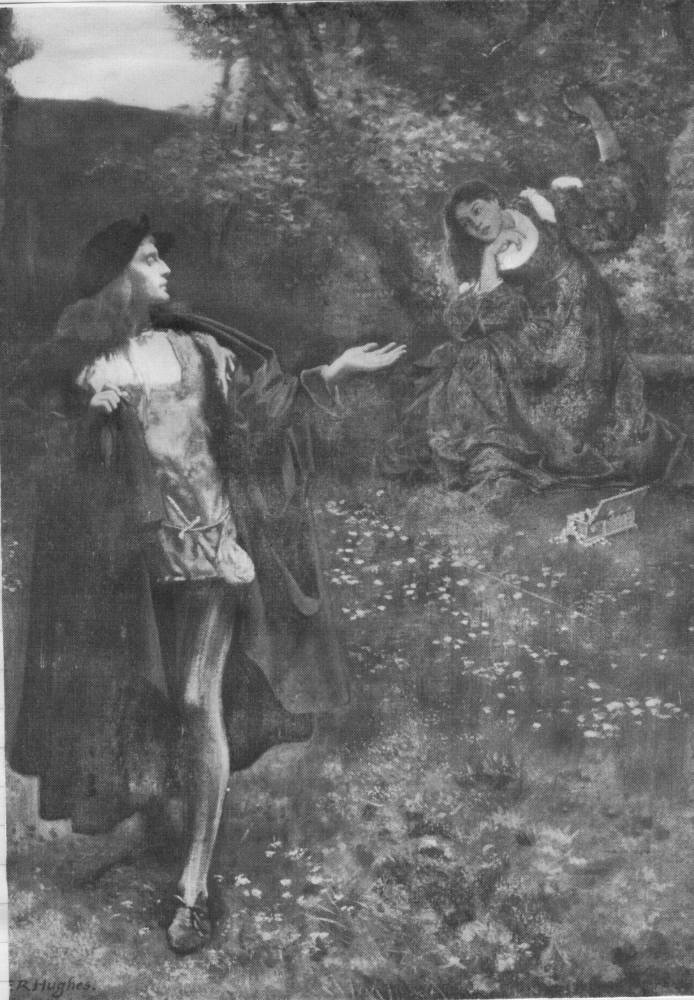
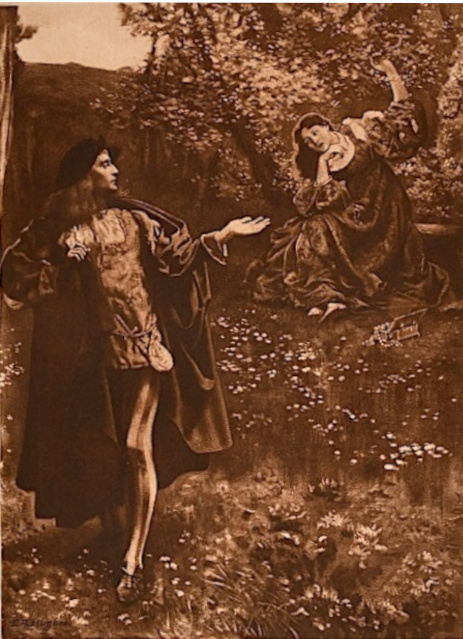
Bertramo's Renunciation. Left: Watercolour and gouache [?]; 22 x 16 inches (56 x 41 cm). Private collection, image courtesy of Sotheby's Belgravia. Right: Grisaille illustration from The Novellino of Masuccio. Image facing p. 20, scanned by the author. [Click on the images to enlarge them.]
Hughes worked up this finished watercolour from an earlier illustration, this one based on Masuccio Salernitano's "Bertramo's Renunciation" from The Novellino of Masuccio, translated by W. G. Waters, and published in two voiumes by Lawrence and Bullen in London in 1895. The grisaille illustration for this subject was found in Volume II, facing page 20. A summary of the story, which was published as the twenty-first novel, is provided by Waters before the story starts:
Messer Bertramo d'Aquino is enamoured of a lady without getting a return of his passion. But for the reason that the husband of the lady aforesaid lavishes great praise on this suitor of hers under the guise of a falcon, she is at length induced to take her lover into favour. When they foregather, Messer Bertramo demands to know why she has let him come to her. Having heard this, the cavalier bears himself in grateful wise, and, without so much as touching her, takes his departure and leaves her in derision. [11]
From the story as a whole, it becomes quite clear that Bertramo has every reason to act honourably. Not only is the lady's husband a friend of his, but the woman herself truly loves her husband. Bertramo can no longer think of betraying a man who has been praising his "worth and pleasant humour and splendid liberality" so volubly (14). So he simply gives the lady the jewels that he had brought as a love-gift, and asks her to wear them in memory of his renunciation of her, and not to think ever again of being unfaithful to such a husband. He gives her a chaste kiss on the brow before taking his leave (Salernitano II: 12-20). This last part of the story is the scene shown in Hughes's watercolour with Bertramo looking back at Fiola who is seated on the ground under a magnificent tree in her garden, a casket of jewels at her feet.
While many Victorian painters chose subjects from the great writers of the Italian Renaissance, Hughes was particularly interested in subjects taken from more obscure Italian writers like Giovanni Francesco Straparola, Masuccio Salernitano, and Giovanni Fiorentino (Engen 34-37). He did, however, take at least one subject from Giovanni Boccaccio, his watercolour entitled Mona Giovanna.
Dante Gabriel Rossetti, of course, chose subjects from Dante Alighieri, such as Dante's Dream at the Time of the Death of Beatrice, and so did Frederic Leighton, G. F. Watts, and Edward Burne-Jones. William Cave Thomas painted a number of works based on Francesco Petrarch, such as Laura in Avignon. Marie Stillman produced a watercolour of The First Meeting of Petrarch and Laura. For the Pre-Raphaelites and their associates, however, by far the most important source for subjects was Boccaccio, with numerous paintings based on his Il Decamerone. Watts, for instance, decorated the Villa Careggi in Careggi with frescoes based on The Decameron. Leighton exhibited one of his most famous paintings Cymon and Iphigenia, in 1884. A number of artists produced paintings based on Boccaccio's story of "Elisabetta [Lisabetta] and the Pot of Basil," although usually the source was the later poem by John Keats "Isabella and the Pot of Basil." Subjects based on this story include the following works by John Everett Millais, William Holman Hunt, John William Strudwick and John William Waterhouse. Marie Spartali Stillman also based a number of her watercolours on The Decameron as did John Byam Shaw.
When Hughes's watercolour of Bertramo's Renunciation sold at Sotheby's Belgravia in 1978 the subject was misidentified as being that of Faust and Helen.
Bibliography
Engen, Rodney. "The Twilight of Edward Robert Hughes, RWS." Water-Colours and Drawings Magazine (Winter 1990): 34-37.
Salernitano, Masuccio. The Novellino of Masuccio. Translated by W. G. Waters. 2 vols. London: Lawrence and Bullen, 1895: Novel twenty-one: 11-21. Internet Archive, from a copy in the University of California Libraries. Web. 3 May 2026.
Victorian Paintings, Drawings and Watercolours London: Sotheby's Belgravia (15 July 1978): lot 248, 43.
Created 3 May 2026