
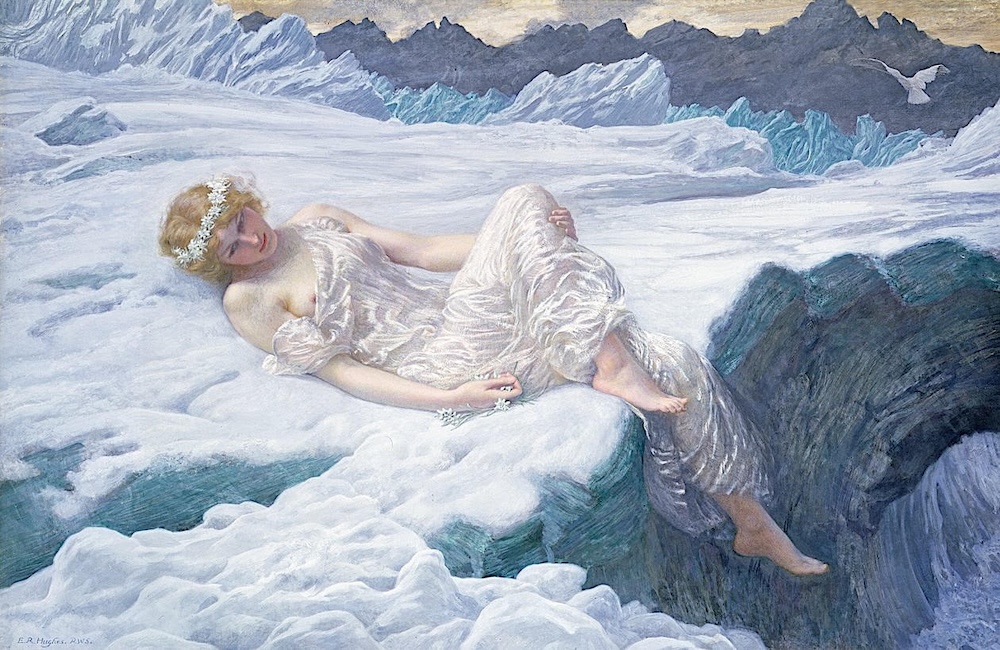
Heart of Snow. 1907. Watercolour and gouache on paper. 22 1/2 x 44 1/2 inches (57 x 113 cm). Private collection. Image courtesy of Peter and Renate Nahum. [Click on the image to enlarge it.]
Hughes exhibited Heart of Snow at the Summer Exhibition of the Royal Society of Painters in Water Colours in 1907, no. 62. Although this watercolour was not accompanied in the catalogue by any lines of poetry, its title is apparently derived from lines from Charles Beaudelaire's poem "La Beauté" from his book Les Fleurs du Mal first published in 1857:
Je trône dans l'azur comme un sphinx incompris;
J'unis un coeur de neige à la blancheur des cygnes;
Lord Alfred Douglas's English translation of 1909 reads:
In the blue air, strange sphinx, I brood supreme;
With heart of snow whiter than swan's white crest;
Hughes painting depicts a beautiful young woman in a diaphanous white gown with a crown of white flowers on her head and clutching similar flowers in her right hand. She has a hardened unhappy expression on her face. Her clothing is incongruous with the glacial landscape she lies upon, with her left leg dangling downwards from a precipice. A white dove hovers in the upper right which is normally symbolic of peace, love, and purity. In ancient times it was associated with the goddess Aphrodite so it seems a strange accompaniment to a woman representing a "heart of snow" and one wonders why Hughes chose this bird rather than the white swan mentioned in Baudelaire's poem. A bare rocky range of mountains forms the background. The colour scheme used in this painting reminds one of James Whistler's various Symphonies in White, of which Hughes was undoubtedly aware. A retrospective of Whistler's work had been held by the International Society of Sculptors, Painters and Gravers in London in 1905.
Victoria Osborne has pointed out the importance of Baudelaire's poetry for the European symbolist movement in art:
Hughes's choice of a quotation from Baudelaire as a title for his watercolour is significant, reflecting the fact that the poet had caught the imagination of fin-de-siècle writers and artists in England, as well as in France. An interest in Baudelaire had awakened in Aesthetic and Decadent circles in England as early as 1862…. By the time Hughes painted Heart of Snow, a link between Baudelaire and Symbolism had become firmly established in England, as in France…. Hughes's Heart of Snow depicts a young woman in white drapery, reclining in a wintry landscape. This delicate, even vulnerable young girl is far from evoking the mysterious and immortal figure of Beauty as goddess evoked by Baudelaire's poem and described by Sturm [Frank Pearce Sturm] as "as terrible as Pallas, 'the warrior maid invincible.'" Nonetheless, the placing of a female figure in a frozen landscape, together with the title Heart of Snow, suggests a connection with Symbolist depictions of women as alluring yet cold and forbidding.'….In the case of Heart of Snow, the presence of the dreaming young woman in the icy landscape is left unexplained. Instead, the emphasis is on evoking a mood of silent reverie. In this suppression of narrative content and elevation of formal qualities, and in its exploration of subtle variations in tone, Heart of Snow recalls the concerns of Aesthetic painting of the 1870s and '80s, for example the many depictions of contemplative young women in classicizing robes by Albert Moore…. In Heart of Snow, the quotation from Baudelaire's poem becomes a kind of pivot around which the formal and compositional qualities of the work revolve. The reference to snow and to the whiteness of swans in the text is the stimulus for Hughes to create an exploration of variations on white, juxtaposing the garlands of pale flowers, drapery, icy landscape, and white feathers of the bird swooping low over the snow (perhaps intended as a nod to Baudelaire's "whiteness of swans") with the slight flush and warmth of the girl's skin. [67-69]
Osborne additionally suggests that the connection between Hughes's watercolour and European developments extends beyond its literary source. She feels Hughes depiction of a draped female figure in a barren, snow-covered landscape in Heart of Snow was influenced by the Italian symbolist painter Giovanni Segantini's painting The Punishment of Lust which had been shown initially at the first exhibition at the Grafton Galleries in London in 1893, and then later that same year at the Liverpool Autumn Exhibition where it was bought by the Walker Art Gallery. As Osborne points out Hughes would surely have been aware of this work because it was amongst the most discussed works in the exhibition at the Grafton Galleries and was also much reproduced. [69-70]
As compared to Segantini's painting, Osborne feels, "the nature of the implied coldness at the heart of the young woman in Hughes's watercolour is more ambiguous, but it is significant that she wears a garland of flowers around her head and carries more blossoms in her hand, suggesting the coming of spring and thaw and implying a melting of her own 'heart of snow'" (70-71).
Peter Nahum Ltd, London has most generously given its permission to use in the Victorian Web information, images, and text from its catalogues, and this generosity has led to the creation of hundreds of the site's most valuable documents on painting, drawing, and sculpture. The copyright on text and images from their catalogues remains, of course, with Peter Nahum Ltd.
Readers should consult the website of Peter Nahum at the Leicester Galleries to obtain information about recent exhibitions and to order their catalogues. [JB]
Bibliography
Nahum, Peter and Victoria Osborne. "Heart of Snow." London: Leicester Galleries. Web. 9 May 2026. https://www.leicestergalleries.com/browse-artwork-detail/MTY0OTQ=
Osborne, Victoria Jean. "A British Symbolist in Pre-Raphaelite Circles: Edward Robert Hughes RWS (1851-1914)." M. Phil. thesis, University of Birmingham, 2009.
Created 9 May 2026