
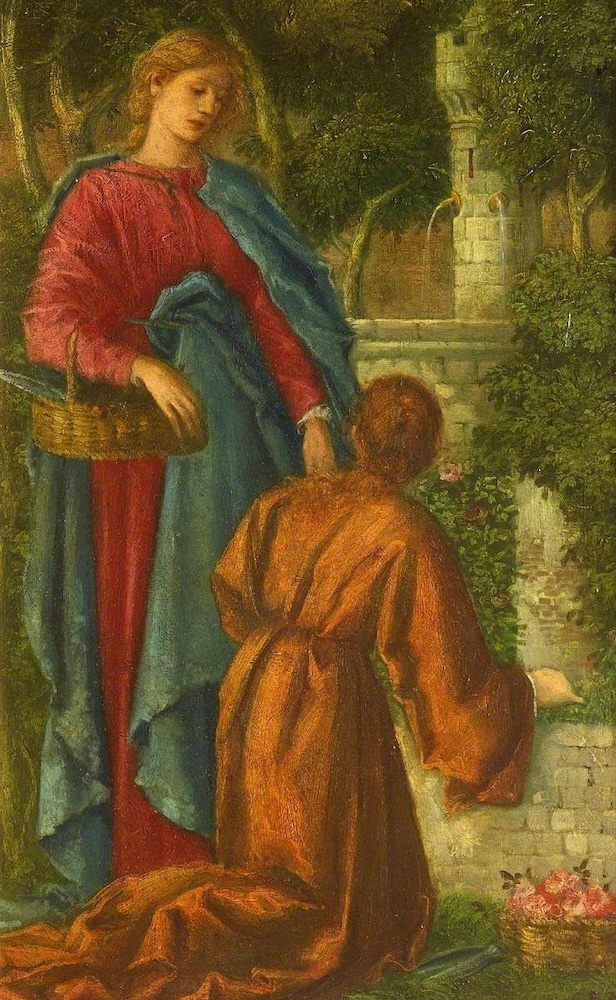
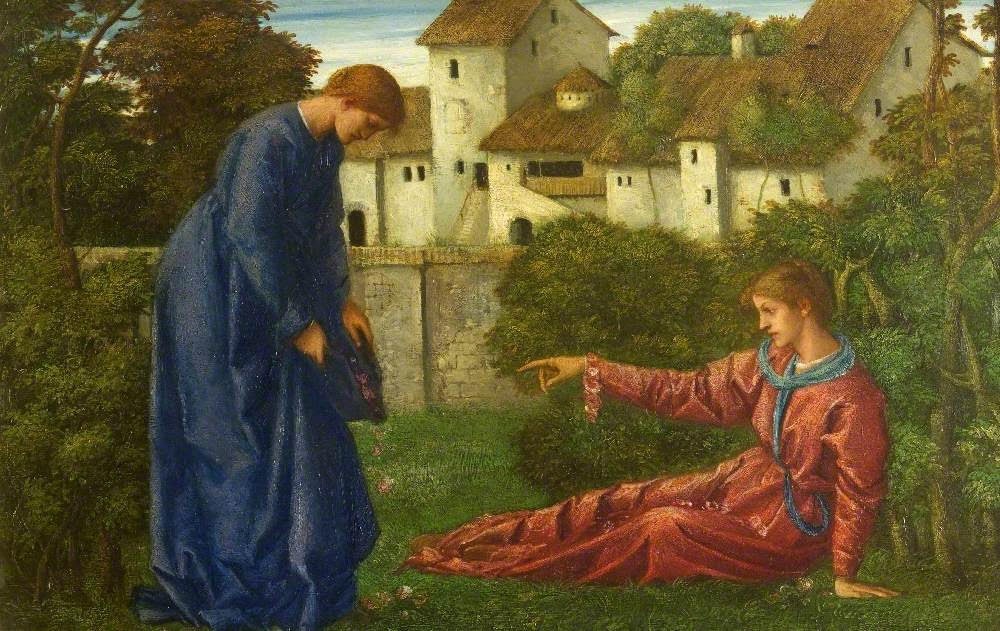
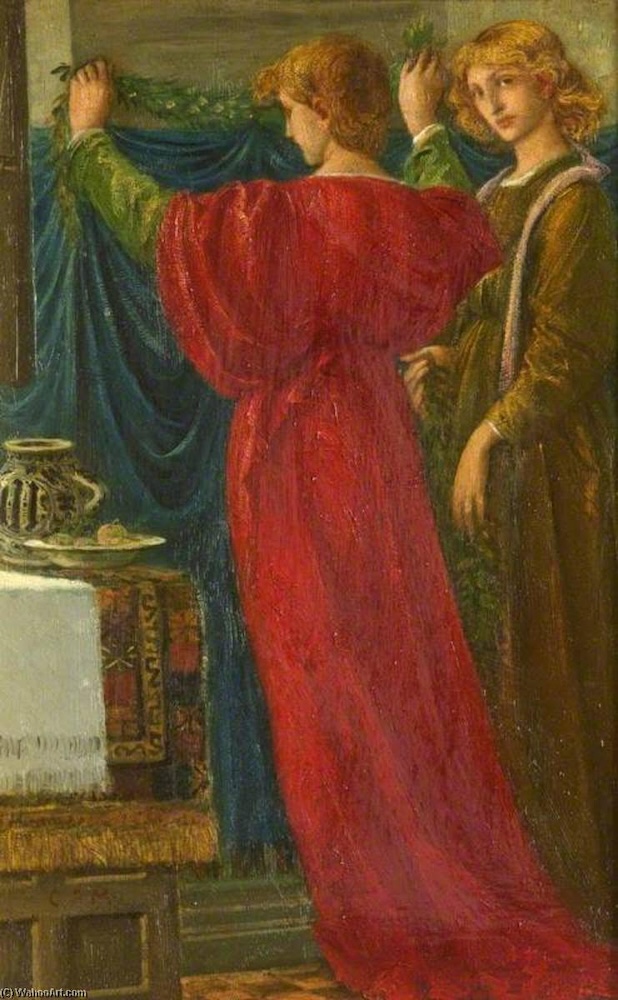
The Garland Makers, by Charles Fairfax Murray (1849-1919). c.1879 Oil on wood panel. Triptych. Left wing: 11 13/16 x 7 1/2 inches (30 x 19 cm); central panel: 11 13/16 x 18 7/8 inches (30 x 48 cm); Right wing: 11 13/16 x 7 1/2 inches (30 x 19 cm). Collection of Tyntesfield, Wraxhall, Bristol, North Somerset, National Trust, accession no. NT 13753. Image courtesy of Tyntesfield, National Trust, reproduced via Art UK for purposes of non-commercial academic research.
Murray painted this triptych in Italy in the late summer of 1878 and exhibited it the following year at the Grosvenor Gallery, no. 38. The Grosvenor Gallery was in the vanguard of exhibiting Aesthetic Movement art, making this a highly appropriate venue to show this painting. The composition of this triptych features young female garland makers gathering flowers and leaves which they fashion into wreaths that can either be worn on the head or hung as a decoration. In Giovanni Boccaccio's The Decameron the seven young women escaping the plague in Florence by staying at a villa outside the city spend part of their leisure hours gathering flowers to make into garlands. This was obviously a popular pastime for upper-class women in the Renaissance.
In the central largest panel are two young women gathering flowers. The standing figure in the blue dress looks down at the flowers held in the folds of her gown. A seated maiden in a red dress has flowers in her lap and has fashioned a wreath which hangs around her right wrist while she points to the flowers held in her companion's dress. They are situated in a walled garden with trees to the right and left of the composition. In the distant background is a large villa made of stone characteristic of the architecture of rural Tuscany. In 1878 Murray and his family were living in Sienna. The left-hand panel again shows two young women in a walled garden. A standing figure in a red dress and blue mantle holds a wicker basket on her right arm and looks down on her companion. The other damsel wears a dark orange dress and is kneeling on the ground. She has obviously been gathering pink flowers, likely roses, which are seen in her basket in the lower right. In the background are trees and a water tower spouting water. The right-hand panel is an indoor scene showing two young women standing. One is in a red dress with green sleeves looking away from the viewers and occupied in hanging a garland on the wall. The second figure wears an olive-green dress with a square collar and is turned looking towards the observers. She holds another garland in her hands.
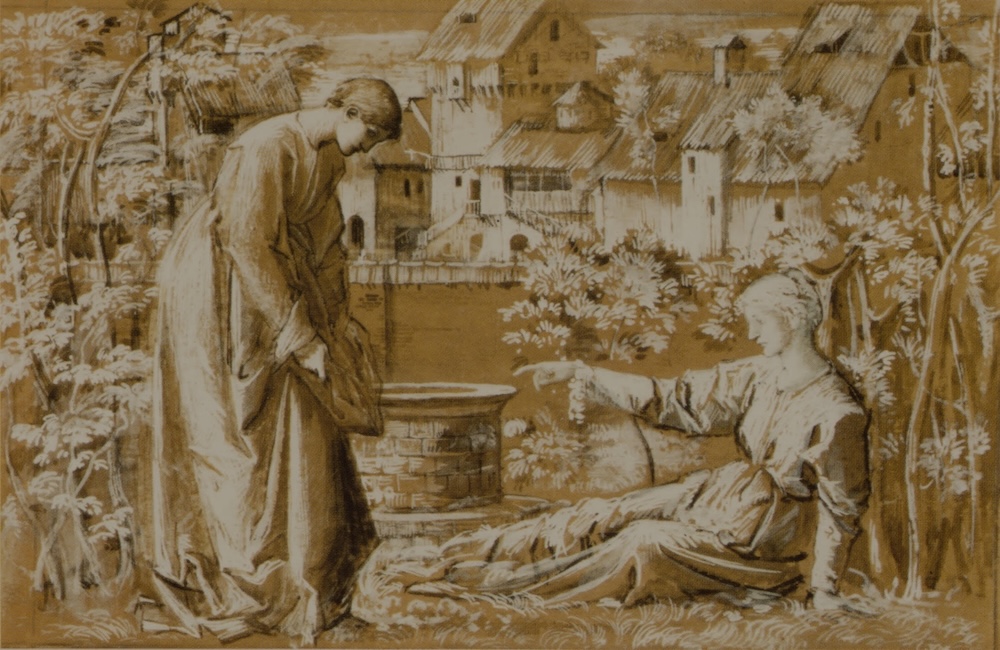
Study for The Garland Makers. Watercolour and white gouache on brown paper; 12 x 8 ½ inches (30.4 X 21.5 cm). Private collection. Image courtesy of the author.
A brown monochrome watercolour study heightened with white gouache, said to be for The Kings' Daughters but obviously for this painting instead, was offered for sale at the Shepherd Gallery in New York in 1994. It had previously been for sale at the Maas Gallery in London. An even earlier preliminary drawing for the central panel was offered for sale at Bourne End Auction Rooms, Buckinghamshire, on 6 October 2021, lot 168.
Contemporary Reviews
Murray's triptych received little recognition when it was shown at the Grosvenor Gallery. A critic for The Illustrated London News merely noted the influence of Venetian Renaissance painting: "Garland Makers (38), by C. Fairfax Murray in servile imitation of Venetian colouring" (567). The most laudatory and extensive review came from Harry Quilter in The Spectator who praised the colouring:
... turn to Nos. 38 and 39, by G.[sic] Fairfax Murray. These are two very small pictures, one of them in three divisions, called Garland-makers, and A Pastoral. There is rather a peculiar point to be noticed about them, first of all, - and that is, that though very much smaller in size than any of the pictures to right and left, yet if the visitor to the Gallery will take the trouble to cross the room and let his eyes rove along the wall from end to end, he will find that his attention is infallibly arrested by these little works, and that each blazes, as it were, like a jewel amongst the varying hues of the other pictures. He will be puzzled, perhaps, to account for this, as the works around are by no means deficient in brightness of colouring…. On a closer examination, however, of Mr. Murray's compositions, it becomes evident that the strength of his colouring is wholly dependent upon the study of the earlier Italian masters, - a study which is by no means to be confounded with a slavish imitation. Give five minutes to each of these works, allowing the first feeling of repulsion to subside, and we think it will be found that with every increasing time that you see them, their beauty will increase upon you. This is colour. Herkomer's [Hubert Herkomer] was not; this, though deficient in many respects in the drawing, is "painting,"" - that is, the art of using a brush has been here mastered. You may walk around the whole of this gallery till you come to the work of Burne Jones, and you will not see a single picture in which the knowledge of pure colour is shown, as it is in these two works. There can hardly be called any subject in either; they are simply beautiful figures, arranged beautifully, and as such, satisfying. Had they been of greater size, the comparative slightness of the drawing and the lack of interest would have taken away much of their merit. As it is, we are content, in the same way as we are content with the lustre of a ruby, only that the delight which can be gained by pure colour, exquisitely gradated and combined, is far above rubies. [691-92]
This painting was even reviewed by Oscar Wilde in the Irish daily News who contrasted it to the work of J.M. Strudwick:
Mr. Strudwick sends a picture of Isabella, which realises in some measure the pathos of Keats's poem, and another of the lover in the lily garden from the Song of Solomon, both works full of delicacy of design and refinement of detail, yet essentially weak in colour, and in comparison with the splendid Giorgione-like work of Mr. Fairfax Murray, are more like the coloured drawings of the modern German school than what we properly call a painting. The last-named artist, while essentially weak in draughtsmanship, yet possesses the higher quality of noble colour in the fullest degree. The draped figures of men and women in his Garland Makers, and Pastoral, some wrought in that single note of colour which the earlier Florentines loved, others with all the varied richness and glow of the Venetian school, show what great results may be brought about by a youth spent in Italian cities.
Although many critics felt Murray was just an imitator of Venetian Renaissance painting, Percy Bate had a high opinion of Murray's work as an artist: "The painter is by no means an imitator, but an artist of great original power; and since poetic inspiration and accomplished presentation, such as mark his work, can ill be spared, it is justly a matter of great regret to his sympathisers that artistic pursuits of another kind should have precluded Fairfax Murray from practicing his craft to the full" (109).
Bibliography
19th & 20th Century Design Followed by Antiques, Fine Art & Collectables. Bourne End: Bourne End Auction Rooms (6 October 2021), lot 168.
Bate, Percy. The English Pre-Raphaelite Painters Their Associates and Successors. London: George Bell & Sons, 1905.
Blackburn, Henry. Grosvenor Notes. London: Chatto & Windus (May 1879): cat. 38, 18.
Elliott, David B. Charles Fairfax Murray. The Unknown Pre-Raphaelite. Lewes, Sussex: The Book Guild Ltd., 2000. 75 & 115.
English Romantic Art 1840-1920. New York: Shepherd Gallery (Autumn 1994): cat. 98.
The Garland Makers. Art UK. Web. 14 February 2026.
"The Grosvenor Gallery." The Illustrated London News. LXXIV (14 June 1879): 567.
Maas, Rupert. John Ruskin and his Circle. London: Maas Gallery 1991, cat. 96, 54.
Quilter, Harry. "Art. The Grosvenor Gallery." The Spectator. LII (31 May 1879): 690-92.
Wilde, Oscar. "The Grosvenor Gallery." Irish Daily News (5 May 1879).
Created 14 February 2026