
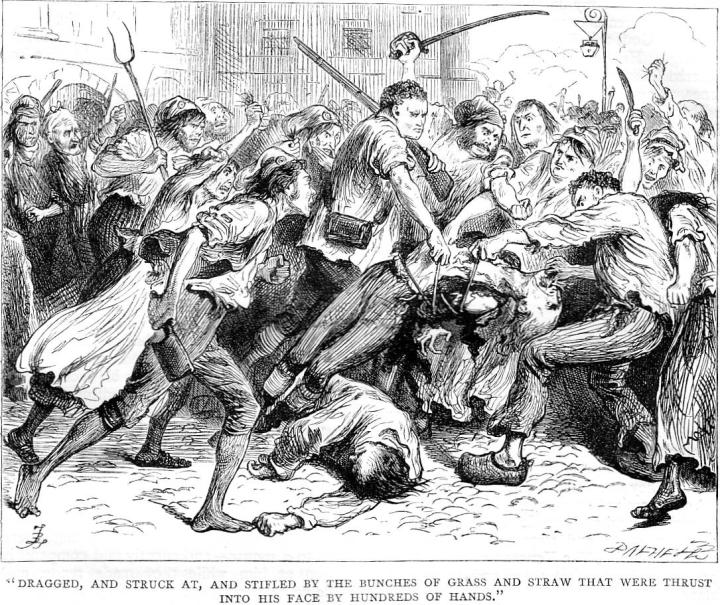
The fifteenth of Fred Barnard's twenty-five composite woodblock engravings in the eighth volume of the Household Edition of the Works of Charles Dickens: A Tale of Two Cities (1874), Book the Second, "The Golden Thread," Chapter XXII, "The Sea Still Rises": Dragged, and struck at, and stifled by the bunches of grass and straw that were thrust into his face by hundreds of hands. 4 ¼ inches high by 5 ½ inches wide (10.8 cm by 13.8 cm), framed. [Click on the illustration to enlarge it.]
Commentary: The Death of Foulon de Doué at the Hands of the Mob
Barnard follows up the tranquil interior scene between the Dr. Manette and Jarvis Lorry, which dramatised a psychological conflict, with a violent mob scene that Dickens based on actual historical events that occurred in the early stages of the French Revolution — namely the mob's attacking an official named Foulon de Doué at the Hotel de Ville, Paris, and subsequently hanging him at the Place de Grève on 22 July 1789. Probably having had access to Jean-Louis Prieur's famous graphic rendering of the event or of another that depicts the execution of Bertier de Sauvigny at the same location later that same day, Barnard has achieved a dynamic realisation of Dickens's account of revolutionary violence that is all the more interesting in that it invites the reader to compare the Household Edition's handling of his material and that of Phiz in the original serial sequence's in "The Sea Rises" (see below) in Dickens's A Tale of Two Cities, Book the Second, "The Golden Thread," Chapter XXII, "The Sea Still Rises," the October 1859 monthly number.
Although he was probably not acquainted with John McLenan's headnote vignette for "The Sea Still Rises" (see below) in Harper's Weekly (10 September 1859), Barnard has certainly responded effectively to the Phiz illustration bearing the same title, which appeared in the twenty-second chapter of the second book in the serial sequence. The textual moment realised in "The Sea Still Rises" occurs immediately prior to the picture of revolutionary mob violence in the Household Edition:
At length the sun rose so high that it struck a kindly ray, as of hope or protection, directly down upon the old prisoner's head. The favour was too much to bear; in an instant the barrier of dust and chaff, that had stood surprisingly long, went to the winds, and Saint Antoine had got him!
It was known directly, to the furthest confines of the crowd. Defarge had but sprung over a railing and a table, and folded the miserable wretch in a deadly embrace — Madame Defarge had but followed and turned her hand in one of the ropes with which he was tied — The Vengeance and Jacques Three were not yet up with them, and the men at the windows had not yet swooped into the Hall, like birds of prey from their high perches — when the cry seemed to go up, all over the city, "Bring him out! Bring him to the lamp!"
Down, and up, and head foremost on the steps of the building; now, on his knees; now, on his feet; now, on his back; dragged, and struck at, and stifled by the bunches of grass and straw that were thrust into face by hundreds of hands; torn, bruised, panting, bleeding, yet always entreating and beseeching for mercy. . . . [103]
With such vigorous writing in the historic present, which the vivid illustrations of Phiz and Barnard complement so well, it is no wonder that some modern readers believe that A Tale of Two Cities provides an accurate account of events leading up to the French Revolution — and that Madame Defarge and her publican husband are historical figures rather than purely literary inventions. Dickens describes her in the midst of the action, playing with the hapless Foulon "as a cat might have done to a mouse" (103) while her compatriots from Saint Antoine revile him, and continue to stuff his mouth with grass. According to such historians of the period as Charles Knight (1857), the group that abducted and hanged Foulon from a lamp standard near the city hall were peasants from Vitry, near Fontainebleau where Foulon had fled after the fall of the Bastille on July 14 — but why spoil a good story? Dickens expropriated and assimilated "The Murder of Foulon and Berthier" in the fashion of such historical novelists as Sir Walter Scott, having the urban unemployed of Saint Antoine rather than agricultural workers from south of the metropolis punish Foulon for his hubris: "Foulon . . . has been denounced as a speculator in famine — one who said the poor should eat grass if they could not get bread" (Knight, 175). Other sources give "hay," so that Dickens's text refers to both forms of animal fodder.
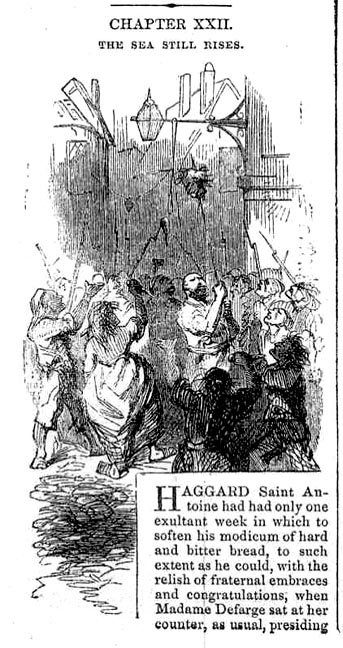
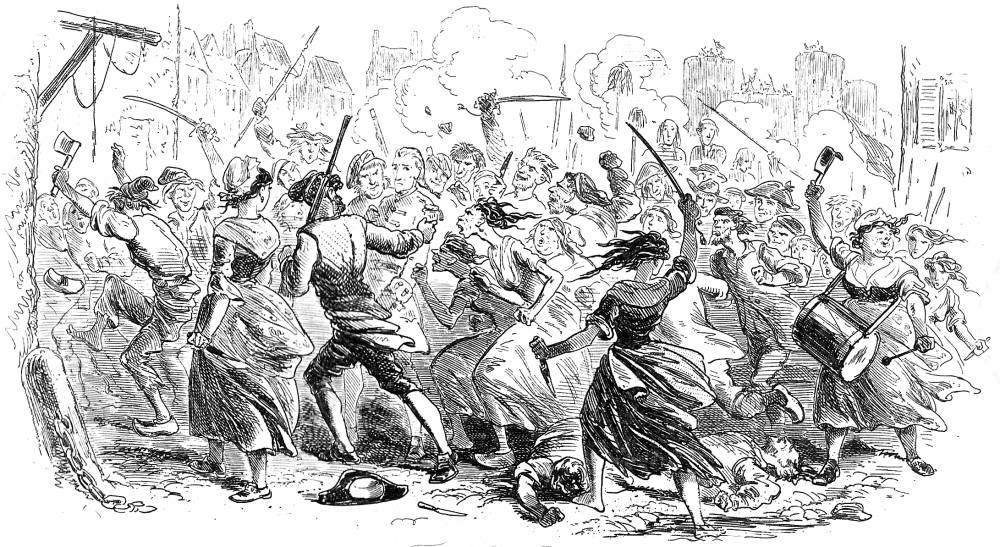
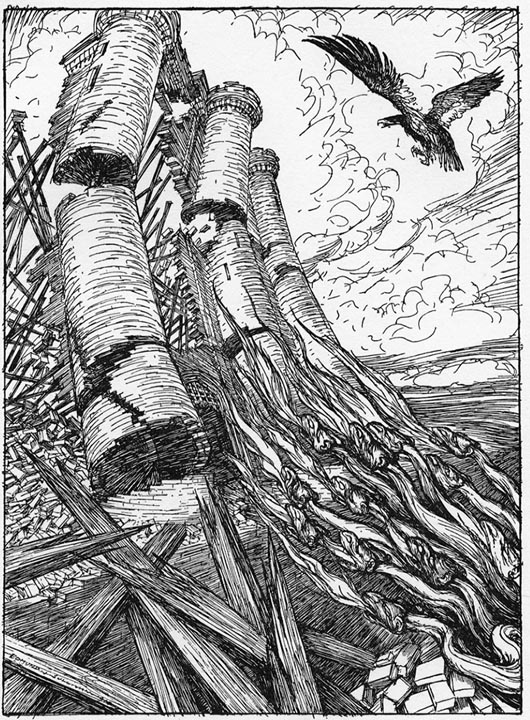
Three illustrations depicting volence during the Frech Revolution. From left to right: (1) John McLenan's headnote vignette depicting The Sea still rises. (2) The Sea Rises by Phiz. (3) The Fall of the Bastille by E. J. Sullivan (1910).
Using his imagination to realise the violent moment from history and literature, Barnard has wooden-shod peasants and urban proletarians with slippers and even bare feet truss up Foulon, in preparation for hoisting him up on the lamp post (right rear, opposite the Hotel de Ville), the Jacobin cap and revolutionary cockade being historical artifacts that Barnard repeats throughout the scene to lend it verisimilitude. One of the guards who had lately had custody of Foulon lies beneath his feet, presumably struck down by the meat-cleaver wielded by the gaunt, muscular Jacobin (left). Although he has incorporated a number of female heads and limbs among the "forest of legs," curiously Barnard has not included the recognisable figures of Defarge and his wife. Shortly, as in McLenan's headnote vignette, the mob will severe Foulon's head and parade it through the streets on a pike. Whereas in Phiz's The Sea Rises Foulon in military uniform is still standing, the centre of verbal abuse which the harridans of Saint Antoine hurl at him, in Barnard he has been swept off his feet and is barely recognisable as the uniformed official of Phiz's earlier illustration. Whereas Phiz gives us a sea of figures waving swords aloft and clearly shows the Bastille in the background, Barnard focuses on the foreground, giving us fewer but more solid figures in contrast to the October 1859 illustration. Muting the violence somewhat as he emphasises the release of pent-up energy in the swirling mass of Saint Antoine women, Phiz has placed several bodies lying on the pavement, but these do not arrest our attention as does the single corpse at the centre of Barnard's composition. Dickens and his illustrators seem to have been far more sympathetic to the universally disliked Joseph-Francois Foullon de Doué (1715-1789) than was Dickens's source, Thomas Carlyle, who in The French Revolution: A History (3 vols., Chapman & Hall, 1837) vilified the finance official who briefly replaced the corrupt royal minister Jacques Necker as a venial military profiteer who reaped what he sowed.
Other Illustrated Editions (1859-1910)
- Hablot K. Brown or 'Phiz' (16 illustrations, 1859)
- John McLenan (63 illustrations, 1859)
- Sol Eytinge, Junior (8 illustrations, 1867)
- A. A. Dixon (12 illustrations, 1905)
- Harry Furniss (32 illustrations, 1910)
Related Material
- John McLenan's Thirty-One Headnote Vignettes for A Tale of Two Cities in Harper's Weekly (7 May — 3 December 1859)
- Hablot Knight Browne's (Phiz's) Monthly Serial Illustrations (June-December 1859)
- McLenan's and Phiz's Illustrations for
A Tale of Two Cities (1859): A Correspondence?
- Images of the French Revolution from Various Editions of A Tale of Two Cities (1859-1910)
Scanned image by Philip V. Allingham; text by PVA and George P. Landow. [You may use this image without prior permission for any scholarly or educational purpose as long as you (1) credit the person who scanned the image and (2) link your document to this URL in a web document or cite the Victorian Web in a print one.]
Bibliography
Allingham, Philip V. "Charles Dickens's A Tale of Two Cities (1859) Illustrated: A Critical Reassessment of Hablot Knight Browne's Accompanying Plates." Dickens Studies. 33 (2003): 109-158.

Dickens, Charles. A Tale of Two Cities. illustrated by Phiz. London: Chapman & Hall, 1859.
Dickens, Charles. A Tale of Two Cities. Illustrated by Fred Barnard. The Household Edition. Vol. VIII. London: Chapman & Hall, 1874.
Dickens, Charles. A Tale of Two Cities. Illustrated by John McLenan. Harper's Weekly. Tenth instalment (2 July 1859): 405.
"Foulon, Joseph de Doué." Wikipedia. Accessed 28 February 2011. http://en.wikipedia.org/wiki/Joseph_de_Doue.
Guiliano, Edward, and Philip Collins. The Annotated Dickens. 2 vols. New York: Clarkson N. Potter, 1986.
Knight, Charles. The Popular History of England. Vol. VII. London: Chapman and Hall, 1857.
Sanders, Andrew. A Companion to "A Tale of Two Cities." The Dickens Companion Series, Vol. 4. London: Unwin Hyman, 1988.
Vann, J. Don. "A Tale of Two Cities in All the Year Round, 30 April — 26 November 1859." Victorian Novels in Serial. New York: The Modern Language Association, 1985. Pp. 71-72.
Created 22 February 2011
Last modified 1 December 2025