
Introduction
Early in 1859, Charles Dickens was concerned not only with the social problems of England — indeed, he had been concerned with them ever since he embarked upon a career as a professional writer and journalist in the 1830s — but also with his own problems as a partner in a new publishing enterprise, All the Year Round, his weekly journal in the same double-columned format (and available at the same price) as Household Words (1850-59). This valuable property, All the Year Round. A Weekly Journal. Conducted by Charles Dickens. With which is Incorporated Household Words, he was determined to defend vigorously in the marketplace by serialising new fiction, beginning with his own historical novel A Tale of Two Cities, derived in part from Thomas Carlyle's description in The French Revolution (1837, revised 1857) on the chief events and personalities associated with that social upheaval.
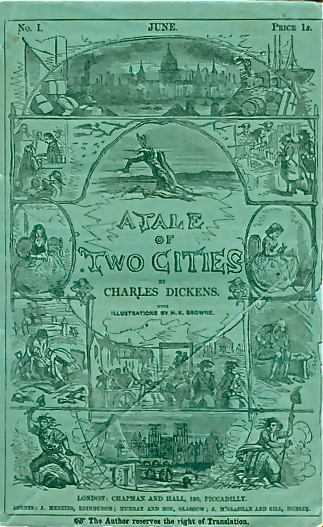
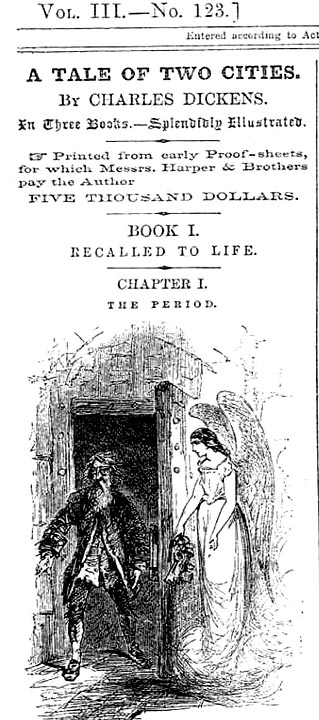
In publishing A Tale of Two Cities in three distinct serial formats prior to volume publication in November 1859 in London, Charles Dickens adopted the novel approach of simultaneous weekly and monthly serialisation: in weekly but unillustrated instalments in All the Year Round, in the weekly illustrated instalments from All the Year Round proofs that he forwarded directly to Henry Harper in New York, and in monthly parts, illustrated by his regular visual collaborator, Hablot Knight Browne. Although undoubtedly Dickens played no part in John MacLenan's weekly illustrations for readers on the other side of the Atlantic, his detailed sequence of medium- and small-sized wood-engravings dropped into the letter-press constitutes the first independently produced narrative-pictorial sequence for the novel (7 May through 3 December 1859).
Over the course of the next fifty years there were to be other illustrated editions: by Sol Eytinge, Junior, for the Diamond Edition (1868), by Fred Barnard in the Household Edition (1874), by A. A. Dixon for the Collins Pocket Edition (1905), and by Harry Furniss for Volume 13 in the Charles Dickens Library Edition (1910). Clearly, as one may judge from the eighteenth-century costuming of the characters in these realisations, the illustrators had not merely read and re-read Dickens; they had also scrupulously researched the clothing and fashions of the period, often contrasting the styles of the 1770s with the later fashions of the 1790s. Moreover, through their choice of subjects, these illustrators convey nineteenth-century British and American attitudes towards the French Revolution, not as a necessary and even beneficial societal revitalisation, but as a chaotic and turbulent period of mass bloodletting not to be revisited.
The First British Edition: Phiz or Hablot Knight Browne (1859)
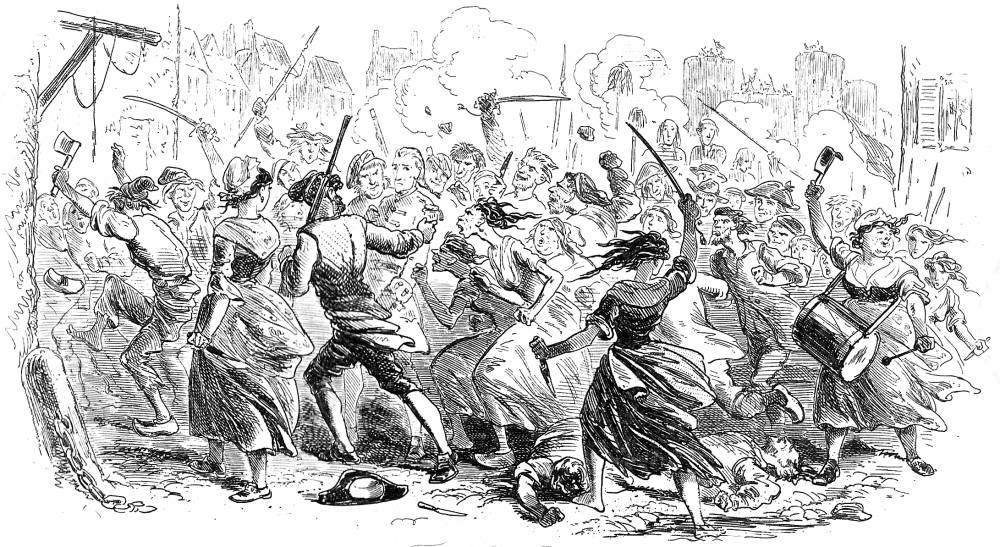
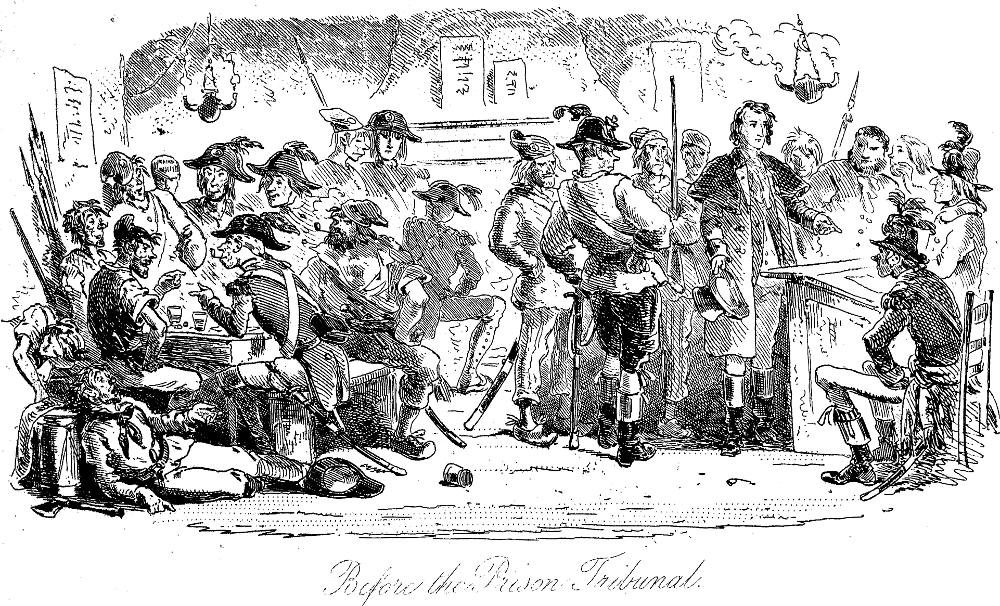
Two of the original monthly steel engravings by Phiz for Dickens's A Tale of Two Cities (a) The Sea Rises. (b) Before the Prison Tribunal. The death of Joseph Foulon de Doué at the hands of the Parisian mob (led by the Defarges in Dickens's novel) occurred on 22 July 1789, or about three weeks after the fall of the Bastille, under demolition on the skyline in Phiz's illustration. [Click on these images for larger pictures.]
In collaboration with the author, Phiz selected for the monthly illustrations scenes that reveal not only the progress of the principal characters, but also of the Revolution itself, from the plotting of the Jacobins at the wine-shop in Saint Antoine, not far from the Bastille, to the mob's seizing and hanging the royalist finance minister Foulon in The Sea Rises (October 1859) and the arbitrary arrest and imprisonment of returning emigrés such as Charles Darnay, the "heretofore Marquis de St. Evrémonde," in Before the Prison Tribunal (November 1859). Phiz, however, does not depict any of the grisly scenes that so disgusted the British public, the public beheadings of thousands of aristocrats during the Reign of Terror, September 1793 through the end of July 1794.
The First American Edition: John McLenan (1859)
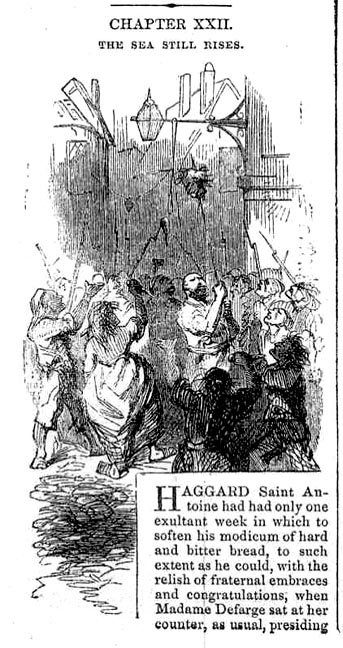
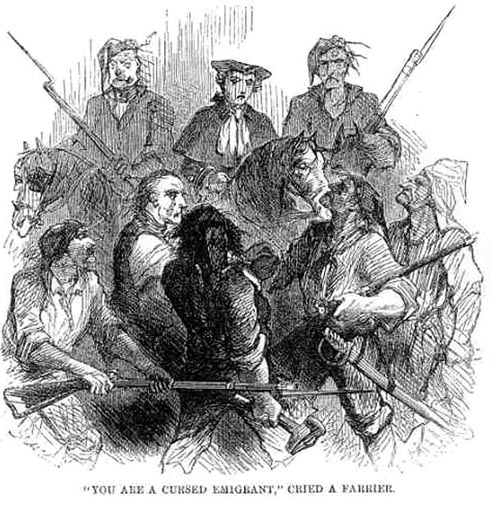
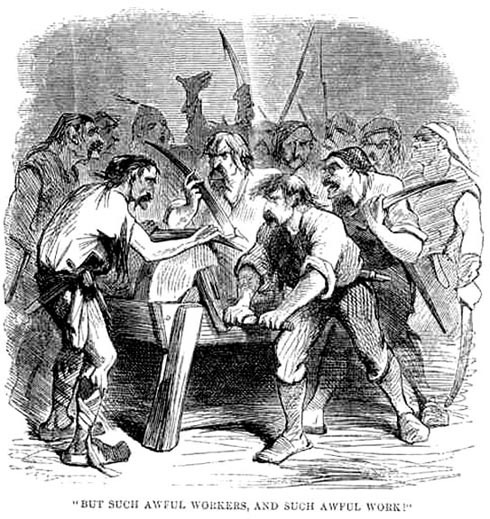
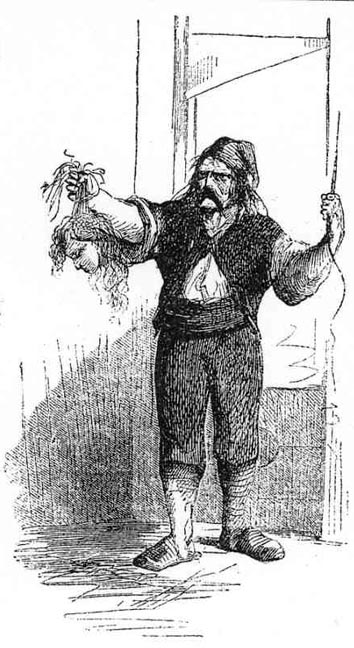
Illustrations by John McLenan in Harper's Weekly: A Journal of Civilization (1859) for Dickens's A Tale of Two Cities: (a) Headnote Vignette for Book II, Chapter 22: The Sea still Rises. (b) "You are a cursed emigrant," cried a farrier. (c) "But such awful workers, and such awful work!" (d) "Headnote vignette for Book III, Chapter 14, The Knitting Done. Some of these composite woodblock engravings, such as the parading of the severed head of Foulon through the narrow streets of Saint Antoine (in the 10 September 1859 number) suggest, that MacLenan attempted to research the historical facts that lie behind Dickens's romance of self-sacrifice. [Click on these images for larger pictures.]
The Second American Edition: Sol Eytinge, Junior (1867)
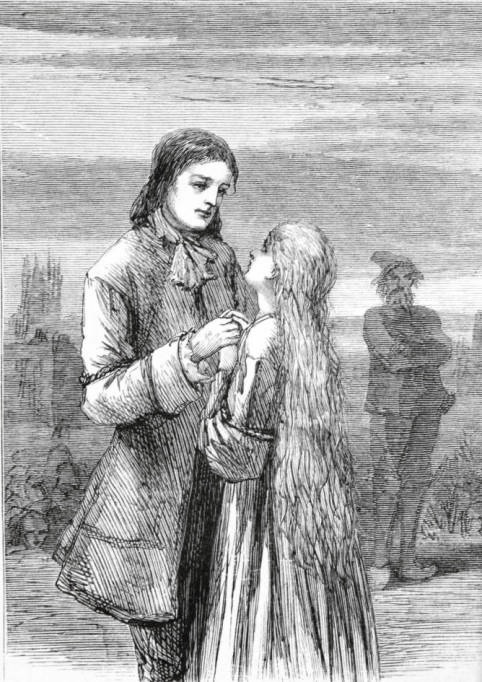
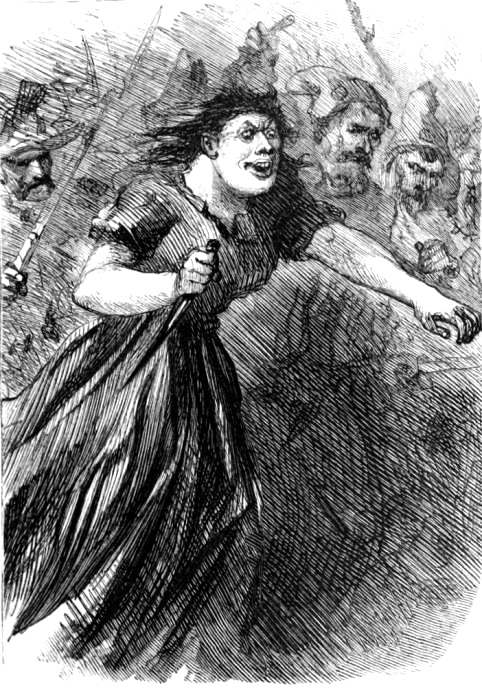
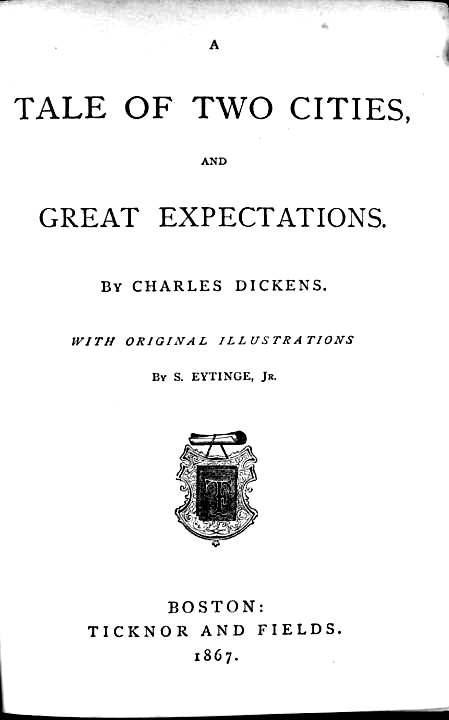
Two llustrations by Sol Eytinge, Junior, for Dickens's A Tale of Two Cities in the Diamond Edition (1868): (a) Frontispiece: Sydney Carton and The Seamstress. (b) The Vengeance. [Click on these images for larger pictures.]
The Second British Edition: Fred Barnard (1874)
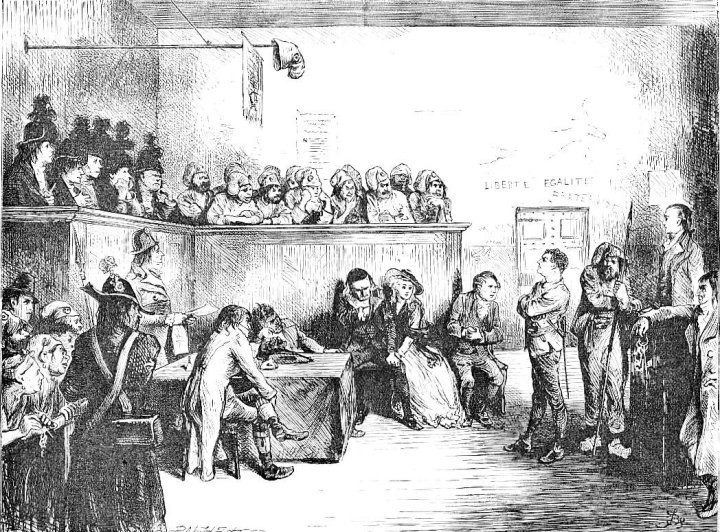
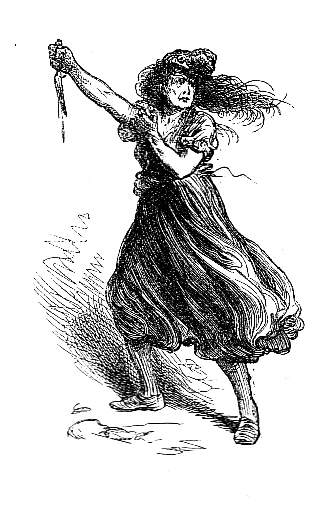
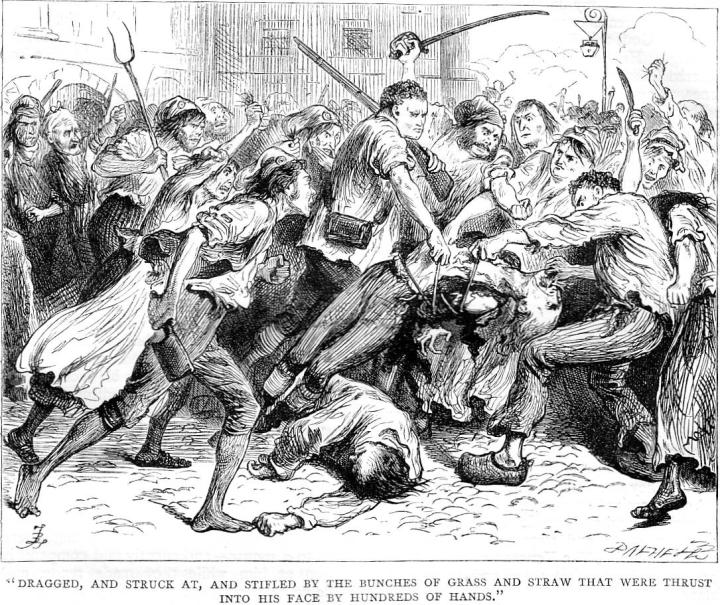
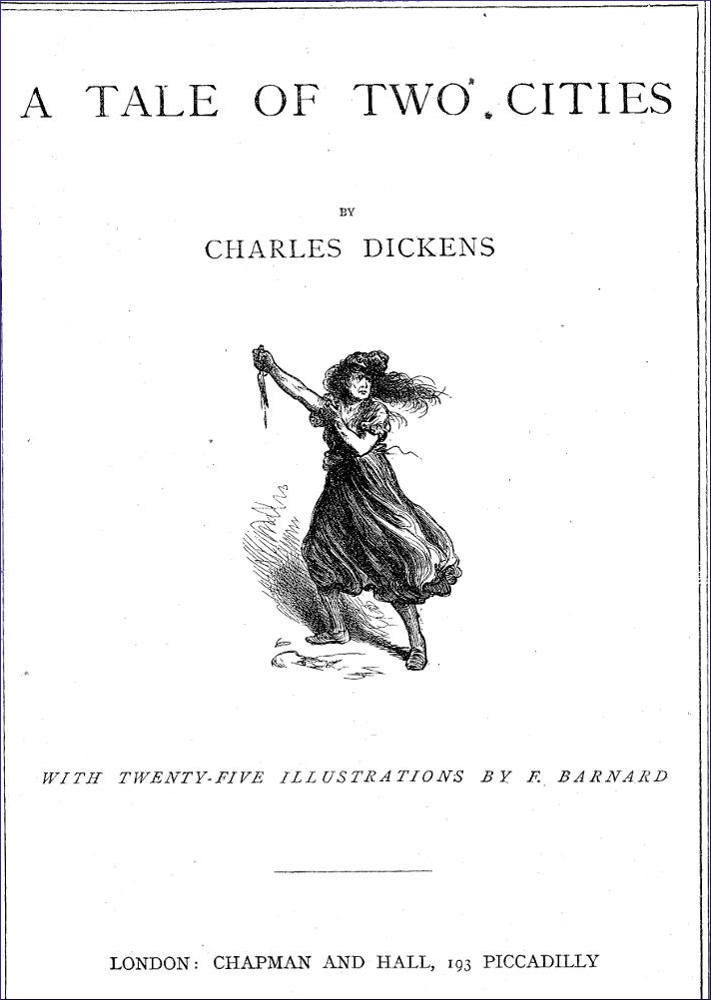
Six of the twenty-four Household Edition illustrations by Fred Barnard for Dickens's A Tale of Two Cities (1874): (a) Frontispiece: The Trial of Evrémonde. (b) Title-page vignette: The figure of a female Jacobin, holding up a blood-dripping dagger. (c) Dragged, and struck at, and stifled [The Death of Foulon].
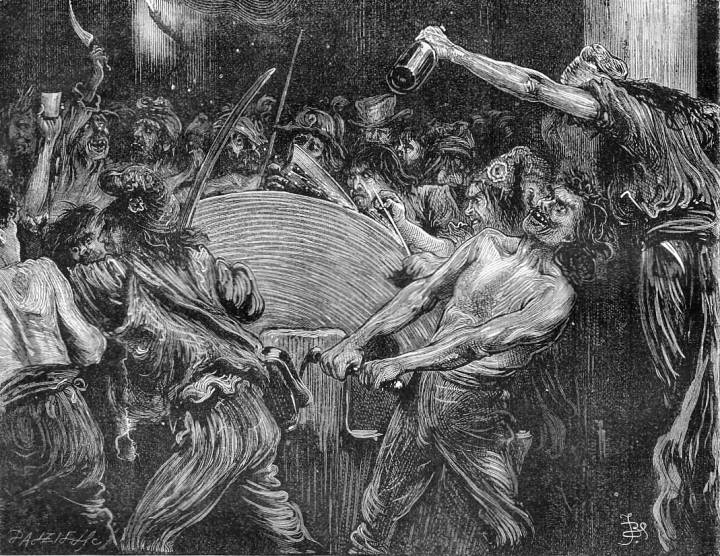
(d) The Grindstone
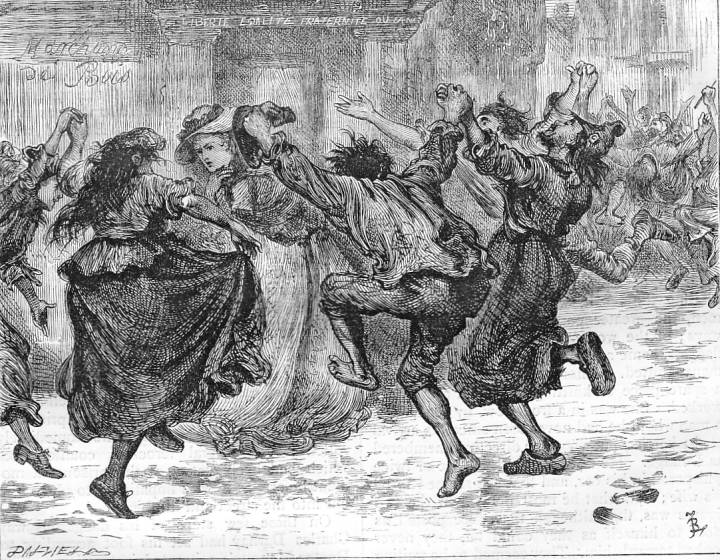
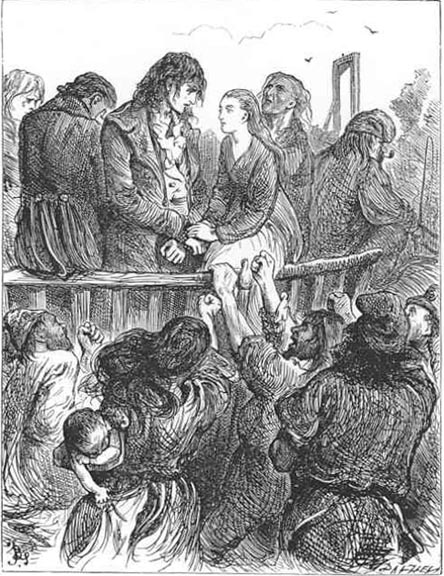
(e) The Carmagnole; and (f) The Third Tumbrel.
Given a lengthier program of illustration (and larger plates) than that for the original monthly serialisation, Fred Barnard — already intimately familiar with the novel in a way that Phiz, working from instalment to instalment, could not be, despite his having had access to Dickens's advice — had the opportunity to realise some of the more sensational scenes of mob violence that Phiz in 1859 had elected not to show. In particular, Barnard realizes Carton's journey to the scaffold erected at the present Place de la Concorde, at the time of the action then known as Place de la Révolution, where many of the victims of the Terror met their deaths on the platform of the guillotine. [Click on these images for larger pictures.]
A. A. Dixon (1905)
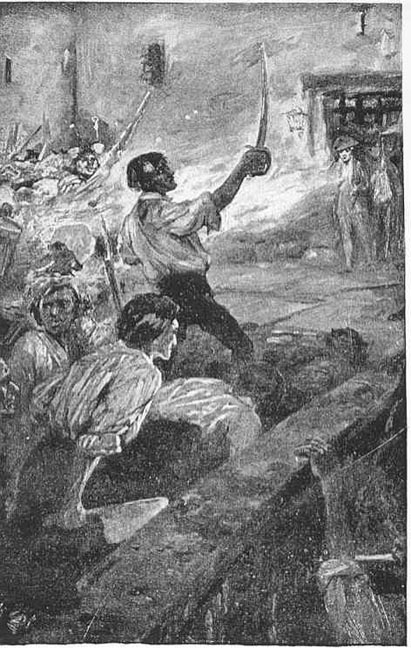
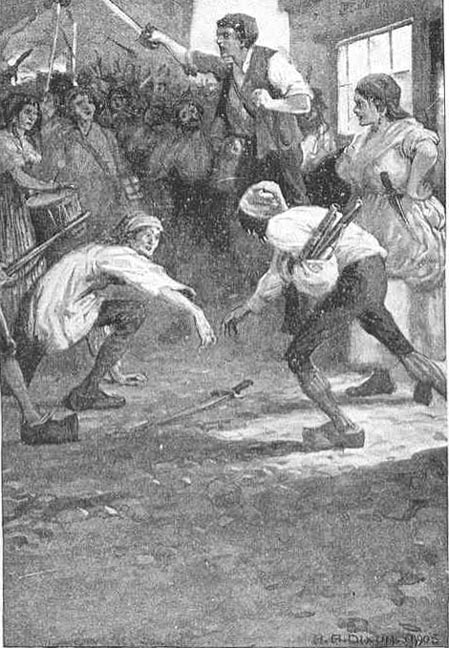
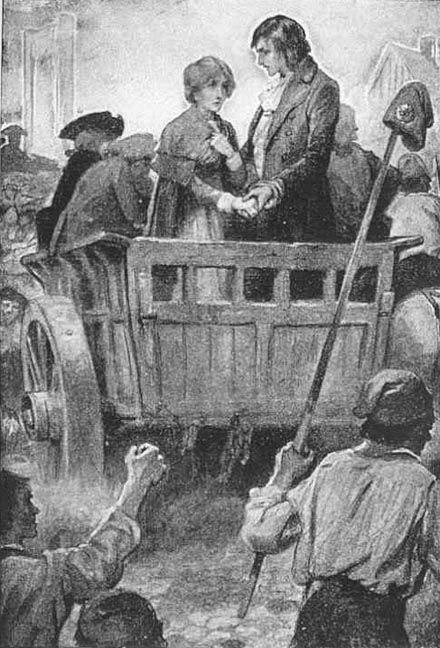
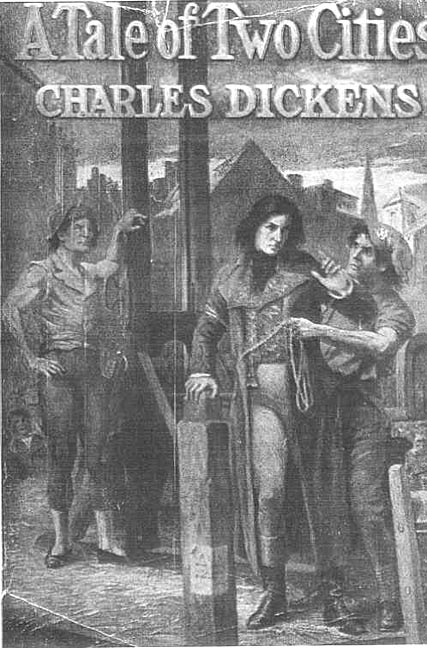
Illustrations by A. A. Dixon of Dickens's A Tale of Two Cities: (a) The Front Wrapper: The Execution of Sydney Carton; (b) The Surrender of the Bastille; (c) Patriots and friends, we are ready?; (d) To the guillotine, all aristocrats!. The little book intended for schoolboy consumption sensationalises the historical subject matter, dwelling on lurid scenes of mob violence and execution, but omitting altogether some of the novel's significant characters such as Jerry Cruncher. [Click on these images for larger pictures.]
Harry Furniss (1910)
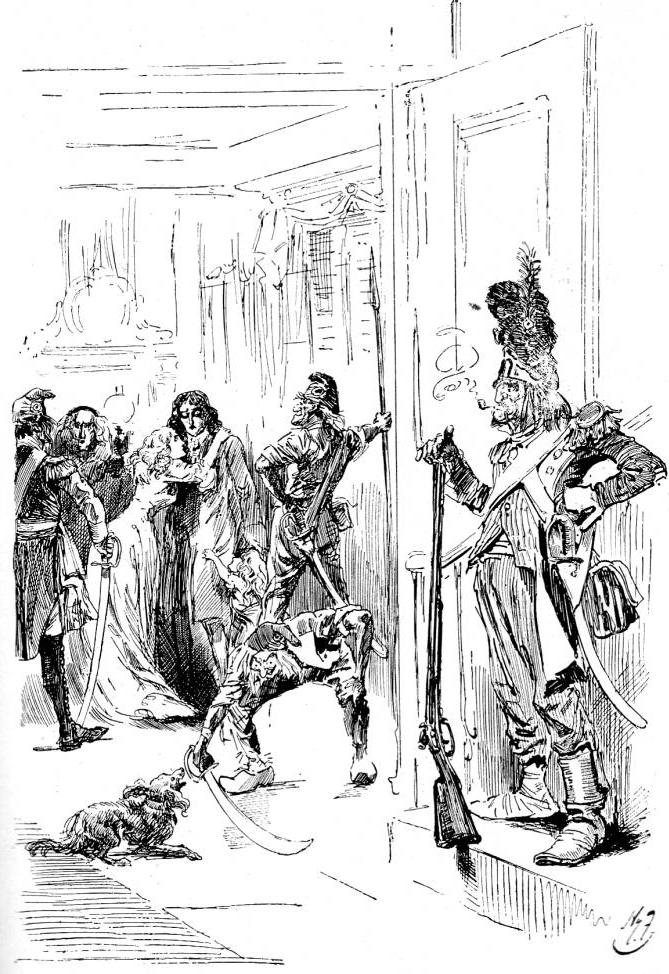
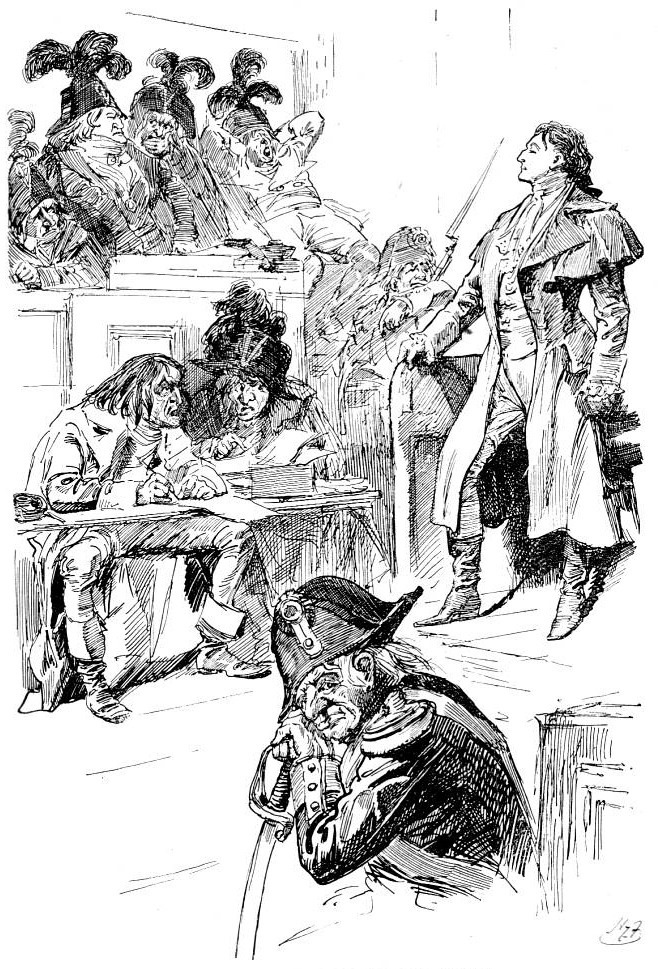
Four illustrations by Harry Furniss of Dickens's A Tale of Two Cities: (a) A Knock at the Door; (b) Darnay arraigned before the judges. [Click on these images for larger pictures.]
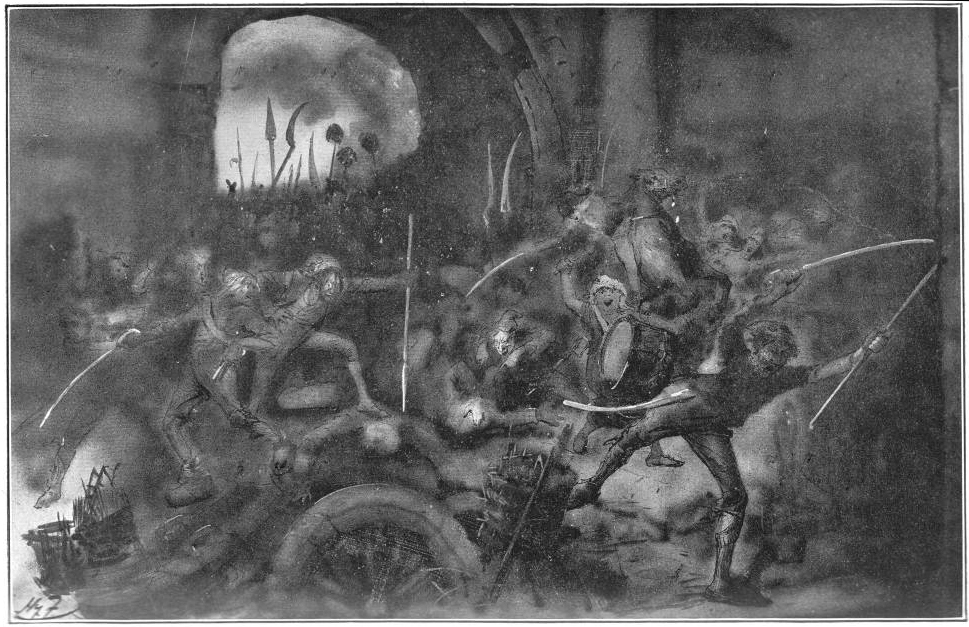
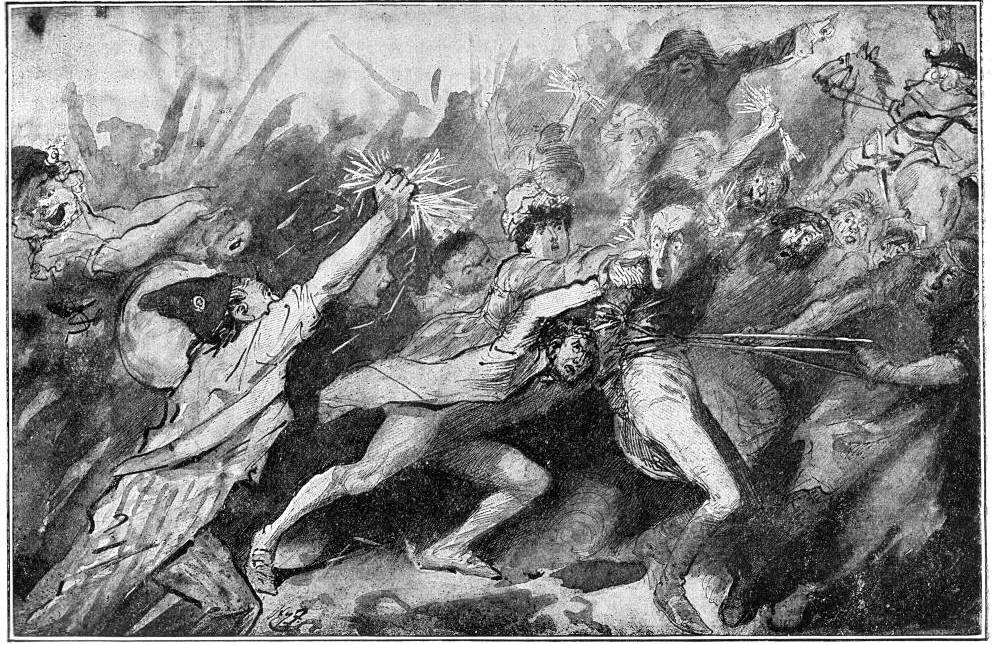
(c) The Fall of the Bastille; and (d) The End of Foulon. [Click on these images for larger pictures.]
In these historical scenes, Furniss uses an an ink-wash to suggest the distance in time from which readers of the Charles Dickens Library Edition are viewing these historical events reflected in the novel. The recurring character in these illustrations is The Vengeance, a grocer's wife from Saint Antoine who marshalls the mob with a bass drum. Of the horrific incidents that occurred during the Reign of Terror of 1793-94, only the execution of Sydney Carton, disguised as Charles Darnay, is featured in most editions, although this climactic moment does not appear in Phiz's original sequence.
Scanned images and text by Philip V. Allingham. [You may use these images without prior permission for any scholarly or educational purpose as long as you (1) credit the photographer, and (2) link your document to this URL in a web document or cite the Victorian Web in a print one.]
Bibliography
Bentley, Nicolas, Michael Slater, and Nina Burgis. The Dickens Index. Oxford and New York: Oxford U. P., 1988.
Davis, Paul. Charles Dickens A to Z: The Essential Reference to His Life and Work. New York: Facts On File, 1998.
Dickens, Charles. The Letters of Charles Dickens. Ed. Madeline House, Graham Storey, and Kathleen Tillotson. Oxford: Clarendon, 1965. Vol. IX (1859-1861).
Dickens, Charles. A Tale of Two Cities. All the Year Round. 30 April through 26 November 1859.
Dickens, Charles. A Tale of Two Cities. Illustrated by John McLenan. Harper's Weekly: A Journal of Civilization. Vol. III, Nos. 123 through 164. 7 May through 3 December 1859.
Dickens, Charles. A Tale of Two Cities. Illustrated by Hablot Knight Browne. London: Chapman and Hall, 1859.
Dickens, Charles. A Tale of Two Cities and Great Expectations. Illustrated by Sol Eytinge, Jr. The Diamond Edition. 16 vols. Boston: Ticknor and Fields, 1867. Vol. XIII.
Dickens, Charles. A Tale of Two Cities. Illustrated by Fred Barnard. The Household Edition. 22 vols. London: Chapman and Hall, 1874. Vol. XIII.
Dickens, Charles. A Tale of Two Cities. Illustrated by A. A. Dixon. London: Collins, 1905.
Dickens, Charles. A Tale of Two Cities, American Notes, and Pictures from Italy. Illustrated by Harry Furniss. Charles Dickens Library Edition. 18 vols. London: Educational Book Co., 1910. Vol. XIII.
Sanders, Andrew. A Companion to "A Tale of Two Cities." London: Unwin Hyman, 1988.
Created 17 December 2013
Last updated 14 January 2026