
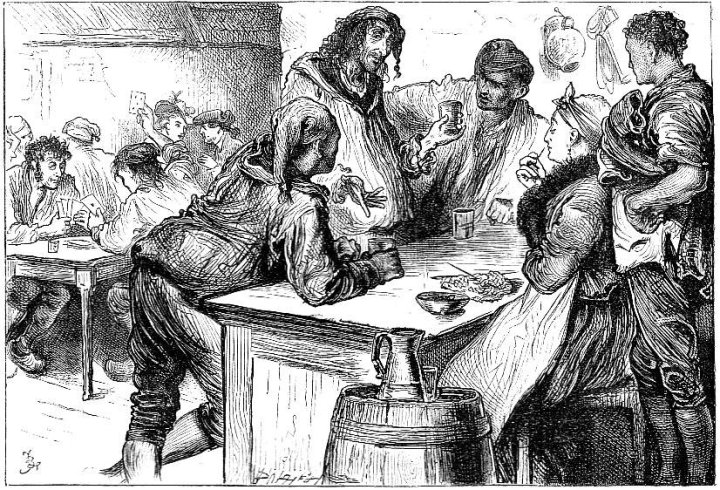
The Wine-Shop (p. 16) by Fred Barnard. 1874. 9.4 x 13.8 cm (3 inches ¾ by 5 ½ inches), framed. The picture of Gaspard, Madame de Farge, and her publican husband, Earnest, at the bar in their St. Antoine wine-shop establishes the context for the imminent arrival of Lucie Manette and Mr. Jarvis Lorry of Tellson's Bank, and more significantly sketches in the social and economic contexts in which the French Revolution will erupt in Dickens's A Tale of Two Cities, Book 1, chap. v, "The Wine-Shop," originally in the third weekly part (14 May 1859) in All the Year Round, and then in the June 1859 illustrated monthly number. [Click on the illustration to enlarge it.]
Passage Illustrated: The St. Antoine Jacques' Revolutionary Leaders.
This wine-shop keeper was a bull-necked, martial-looking man of thirty, and he should have been of a hot temperament, for, although it was a bitter day, he wore no coat, but carried one slung over his shoulder. His shirt-sleeves were rolled up, too, and his brown arms were bare to the elbows. Neither did he wear anything more on his head than his own crisply-curling short dark hair. He was a dark man altogether, with good eyes and a good bold breadth between them. Good-humoured looking on the whole, but implacable-looking, too; evidently a man of a strong resolution and a set purpose; a man not desirable to be met, rushing down a narrow pass with a gulf on either side, for nothing would turn the man.
Madame Defarge, his wife, sat in the shop behind the counter as he came in. Madame Defarge was a stout woman of about his own age, with a watchful eye that seldom seemed to look at anything, a large hand heavily ringed, a steady face, strong features, and great composure of manner. There was a character about Madame Defarge, from which one might have predicated that she did not often make mistakes against herself in any of the reckonings over which she presided. [Book the First, "Recalled to Life," Chapter V, "The Wine-shop," 14]
Commentary: Saint Antoine's Wine-shop — A Breeding Ground for Revolution.
In Barnard's sequence of twenty-five composite woodblock engravings, the illustrator presents the Household Edition's reader with a contrast between the solid, middle-class — albeit old-fashioned — comfort of Dover's Royal George Hotel in the fourth chapter and this well-managed den of poverty and discontent in the fifth. The specific passage in "The Wine-Shop" that the illustration realises is this assessment of the astute publican, Madame Defarge:
Madame Defarge, being sensitive to the cold, was wrapped in fur, and had a quantity of bright shawl twined about her head, though not to the concealment of her large ear-rings. Her knitting was before her, but she laid it down to pick her teeth with a toothpick. Thus engaged, with her right elbow supported by her left hand, Madame Defarge said nothing when her lord came in, but coughed just one grain of cough. This, in combination with the lifting of her darkly-defined eyebrows over her toothpick by the breadth of a line, suggested to her husband that he would do well to look round the shop among the customers for any new customer who had dropped in while he stepped over the way. [14]
Thus, Barnard has chosen to re-examine a subject that his friend Hablot Knight Browne had chosen as his first subject in the fourth monthly number (September 1859), The Wine-Shop. However, Phiz had focused on the garret above the shop in which the Defarges were housing the former prisoner of the Bastille, Dr. Manette, at this point in the story, The Wine-Shop, which refers to events in the sixth chapter of the second book. Barnard conveys a stronger sense of the proletarian patrons of the establishment (left rear), and thus of the wine-shop as the social centre of poverty-stricken St. Antoine. With surer modelling than Phiz's, Barnard brings to life the meeting of the Jacquerie across the Defarges' bar, including even such details as Madame Defarge's fur collar and tooth-pick. The rough-and-tumble atmosphere of the place is immediately apparent through the male-dominated discourse and card-playing: Barnard shows nine men, but only two women. The large cask in the foreground recalls the scene at the opening of the chapter in which animalistic violence erupts in the street outside the shop when a such cask, being delivered, comes tumbling out of a cart and shatters.
John McLenan in the series for the American serialisation published in Harper's Weekly chose a rather more sensational moment for realisation as the headnote vignette for 21 May 1859 (325). Instead of the casual gossip among the Jacquerie inside Saint Antoine's community centre, McLenan depicts the riotous scene outside in the cobble stoned street when the wine cask is smashed as it falls off a cart. An impressionistic jumble of figures surrounds the gigantic cask, "on the stones just outside the door of the wine-shop, shattered like walnut shell" (325), enabling the reader of the weekly illustrated magazine to encounter the same moment simultaneously in two media.
Other Illustrated Editions (1859-1910)
- Hablot K. Brown or 'Phiz' (16 illustrations, 1859)
- Sol Eytinge, Junior (8 illustrations, 1867)
- John McLenan (63 illustrations, 1859)
- A. A. Dixon (12 illustrations, 1905)
- Harry Furniss (32 illustrations, 1910)
Related Material
- John McLenan's Thirty-One Headnote Vignettes for A Tale of Two Cities in Harper's Weekly (7 May — 3 December 1859)
- McLenan's and Phiz's Illustrations for
A Tale of Two Cities (1859): A Correspondence?
- Images of the French Revolution from Various Editions of A Tale of Two Cities (1859-1910)
- French Revolution
- "A Tale of Two Cities (1859): A Model of the Integration of History and Literature"
Scanned image, caption, and commentary by Philip V. Allingham. [You may use this image without prior permission for any scholarly or educational purpose, as long as you (1) credit the person who scanned the image, and (2) link your document to this URL in a web document or cite the Victorian Web in a print one.]
Bibliography
Allingham, Philip V. "Charles Dickens's A Tale of Two Cities (1859) Illustrated: A Critical Reassessment of Hablot Knight Browne's Accompanying Plates." Dickens Studies. 33 (2003): 109-158.

Davis, Paul. Charles Dickens A to Z: The Essential Reference to His Life and Work. New York: Checkmark and Facts On File, 1998.
Dickens, Charles. A Tale of Two Cities. Illustrated by Phiz. London: Chapman & Hall, 1859.
Dickens, Charles. A Tale of Two Cities. Illustrated by Fred Barnard. The Household Edition. London: Chapman & Hall, 1874.
Dickens, Charles. A Tale of Two Cities. Illustrated by John McLenan. Harper's Weekly. (21 May 1859): 325.
Dickens, Charles, and Fred Barnard. The Dickens Souvenir Book. London: Chapman & Hall, 1912.
Created 2 April 2017
Last updated 17 December 2025