

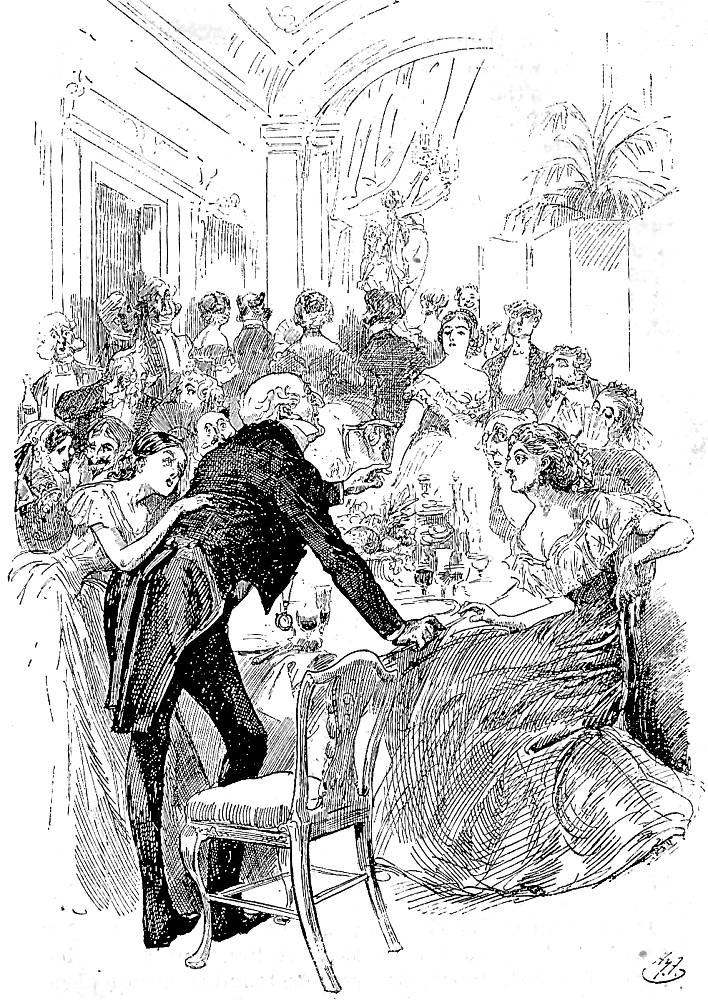
“Mr. Dorrit will forgive me.”
Arthur A. Dixon
1906
Lithographic reproduction of a watercolour
12.1 cm high by 8 cm wide (4 ⅞ by 3 ⅛ inches), framed.
Seventh illustration for Little Dorrit, Collins' Pocket Edition (1906), facing p. 651, referencing p. 650.
[Click on the image to enlarge it and mouse over text for links.]
Scanned image and text by Philip V. Allingham.

Passage Illustrated Rigaud has a rendezvous with Miss Wade and Tattycoram:
‘Mr. Dorrit,’ returned Mrs. General, ‘is ever but too obliging, ever but too appreciative. If there have been moments when I have imagined that Miss Dorrit has indeed resented the favourable opinion Mr. Dorrit has formed of my services, I have found, in that only too high opinion, my consolation and recompense.’
‘Opinion of your services, madam?’ said Mr. Dorrit.
‘Of,’ Mrs General repeated, in an elegantly impressive manner, ‘my services.’
‘Of your services alone, dear madam?’ said Mr Dorrit.
‘I presume,’ retorted Mrs General, in her former impressive manner, ‘of my services alone. For, to what else,’ said Mrs General, with a slightly interrogative action of her gloves, ‘could I impute ——’
‘To — ha — yourself, Mrs General. Ha, hum. To yourself and your merits,’ was Mr. Dorrit’s rejoinder.
‘Mr. Dorrit will pardon me,’ said Mrs General, ‘if I remark that this is not a time or place for the pursuit of the present conversation. Mr. Dorrit will excuse me if I remind him that Miss Dorrit is in the adjoining room, and is visible to myself while I utter her name. Mr. Dorrit will forgive me if I observe that I am agitated, and that I find there are moments when weaknesses I supposed myself to have subdued, return with redoubled power. Mr. Dorrit will allow me to withdraw.’
‘Hum. Perhaps we may resume this — ha — interesting conversation,’ said Mr. Dorrit, ‘at another time; unless it should be, what I hope it is not — hum — in any way disagreeable to — ah — Mrs General.’
‘Mr. Dorrit,’ said Mrs. General, casting down her eyes as she rose with a bend, ‘must ever claim my homage and obedience.’ [Book Two, “Riches,” Chapter XIX, “The Storming of the Castle in the Air,” pp. 650-651]
Commentary: The Designing Mrs. General — Companion, Chaperone, and Future Stepmother
Dickens has introduced the abrasively critical Mrs. General as Amy's fastidious chaperone to demonstrate how Pancks's uncovering a long-unclaimed estate has radically changed the Dorrits' lives. Released from debtors' prison, William Dorrit, his daughter, son, and brother are now touring the Continent. The present scene, for example, transpires in the Dorrit villa on the outskirts of Rome. Here, Dixon illustrates the power that the socially rigid Mrs. Hortensia General holds over William Dorrit because he is so desperate to be accepted into the upper echelons of English society.
Although we have already met the dignified and imposing widow of a British officer in the second chapter of Book Two, Dickens had not introduced her celebrated elocution exercise of “Papa, potatoes, poultry, prunes, and prism” (p. 606) until Chapter XV (“No Just Cause or Impediment Why These Two Persons Should Not be Joined Together”), when William Dorrit hires her as Amy's companion and chaperone for the Grand Tour. His untimely death thwarts her designs to make him her second husband, designs that are only too evident in this Dixon illustration.
Pertinent illustrations in four other editions: 1856-7, 1867, 1873, and 1910
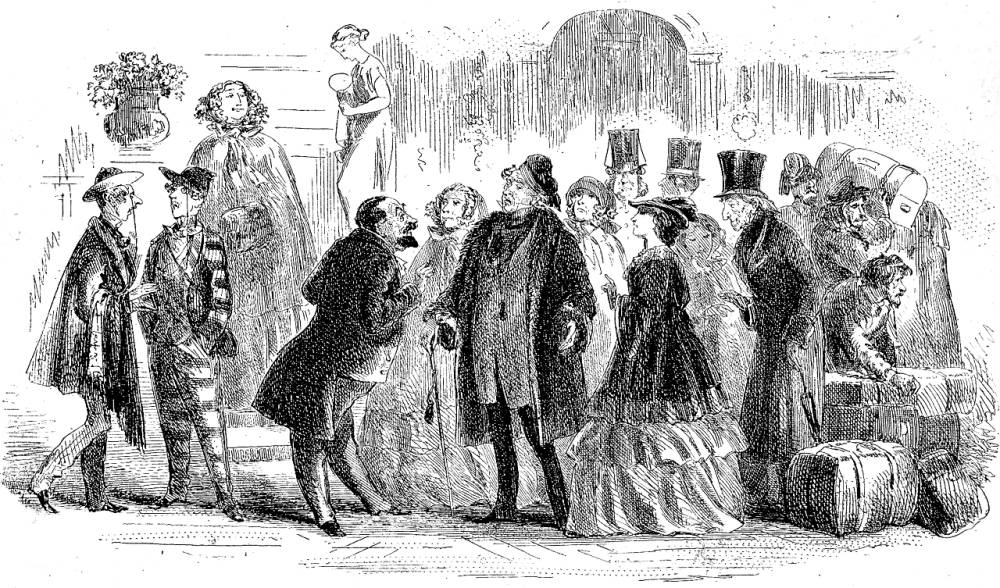
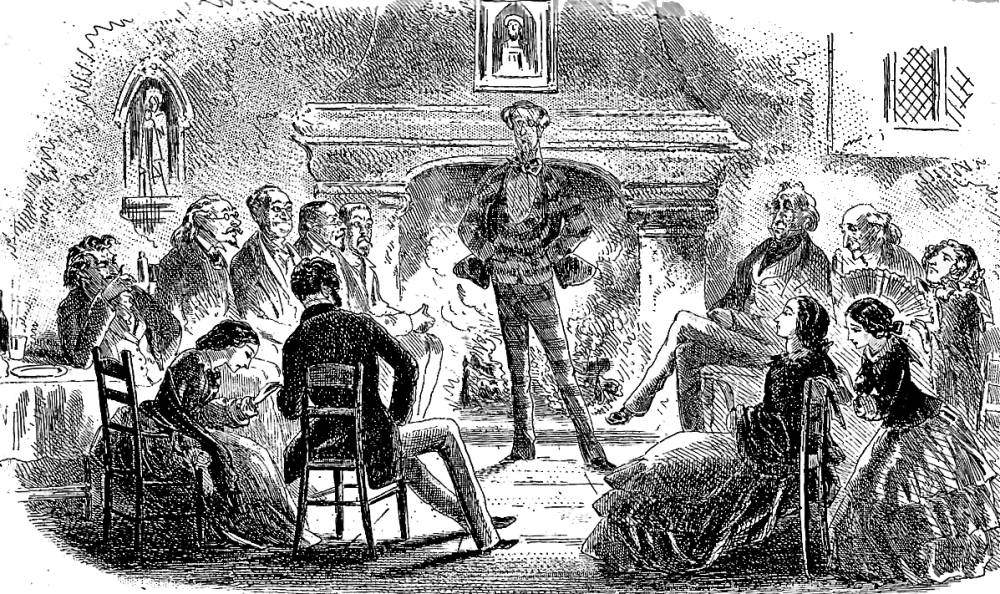
Left: Phiz's introducing Mrs. General, who (left rear) is overlooking the scene in the inn at The Great Saint Bernard, The Family Dignity is Affronted in Part 11 (October 1856). Right: Phiz's other illustration of the Dorrit party in Part 11, The Travellers, for Book II, Chapter 1, “Fellow Travellers.”
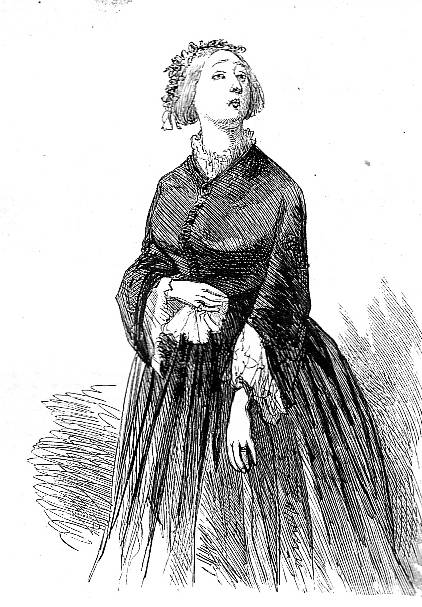
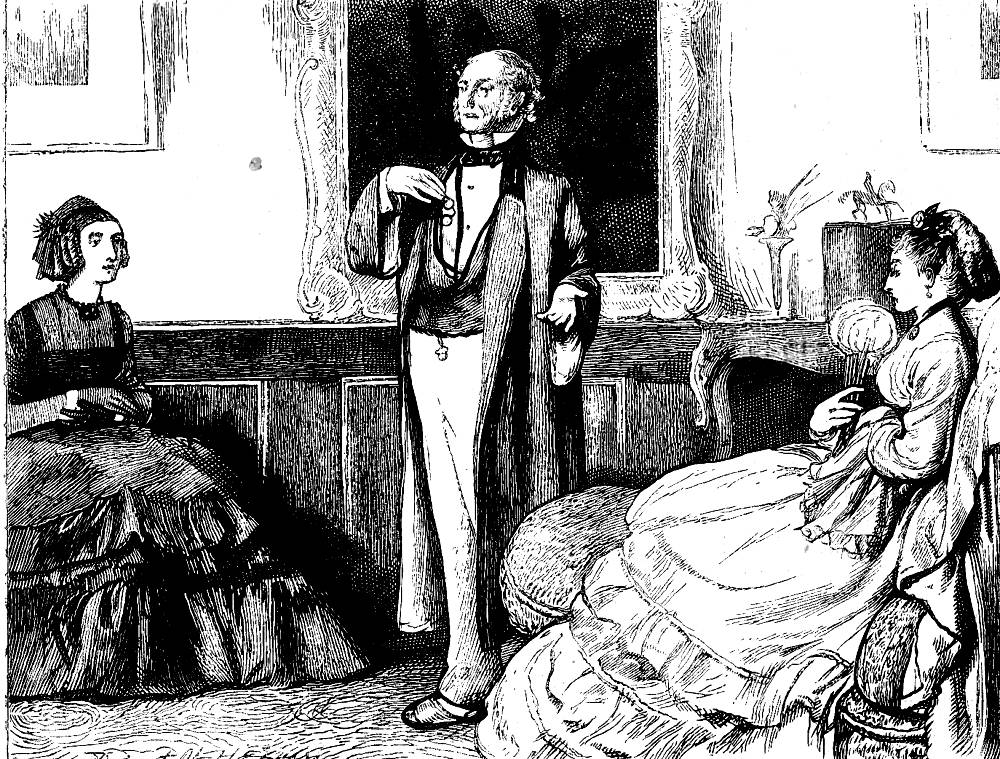
Left: Sol Eytinge, Junior's study of the the imperious Mrs. General's elocution lesson, “Papa, potatoes, poultry, prunes, and prism” in Prunes and Prism (1867). Centre: James Mahoney's forty-first Household Edition illustration, which places Fanny, William Dorrit, and Mrs. General in an ornately furnished parlour, Mrs. General changed her gloves, as to the right glove being uppermost. . . . (1873). Right: Furniss's group study foregrounds Amy (left), William Dorrit (centre), and Mrs. General (right): Mr. Dorrit Forgets Himself for Book II, Chapter 19 (1910) [Click on the images to enlarge them.]
Related Material: The Other Illustrated Editions (1863 — 1910)
- Illustrations by "Phiz" (Hablot Knight Browne) for Little Dorrit (December 1855 — June 1857)
- James Mahoney's 58 illustrations for Dickens's Little Dorrit (1873)
- Harry Furniss's 29 illustrations for Dickens's Little Dorrit (1910)
- Charles Dickens's Little Dorrit (1857): Site Map
- Felix Octavius Carr Darley — three engraved frontispieces, volumes 1, 2, and 4: 1863)
- Illustrations by Sol Eytinge, Jr. — 16 plates from the Ticknor and Fields' Diamond Edition (1867)
Bibliography
Dickens, Charles. Little Dorrit. Illustrated by Hablot Knight Browne ("Phiz"). The Authentic Edition. London: Chapman and Hall, 1901 [rpt. 30 May 1857 volume].
Dickens, Charles. Little Dorrit. Frontispieces by Felix Octavius Carr Darley and Sir John Gilbert. The Household Edition. 55 vols. New York: Sheldon & Co., 1863. 4 vols.
Dickens, Charles. Little Dorrit. Illustrated by Sol Eytinge, Jr. The Diamond Edition. 14 vols. Boston: Ticknor & Fields, 1867.
Dickens, Charles. Little Dorrit. Illustrated by James Mahoney. The Household Edition. 22 vols. London: Chapman and Hall, 1873. Vol. V.
Dickens, Charles. Little Dorrit. Illustrated by A. A. Dixon. With an engraved title by Harry Furniss. London and Glasgow: Collins Clear-Type Press, 1906.
Dickens, Charles. Little Dorrit. Illustrated by Harry Furniss. The Charles Dickens Library Edition. 18 vols. London: Educational Book, 1910. Vol. XII.
Steig, Michael. "Chapter 6: Bleak House and Little Dorrit: Iconography of Darkness." Dickens and Phiz. Bloomington: Indiana University Press, 1978.
Created 11 September 2026