
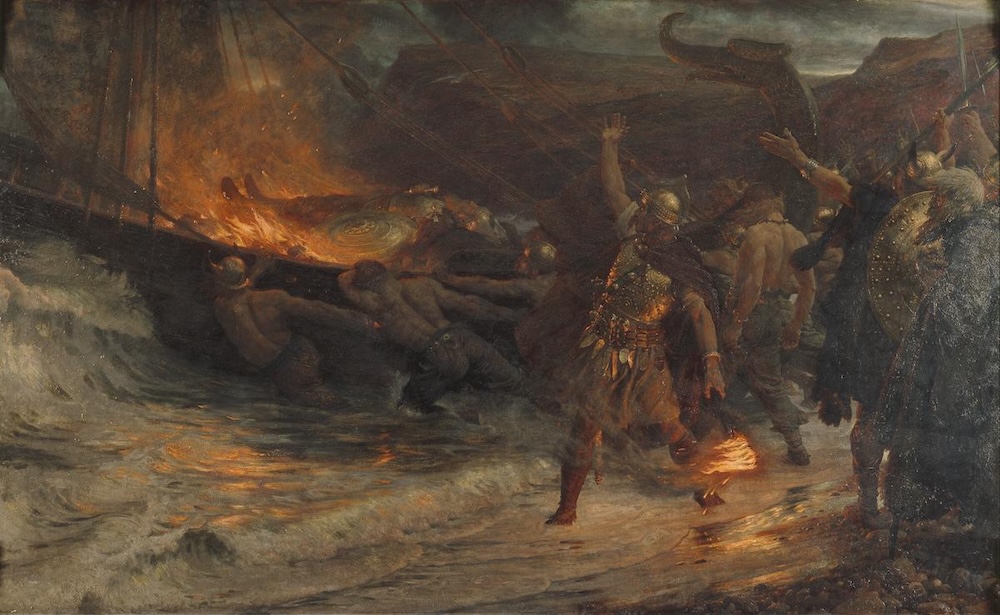
The Funeral of a Viking, by Sir Frank Dicksee (1853–1928). 1893. Oil on canvas. 73 3/8 x 120 1/4 inches (186.4 x 305.5 cm). Collection of Manchester Art Gallery, accession no. 1928.13. Image courtesy of the Manchester Art Gallery under the terms of the Creative Commons Attribution-NonCommercial-NoDerivatives licence (CC BY-NC-ND).
The Funeral of a Viking was exhibited at the Royal Academy in 1893, no. 131. It is not only the largest, but also one of the most impressive of his paintings. It is a twilight scene under a dark stormy sky showing a cohort of Vikings with their arms raised in a final salute to their dead comrade. In the centre of the composition is a man wearing an impressive armour breastplate with raised ornamentation and a crested helmet. His right arm is raised while his left hand holds a flaming torch. In the Viking boat can be seen the recumbent figure of a dead warrior with flames already lapping around his body. His fellow warriors are pushing the imposing ship with its dragon-headed stern, which will serve as his funeral pyre, out to sea. A rocky headland makes up the background to the right of the composition. The model for the central figure, holding the flaming torch, is Angelo Colarossi Snr.
The Manchester Art Gallery has these insightful comments on their picture:
A Viking killed in battle is laid out in his boat which has been ceremonially set ablaze and is being pushed out to sea with the tide. Fire and water will combine to release the spirit, allowing the heroic warrior to enter Valhalla, the god Odin's glorious Hall of the Slain. The vantage point that Dicksee has selected invites the viewer to feel they are part of the crowd gathered in the gloom for this ancient ceremony. Viking subjects were unusual in Victorian art although Norsk mythology was becoming popular. Dicksee may have been inspired by a funeral scene in the Anglo Saxon poem Beowulf or perhaps by the discovery of a Viking ship burial which was excavated in 1893, in Gokstad, Norway. The shortage of genuine Viking material available meant that Dicksee had to draw on his imagination, painting an artistic mix of Viking shields, Roman body armour and Celtic horned helmets.
Contemporary Reviews of the Painting
A critic for The Artist gave a very long and detailed review of this important picture even prior to it being shown at the Royal Academy:
Frank Dicksee has spent the whole year upon one picture, which is the largest and will probably rank as the most important that he has yet painted. It is the 'last voyage' of a Viking. The dead chief is laid in full splendour on the funeral pyre which is mounted high on his boat. His brothers-in-arms are pushing him off into a heaving surge which lifts the stem as it rolls shorewards. The torch has been applied to the pyre, and the flames are leaping up through the masts and yards, illuminating the recumbent figure which they have not yet touched. On the shore is a crowd of Norse warriors with uplifted arms giving him the last salute. One notable figure in full armour, with breastplate and helmet of bronze most curiously wrought, stands forward from the group, holding in his hand the inverted torch with which the pyre has just been kindled. To the right the crowd thickens; there are young men armed and old men in flowing robes, and the forest of arms and weapons gives hints of many more that are not seen. Then behind a long line of lofty cliffs, solemn and gloomy in the twilight, shows the contour of the bay. The sun is setting; its last rays are just seen over the cliff-top, and are reflected in the belly of the great wave which floats the Viking's boat. Every detail of this picture has been most elaborately wrought. To get the exact form of his big wave Mr. Dicksee made many careful studies by the sea-shore, and all the draped figures have been studied in the nude. The large shield which lies by the side of the dead Viking was painted from a shield specially made for this purpose on the Norse model. The rest of the armour and the draperies, as well as the form of the boat with its tall prow towering above the heads of the groups on shore, all followed tradition, so far as it can be ascertained. But these details, though they add to the richness and the actuality of the picture, are by no means its essential feature. Mr. Dicksee has endeavoured to give the sentiment of the whole scene, and to present us, so to speak, with a fragment of an epic. The colour scheme and the composition are in harmony with the sentiment, and the aim of both is to be solemn and impressive. The dark cliffs are in fine contrast with the flames of the pyre, and these again have the peculiar effect of lights at twilight. All the faces are interesting, and some are of a type rather new for Mr. Dicksee. [117]
However, F.G. Stephens in The Athenaeum thought Dicksee once had nobler aims in his exhibited works: "Mr. F. Dicksee contributes a huge canvas, Funeral of a Viking (131). As a show-piece pure and simple it is perfect, and more easy to read than we dared expect from one who began life as a devotee of Sir Frederic Leighton's academicism and somewhat over-refined art. Mr. Dicksee has often succeeded in playing to the gallery without violating good traditions, and he once had nobler aims than those of No. 131. There are several clever points of a spectacular kind in this picture; of these the reflections of the torches on the sea and armour are the best" (611). D. S. MaColl, the reviewer for The Spectator, found this work "stagey": "The talent for staging is obvious in the Vikings Funeral, and a thoroughness in the consideration, the disposition, the execution of the properties of the scene. As poetry or colour it does not exist; it is merely what will pass for these things with a public that is gratified by the same order of contrivance in literature or on the stage" (573).
Marion Spielmann in The Magazine of Art praised the work as a prime example of painting according to academic principles:
The place of honour of the whole Academy has been awarded to Mr. Frank Dicksee's Funeral of a Viking, and not without good academical reason. The picture is the offspring of Academy teaching, scholarly and learned in drawing and arrangement, elevated in conception, good in composition, and far more virile and solid than any painting Mr. Dicksee has painted for some years. The whole arrangement of this old Viking, whose bier is his ship, and which, set on fire by his people as night falls in, is pushed off from shore to sail away into the night of death, is fine, and is in the best sense impressive; but by the very academic inspiration of which I spoke it does not altogether escape from the taint of the artificial, or, at least, the stagey. But it must be admitted that Dicksee's work – chiefly through the key in which it is painted – suffers sadly from the light of the Academy. [258]
Bibliography
Blackburn, Henry. Academy Notes XIX (London: Chatto and Windus (May 1893): 52.
The Funeral of a Viking. Art UK. Web. 7 July 2026.
The Funeral of a Viking. Manchester: Manchester Art Gallery. Web. 7 July 2026.
Gaunt, William. The Restless Century. London: Phaidon, 1972, no. 161.
MacColl, Dugald Sutherland. "The Royal Academy." The Spectator LXX (April 29, 1893): 572-73. Google Books. Free to read. Web. 7 July 2026.
Spielmann, Marion H. "The Royal Academy Exhibition.": The Magazine of Art XVI (1893): 253-58.
Stephens, Frederic George. "Fine Arts. The Royal Academy." The Athenaeum No. 3420 (13 May 1893): 609-11.
"Studio and Personal Notes." The Artist XIV (1 April 1893): 115-18.
Toll, Simon. Frank Dicksee 1853-1928, His Art and Life. Woodbridge: ACC Art Books, 2016, cat. no. FD.1893.1, 92-96 & 231.
Created 7 July 2026
Last modified 15 July 2026