

Dr Allen is Director and Curator of The Stained Glass Museum, located in Ely Cathedral, Cambridgeshire. Her article on this topic first appeared in True Principles, The Journal of the Pugin Society, vol. 5, no.1 (Spring 2016), pp.11-28, and has been reproduced here by kind permission of the author herself, and of the editor of that issue, Professor David Frazer Lewis. It has been reformatted for our own website, with the addition of links to other material on the website. For copyright reasons, a few images have been replaced by similar ones in the public domain. — Jacqueline Banerjee
The Medieval Court at the Great Exhibition of 1851 played a key role in the burgeoning Gothic Revival and the development of stained glass in the mid-nineteenth century (see Allen 2012 and 2013). By examining A.W.N. Pugin's motives for selecting individual windows for display and by discussing both the successes and difficulties of displaying stained glass in an exhibition context, this article reveals Pugin's own attitudes towards stained glass and public exhibitions as well as contemporary critical responses to the Gothic-inspired furniture and decorations on display. The Medieval Court presented an integrated display that influenced the reception and development of the Gothic style, and had a lasting influence on the reputations of exhibitors and the contextual display of stained glass in temporary exhibition settings.
Pugin and the Crystal Palace
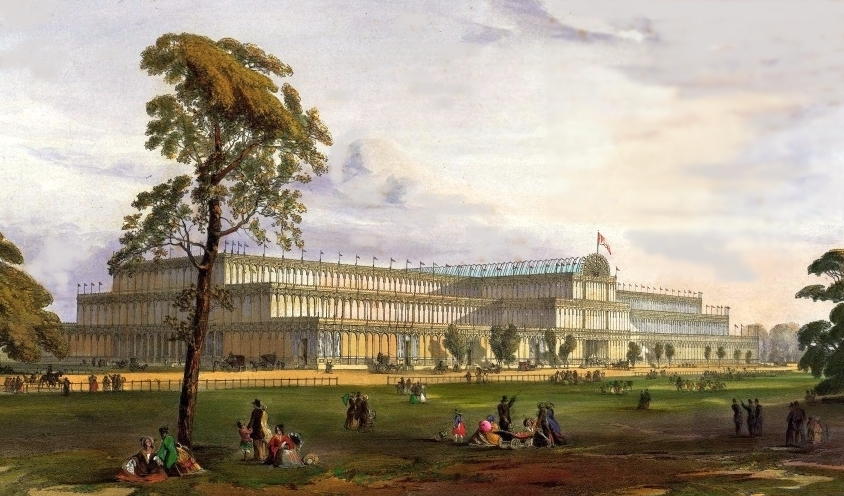
The Crystal Palace in Hyde Park. Source: Dickinson, frontispiece.
The Crystal Palace was erected in Hyde Park, London, to house the world's first international exhibition, The Great Exhibition of the Works of Industry of All Nations, which took place between 1 May and 15 October 1851. The large glass and iron building designed by Joseph Paxton is today considered a great monument of nineteenth-century architecture, a striking symbol of Victorian modernity. However, at the time of its inception, the building drew many critics. An article in The Ecclesiologist, the journal of the Cambridge Camden Society, proclaimed that Paxton's Crystal Palace was "engineering of the highest merit and excellence not architecture" ("Design of Crytal Palace," 1851).
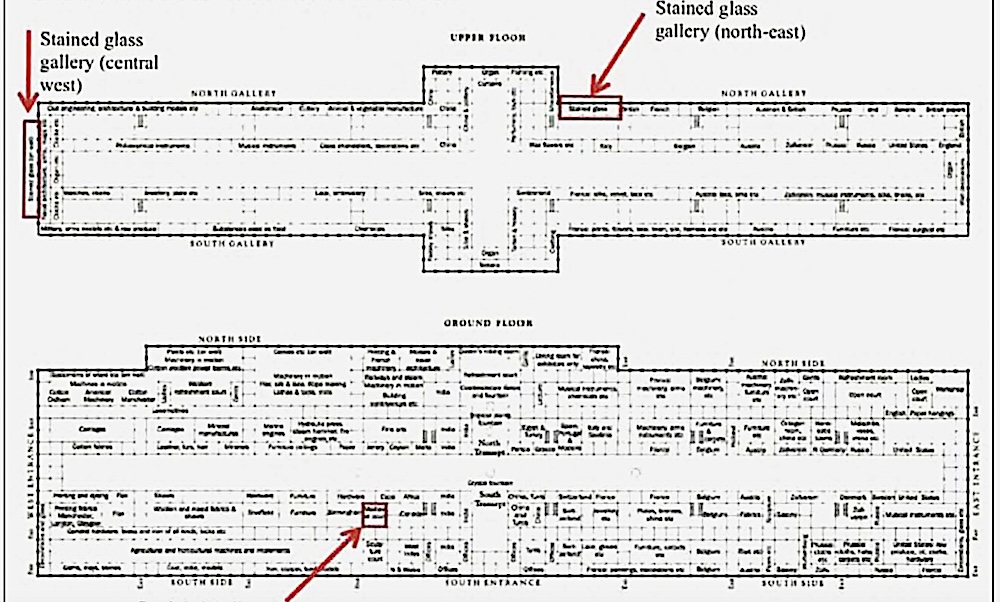
Plan of the Crystal Palace, showing locations of stained glass exhibits in upper galleries and Pugin's Medieval Court, 1851 (Wikimedia).
These views appear to have been shared by the Gothic Revival architect and polemicist A.W.N. Pugin, who after visiting the Crystal Palace for the first time, referred to the building as the "Vert Monstre" or "green monster" (Wedgwood 238, n.9). In a letter to decorator John Gregory Crace, he stated that:
The building appears to me a great failure, and the Length should have been archd. The transept is not half so important - it is a capital place for plants. What is it? A large greenhouse, very ingenious, a great credit to inventors, wonderful mechanism &&c but a beastly place to show off gothic work. [Wedgwood 238, n.9.]
Pugin's remarks were echoed by eminent art critic John Ruskin a few years later, when the Crystal Palace relocated to Sydenham, where it reopened to the public in 1854 amongst landscaped park grounds, and was destroyed by fire in 1936. Ruskin compared the building to "a giant cucumber-frame" and remarked: "We suppose ourselves to have invented a new style of architecture, when we have magnified a conservatory!" (Ruskin 5). Both critics alluded to Paxton's experience designing horticultural buildings, and his inspiration for the ridge and furrow roof of the Crystal Palace, which had been inspired by the rib-structured leaves of the Victoria Regia water lily.
Medieval Court
In spite of his opinions of the design and origin of the Crystal Palace, A.W.N. Pugin was keen to take part in the Great Exhibition. Shortly after plans for the Great Exhibition were announced, he wrote to John Gregory Crace in March 1850 declaring his intention to apply for a room to showcase the work of his closest collaborators (Wedgwood 238, n.9.). A year later they began setting up the Medieval Court, which occupied a 48-by-48-foot (14.6m by 14.6m) exhibition space on the ground floor of the Crystal Palace along the south-western side of the building, near the central crossing. The court was screened off from the rest of the building with framed canvas (Hill 2007, p. 46). Besides Pugin, who had designed many of the objects on display, the other exhibitors whose works were represented in the Medieval Court included Royal Decorator John Gregory Crace of Crace & Sons; Herbert Minton of Minton & Co. ceramics, Stoke-on-Trent; glazier and metalworker John Hardman of Birmingham; and George Myers, a stone-carver and builder. Each side of the court was labelled identifying the four contributors and their trade.
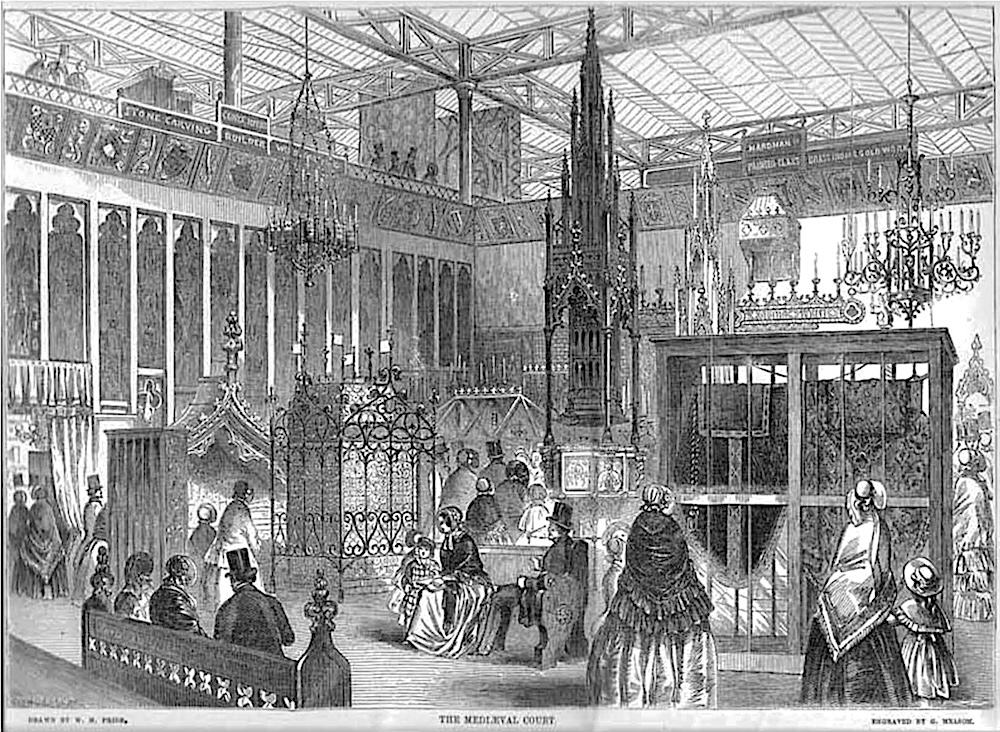
The Medieval Court, 1851: drawn by W.M. Prior, engraved by G. Meason. Wood engraving, in Cassell (Author's Collection).
It is likely that Pugin managed to secure his own separate exhibiting area in such a prime location through his connections with Henry Cole, a member of the Executive Committee and one of the key organisers of the Great Exhibition of 1851.The two men would have known each other through the Society of Arts and were brought into close contact when Pugin was asked to lend several exhibits from his own collection to the Society's 1850 Exhibition of Ancient and Mediaeval Art, which Henry Cole had helped to organise (Wainwright 357). By bringing together several exhibitors' wares in a single exhibition space, Pugin and his collaborators avoided the rigorous rules of classification and arrangement that other exhibitors were subject to. The Great Exhibition classification scheme divided exhibits into four categories demonstrating the progressive stages of the manufacturing process: raw materials, machinery; manufactures, and the fine arts. These four categories were then subdivided into a total of thirty classes (Allwood 450-51). This scheme organised the exhibits and dictated where they would be placed wi thin the building, how they would be listed in the Official Catalogue, and what objects they would be compared with and judged against by the awarding juries.
Most of the exhibits within the Crystal Palace followed a plan of arrangement which saw British exhibits placed in the western portion of the building, displayed according to their classification group, while "foreign" exhibits were placed in national groups on the eastern side — such a display has been interpreted as demonstrating British superiority (Buzard). There were very few exceptions to this rule, but both the stained glass exhibits and the objects shown in the Medieval Court broke conventions. Although stained glass was categorised in Class 24 with the Glass manufactures, the majority of stained glass exhibits were displayed separately in a long gallery along the north-eastern wall on an upper level of the Crystal Palace where they were illuminated by natural sunlight transmitted through the outer glass walls of the building.
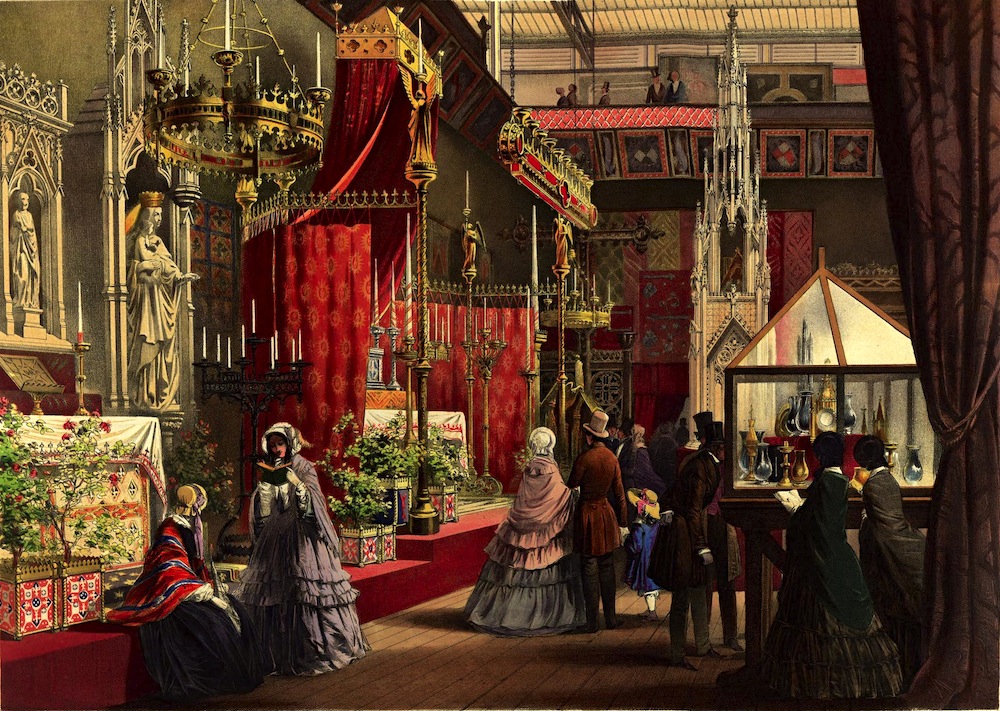
The Medieval Court, 1851: chromolithograph by John Nash, in Dickinson, vol. 2: pl. XII.
Similarly, the exhibits in Pugin's Medieval Court were listed in the Official Catalogue under Class 26 dedicated to "Furniture, upholstery, paper hangings, and papier mache and japanned goods," but they were not displayed with the objects in this classification and instead formed a separate collective display on the ground floor on the south side of the building (Yapp 137). Here, the Medieval Court was located opposite the Sculpture Court and adjacent to "those inexhaustible mines of bad taste, Birmingham and Sheffield," that Pugin abhorred (Pugin True Principles, p.24). With its medieval-inspired exhibits, the Medieval Court offered an alternative to the display of modern manufactures from industrial Birmingham.
The Medieval Court provided a modern showroom of Gothic-styled goods for decorating the home and church, including fabric and wallpaper, encaustic tiles, furniture, stone- and woodcarving, metalwork, and stained glass. The Illustrated Exhibitor concluded that it was a "strikingly-harmonious combination" that suggested "the fullness of beauty and character, and the homogeneousness, of medieval design, however applied, to domestic as to ecclesiastical purposes" (Cassell 92). Amongst the pieces of domestic furniture exhibited were Minton's large Gothic stove for Alton Towers, home of the 16th Earl of Shrewsbury, John Talbot; and some Gothic jardinieres, tiles, wallpapers and wooden cabinets. But ecclesiastical furnishings formed the majority of the display, and included Bishop Thomas Walsh's tomb for St Chad's Cathedral, Birmingham; a high altar, a niche with statue of the Virgin and Child, and an altar and reredos of the Lady Chapel from the Catholic Church of St David at Pantasaph; a font, a tabernacle, and part of the oak screen to the A.W.N. Pugin chantry from St Augustine's, Ramsgate; much ecclesiastical metalwork; and the Great Rood from the screen at St Edmund's College, Ware ("The Medieval Court, Painted Glass").
Controversy
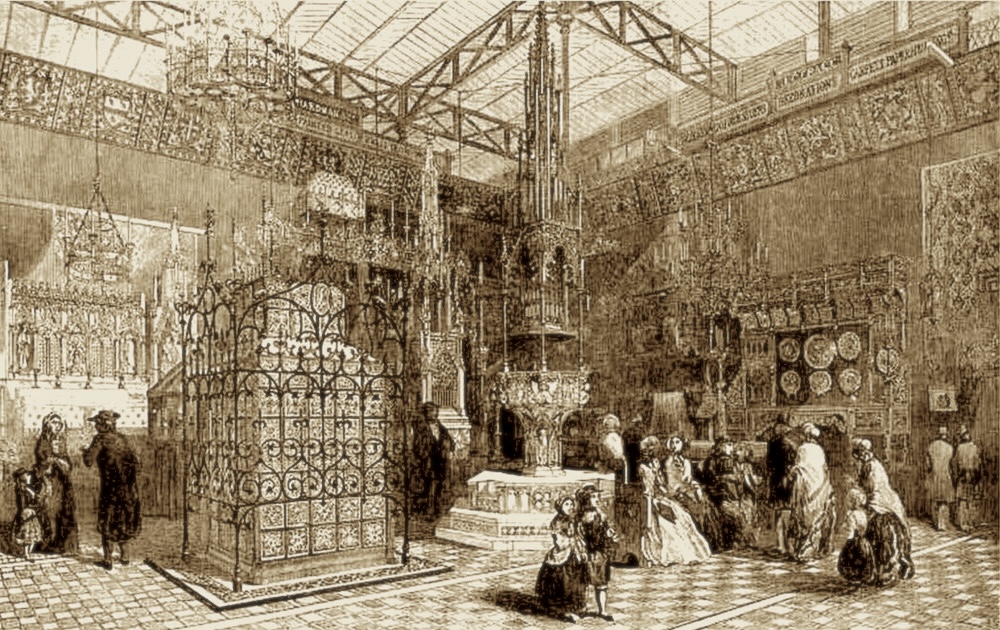
The Medieval Court, in The Illustrated London News of 20 September 1851, p.362 (Author's collection).
The presence of the Ware Rood cross, which was exhibited without the figures of Christ, the Virgin Mary, and St John, caused a stir for appearing "Popish." In order to reassure the public that the Medieval Court was not a Roman Catholic chapel, Lord Granville, President of the Board of Trade, released a statement explaining:
The only thing that has been brought into this court is a Cross, not a Crucifix. [...J Oneside of this Court will be hung with Ecclesiastical ornaments, the other three sides with Domestic furniture, and in the middle there will be a mixture of Fonts, stoves, flowerpots, armchairs, sofas, tables & c & c, which I hope will give it a sufficiently secular character. [Wedgwood 238-39]
Such fears that Pugin was erecting a Catholic chapel were steeped in widespread anti-Catholic feeling. Catholic Emancipation was achieved in 1829 through the Catholic Relief Act, which enabled Roman Catholics to sit in Parliament for the first time since 1688. In September 1850 the Catholic hierarchy had been re-established in England and, in the years following, there were many violent clashes and verbal disputes between Protestants and Catholics, to which the government responded by introducing the Ecclesiastical Titles Bill, which prevented anyone outside of the Established Church from using an episcopal title. The bill was repealed under Gladstone in 1871 (Hill, 26; Wedgwood 238-39). Pugin's desire to revive the Gothic architecture of England's Catholic past, and his own conversion to the Roman Catholic faith in 1834, made many Anglicans suspicious of his intentions with the Medieval Court.
In 1851, the year of the Great Exhibition, Punch published a satirical poem and sketch entitled "The Pilgrims to Rome," a parody of the Prologue to Geoffrey Chaucer's Canterbury Tales. The accompanying illustration depicts a line of notable pilgrims riding to Rome, led by a plump Cardinal Wiseman. A.W.N. Pugin clearly provided inspiration for the "architecte," who is depicted second from last in the line, holding an architectural model with a Gothic spire. The satirical poem highlights that Pugin's church-building and taste for the medieval period was conflated with his Roman Catholic faith. Many visitors brought these preconceptions with them when they entered the Medieval Court.
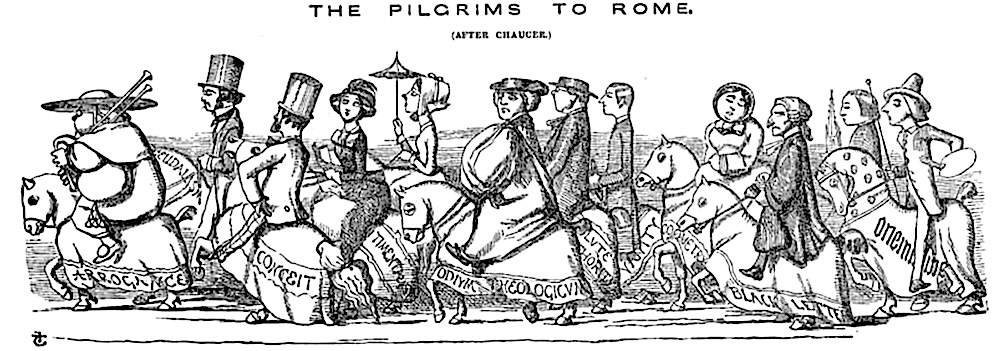
The Pilgrims to Rome in Punch, vol. 20 (1851): 230 (Author's Collection).
The presence of a number of stained glass windows produced by Hardman & Co. under Pugin's direction, arranged along the north side of the Court (filling 1,360 sq. ft. [126 sq. m] of wall space), may have also contributed to people's perceptions of the Medieval Court as a chapel (Fisher, Hardman of Birmingham, 62). At this time stained glass was typically associated with ecclesiastical settings rather than secular environments, and thus the Great Exhibition, devoted to the world's industry, provided a new type of environment for viewing stained glass (Cheshire).
A.W.N. Pugin and Stained Glass
A.W. N. Pugin played a key role in reviving and promoting the art of stained glass (Shepherd, "A.W.N. Pugin"). During his lifetime he worked closely with four significant nineteenth-century stained glass artists: William Warrington from 1838-41, a href="../willement/index.html">Thomas Willement for a brief period in 1841-42, William Wailes from 1842-45, and finally John Hardman from 1845 until his own death in 1852 (for Pugin's relationships with these glass painters see Fisher, Hardman of Birmingham and "John Hardman and Company," and Shepherd, The Stained Glass of A.W.N. Pugin). Pugin persuaded Birmingham metalwork company Hardman & Co. to begin making stained glass to his designs in 1845, and this was his final, most successful and long-lasting collaboration with a stained glass artist (Fisher, Hardman of Birmingham, 61-63); by November 1845 Hardman's were making their first stained glass. which was for St Cuthbert's College, Ushaw.
In 1849 Hardman and Pugin participated in their first public exhibition - The Birmingham Exposition of Arts and Manufactures (Fisher 2008, pp. 61-63). Amongst Hardman & Co.'s exhibits, which occupied an entire upper end of the exhibition room, were four stained glass windows, which were favourably received by critics: Hardman's showed two memorial windows destined for St Nicholas, Copperas Hill, liverpool (no longer extant); some panels for St. Augustine, Ramsgate; and an armorial window for the hall of St Cuthbert's College, Ushaw (Shepherd, The Stained Glass of A.W.N. Pugn, 87-88). The Art Journal described them as "wonderful productions ... on a par with those of the best antique originals" ("Birmingham Exhibition" 1849, p. 320)". The Art-Union singled out Hardman's display and described the firm's stained glass as "extraordinary in the texture of the glass, the colours employed, and the drawing of the figures introduced," acknowledging the fruitful partnership between Pugin and Hardman ("Birmingham Exhibition," p. 349).
The Medieval Court at the Great Exhibition of 1851 developed this successful display but was a larger, more international affair. At the time Britain's stained glass industry was in the early stages of its rapid development, and the stained glass in the Medieval Court designed by A.W.N. Pugin and made by Hardman & Co., signalled the direction that High Victorian stained glass would take in the following decades under the auspices of the burgeoning Gothic Revival movement: besides Hardman & Co. and Powell & Sons, many of the major stained glass firms we associate with the Victorian Gothic Revival (Clayton & Bell, Lavers & Barraud, Heaton, Butler & Bayne, and Morris & Co.) had not yet been founded. The Great Exhibition presented Pugin with an opportunity to demonstrate how the medieval techniques, principles, and function of stained glass might be revived for a modern era. Like other important figures in the revival of stained glass, Pugin cared about the type and quality of the glass he used. He travelled to Evreux and Rouen to study medieval stained glass, and visited Chartres to obtain some samples of thirteenth-century glass for examination. He worked with glass manufacturers Hartley of Sunderland to produce glass to match the desired colours, translucency, and texture of these medieval samples (Shepherd, The Stained Glass of A.W.N. Pugin, pp.31-60).
Above all, Pugin recognised the important role that medieval stained glass played in its architectural and religious environment. In his post as Professor of Ecclesiastical Art and Architecture at St Mary’s College, Oscott, Pugin described the empowering effects of medieval churches to theological students in a series of lectures on "Ecclesiastical Architecture" delivered in 1838. In a shortened version of the first lecture, later published in the Catholic Magazine, Pugin described the important educational, aesthetic, and symbolic role of stained glass windows in sacred buildings where "Every window is a chapter of instruction":
Between the lengthened mullions of the windows are seen glowing masses of the richest hues; whole acres of brilliant imagery sparkle before you, throwing the most variegated reflections and enchanting effects over the whole edifice. [Pugin, "Lectures on Ecclesiastical Architecture," 1838, p. 199]
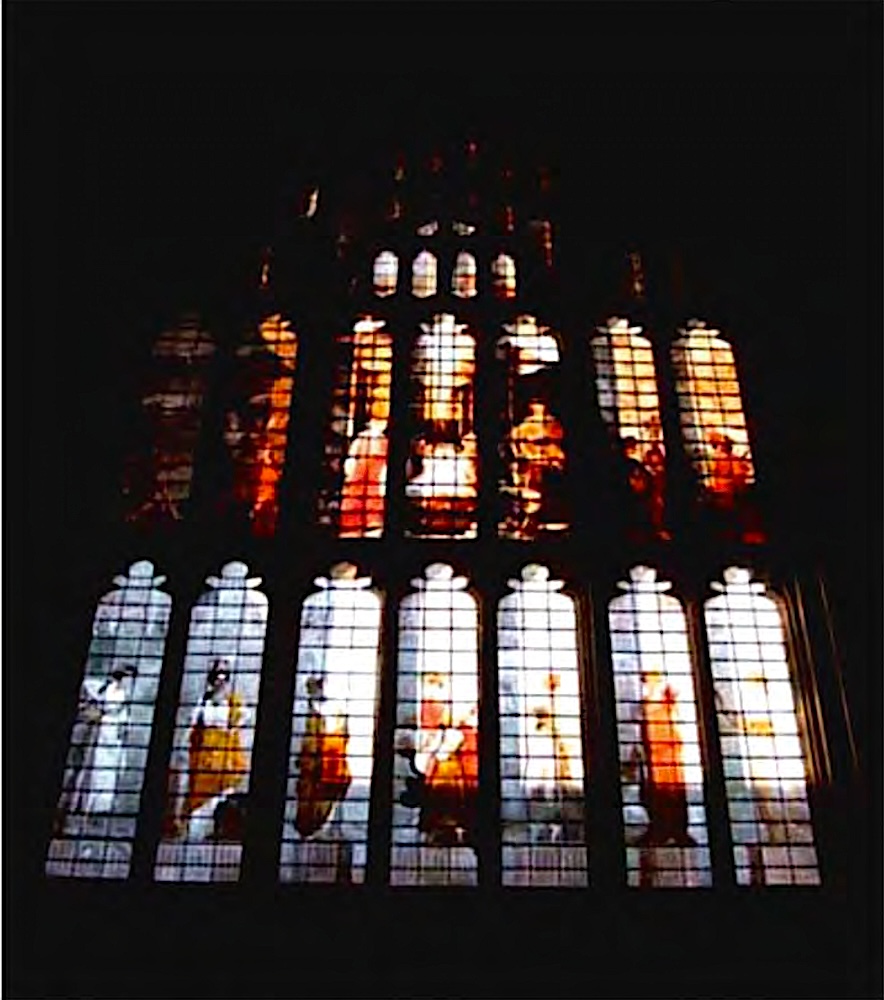
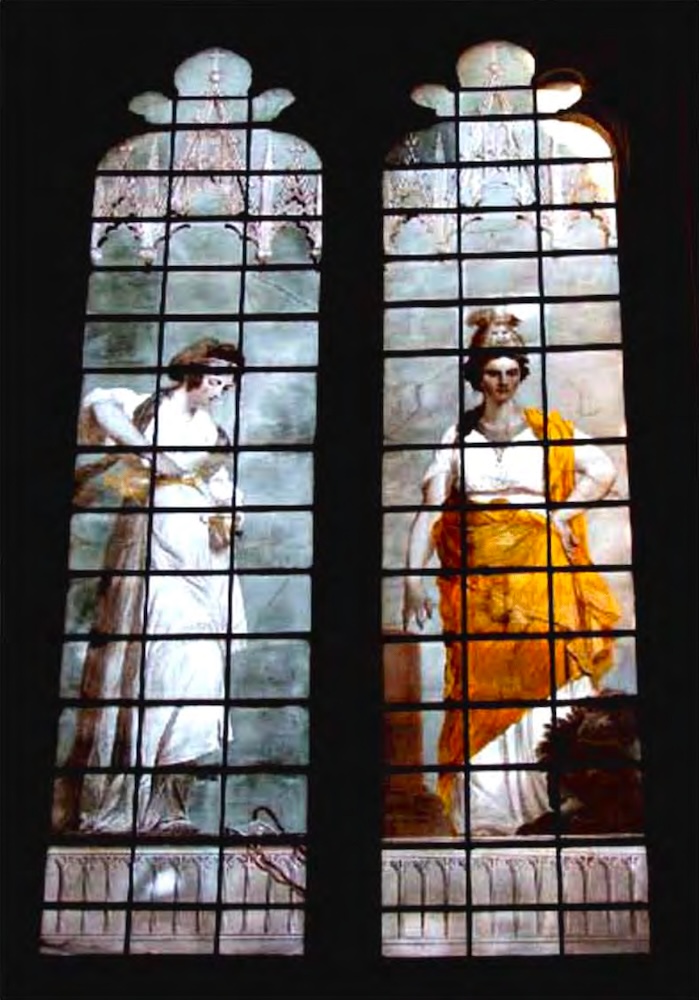
Joshua Reynolds (designer), Thomas Jervais (painter), "Nativity with allegorical figures," c.1787, west window, Antechapel, New College Chapel, Oxford. Left: Whole window; right: Detail of the window (J. Allen).
In his third lecture of the same series, Pugin spoke of the decline in the art of stained glass from the late sixteenth century onwards, and drew the students’ attention to "the miserable attempt [of glass painting] in the west window of New College Oxford" designed by Joshua Reynolds and painted on glass by Thomas Jervais in 1777 (Pugin, "Lectures on Ecclesiastical Architecture," 1839, p. 33). Although now a celebrated example of monumental Georgian glass painting, this window in the antechapel of New College Chapel was, to Pugin and later advocates of the Gothic Revival, the antithesis of medieval principles of stained glass design (Gilchrist and Barley). The whole window is formed of numerous small rectangular panes of white glass painted with washy coloured enamels, and the lead lines around each pane of glass form a "net-work" over the entire picture. The New College Chapel window features in much nineteenth-century discourse on stained glass, but Pugin was one of the first and most witty, outspoken critics of this window, which he described as "two-thirds dirty brown clouds" (Pugin 1839, p.33). He objected to the techniques and principles employed, as well as its overall design in which the large Nativity scene in the upper tier spreads across the stone mullions, ignoring the Gothic architectural framework. The allegorical figures of the cardinal virtues in the seven lights in the lower tier are depicted standing on plinths underneath Gothick canopies, but are full of drama and affectation; Pugin thought they had "the appearance of third-rate actresses" (Pugin, "Lectures on Ecclesiastical Architecture," 1839, p. 33).
Stained Glass in the Medieval Court
Around a quarter of the stained glass exhibits on show at the Great Exhibition of 1851 were pictorial windows painted with enamels, so the display of medieval-inspired stained glass by Hardman & Co. in the Medieval Court stood out precisely as Pugin had intended it to. When selecting which stained glass panels to exhibit Pugin suggested to Hardman, "we ought to have something of each kind" (Shepherd, The Stained Glass of A.W.N. Pugin, p. 89). By this he meant exhibits to represent the three main Gothic styles: Early, Decorated, and Late. But ever business-minded, he reminded Hardman that it would be most cost-effective if "you will only show windows ordered [which are not yet made or installed] and which will be paid for" (Shepherd, The Stained Glass of A.W.N. Pugin, p. 89). Yet Pugin also needed the permission of the donors and clergymen who had commissioned the windows to display their stained glass panels in the Medieval Court prior to installation.
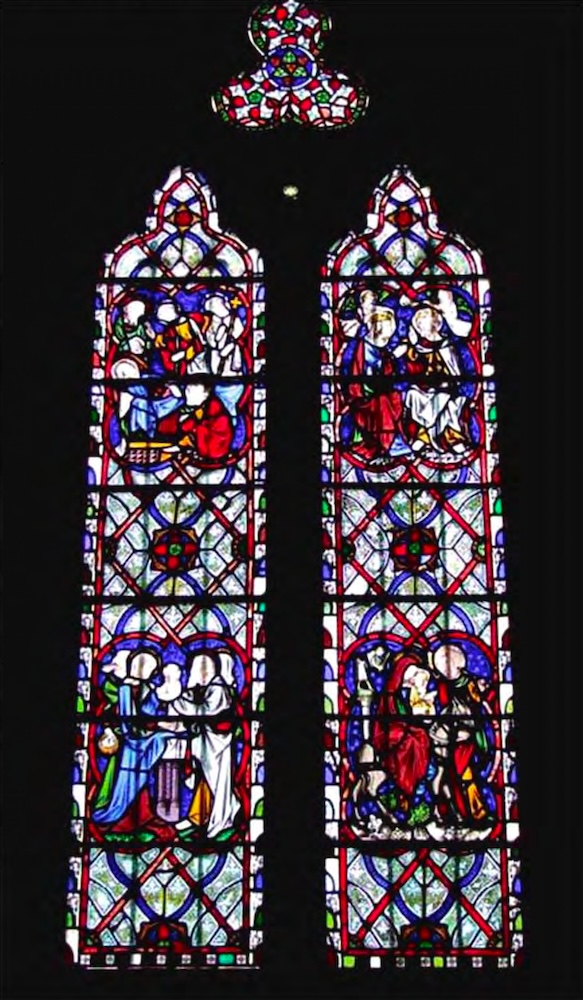
Pugin (designer), Hardman & Co. (manufacturer), The Life of the Virgin 1848 (tracery), 1851 (main lights), s1V, south wall of the Lady Chapel, St Augustine's Ramsgate (J. Allen).
The Early Style (defined by Pugin as c.1190- 1300) was, in the end, not represented at all because the Dean and Chapter at Hereford Cathedral refused to lend a light from their typological east window, which they were anxious to have in place as soon as possible (the glass was replaced in 1871). Consequently, most of the glass exhibited in the Medieval Court was in the Decorated Style. A two-light window depicting St. Thomas the Apostle and St. Thomas the Martyr for the chantry chapel of St. Edmund's College, Ware (now destroyed), was exhibited, as Pugin explained to Hardman, "because we can have it & it is an easy subject 2 Large Saints under canopies" — this large window was destroyed by bombing in World War II. It depicted St. Thomas the Apostle and St. Thomas of Canterbury, the patron saints of Bishop Griffiths, the founder of the chapel (see Shepherd, The Stained Glass of A.W.N. Pugin, p. 89). Three windows from Pugin’s home church of St Augustine's, Ramsgate, were shown, two of which were for the south wall of the Lady Chapel showing scenes from the Life of the Virgin. In these windows each narrative scene is enclosed in a geometrical shape composed ofa large circle intersected by four smaller circles at each corner, with a diapered blue foliage background and ruby border, set against a background of painted foliate grisaille. Both windows now show some signs of paint loss. The third window from St. Augustine’s, Ramsgate, was for the south aisle west wall and depicts the standing figures of saints Ethelbert and Bertha under architectural canopies. This style of stained glass was reminiscent of the early fourteenth-century glazing at Evreux, France, which Pugin visited and studied in 1849 (Shepherd, The Stained Glass of A.W.N. Pugin, pp. 51-52). Another unidentified window in the Decorated Style, depicting the Virgin Mary under a canopy, was also exhibited.
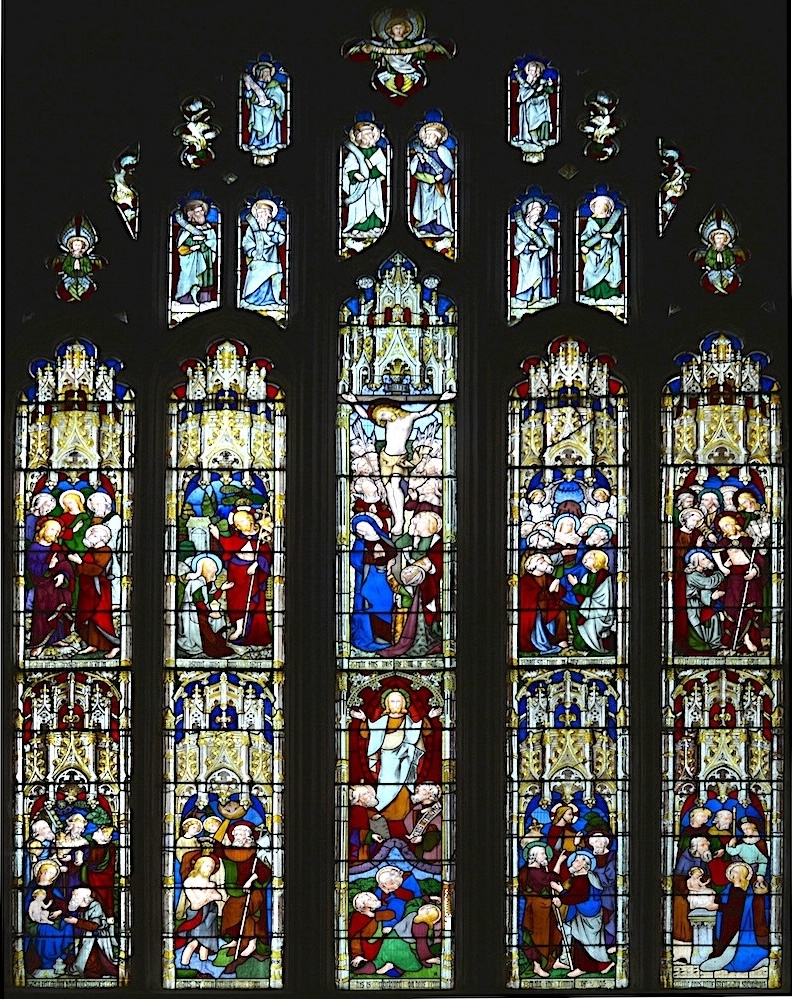
Pugin (designer), Hardman & Co. (manufacturer), Transfiguration and Crucifixion, 1851, east window, St. Andrew's Church, Farnham, Surrey (Lewis Hulbert, Wikimedia).
Stained glass exhibits representing the Late Style (c.13 90-1540) included some panels for windows being made for St Andrew's Church, Farnham, Surrey. The three-light chancel north window depicting the life of St Andrew was exhibited, along with two lights containing the Transfiguration and Crucifixion from the five-light east window. Pugin was unhappy with the execution of this glass, which he felt was not in keeping with the Late Style. Letters from Pugin to Hardman complain that the three-dimensional canopies were painted with too much shadow instead of half-tints, revealing his hands-on approach to the manufacture of his designs for stained glass by the Birmingham studio:
The Farnham light is diabolical disgraceful I have heard the comments of the man who painted it. It is not the least like the cartoon they have put powerful shadows where there are half tints & half tints where there are strong shadows it is a most infamous careless caricature of the cartoons & all painted with black instead of brown shadows which I have begged & prayed for, but nobody in the place has the remotest idea of Late Work & this is damnable it will be a discredit & a shame. My dear Hardman if you don't turn over a new leaf about Late Work the jobs may be given up at once. [Shepherd, The Stained Glass of A.W.N. Pugin, p.345, n.466]
These comments demonstrate Pugin's high artistic standards and his business acumen. Hardman & Co. began producing stained glass upon Pugin's instigation and he played a key role in developing this enormously successful commercial enterprise. From his home in Ramsgate he made the initial sketches for stained glass and oversaw the production of cartoons by designers such as John Hardman Powell and Francis Oliphant (Shepherd, The Stained Glass of A.W.N. Pugin, pp. 61-80). This allowed him to exercise control over the design stage. Once complete, the cartoons were posted to Hardman's studio in Birmingham where Hardman oversaw the glass cutting, leading, and painting. Pugin became increasingly involved in the selection of coloured glass and the methods of glass painting employed. He directed Hardman & Co.'s stained glass department until his death in 1852; the Hardman panels exhibited in the Medieval Court were the results of this successful collaboration.
As other examples of the Late Style, Pugin also wished to display panels destined for the south chancel windows of Jesus College, Cambridge (no longer extant), but the Chaplain and College donors refused to let the panels leave Hardman's studio (Shepherd, The Stained Glass of A.W.N. Pugin, p.198). The Hardman windows in the south chancel were replaced by two windows from Morris & Co. in the early twentieth century. Both the east window (completed by Hardman to A.W.N. Pugin's designs in 1848) and the north chancel windows (completed in 1852) remain in situ. A letter from James Stewart Gammell, an undergraduate of the College and one of the window's donors, explained:
The result is that I regret I cannot accede your request to allow them to be sent to the approaching exposition ... Tho' the reasons are various in the minds of the different subscribers[,] the conclusion they draw from them is the same - Many are unwilling that these windows executed especially for a church & so in a manner already consecrated shd. be made objects of exhibition among a collection & in a manner so purely secular. Others object to the time that would elapse before they could be placed in the chapel & some even speak of withdrawing their subscriptions if they are not to see the first of them before they leave College. [Shepherd, The Stained Glass of A.W.N. Pugin, p. 201]
By this time, preparation for the Great Exhibition and ongoing work for the Houses of Parliament had delayed work in Hardman's studio. Jesus College wrote several times to ask why their windows were not yet finished, revealing the pressures and strains of the growing business.
In addition to ecclesiastical windows, secular stained glass was represented by parts of a window recently provided to one of Pugin's major patrons, John Talbot, the 16th Earl of Shrewsbury, for his dining room at Alton Towers. The Talbot window glazed the main Perpendicular-Style opening in the dining room and celebrated the Earl's family lineage. The central light depicted the standing figure of the First Earl of Shrewsbury, the Great Talbot, crowned and dressed as knight of the garter and holding a sword and sceptre. It was exhibited along with some panels of heraldic glass supported by Talbot hounds from the outer lights. Although the main lights of this window were removed in 1952 and subsequently lost, fragments remain in situ at Alton Towers, rearranged and reinstalled in the tracery lights and main light borders.
Only a few illustrations of the Medieval Court survive and only the engraving published in The Illustrated London News shows the stained glass windows arranged along the wall, so it is difficult to ascertain how prominent the windows were. The Ecclesiologist lamented that the windows were "barely visible from their internal position in the medieval court" ("Ecclesiological Aspect," p.182). This may have been a criticism of the lighting conditions in the building. The Crystal Palace, with its glass walls and ceiling, let in too much light from all sides of the building; light was reflected onto the interior surface of the stained glass exhibits as well as transmitted from behind, causing viewing difficulties. Pugin had anticipated such lighting problems. Two months before the exhibition opened he wrote to Hardman: "since I have been to see the Crystal Palace I am quite out of heart / It will be impossible to exhibit painted glass there / It will be all light" (Shepherd, The Stained Glass of A.W.N. Pugin, p. 89). He feared that, "in such a flood of reflected light," Hardman's stained glass would not be seen to its full advantage (Shepherd, The Stained Glass of A.W.N. Pugin, pp. 201-2). Upstairs, in the stained glass gallery, special measures were taken to ensure better viewing conditions. The roof was darkened, and dark canvas was placed in between the exhibits to limit the amount of light admitted between the panels ("Stained Glass Gallery," 1854).
Yet in spite of these practical problems, the context of the Medieval Court, with its Gothic-style furnishings, appears to have had an advantageous effect on the appreciation of Pugin and Hardman's stained glass exhibits. The Ecclesiologist placed the quality and design of the windows produced by Hardman under Pugin's direction in a class of its own, and the jury for stained glass awarded Hardman & Co. a prize medal, the highest accolade.
French glassmaker Georges Bontemps, who was working at Chance Brothers glassworks at the time, wrote an extensive report on the glass and stained glass exhibited at the Great Exhibition. Bontemps considered Pugin and Hardman to be "trop avances dans leur art" ("very advanced in their art") and praised the composition of their stained glass exhibits, but observed imperfections in the colouring and translucency of the glass (Bontemps 51-52). This was also something that the official Jury Report picked up on:
In the window glass exhibited by this establishment in the Mediaeval Court, the true principles of the style have been faithfully observed; and the execution of the work is very careful. It may be noticed, however, as a defect in these windows, that the glass of the backgrounds between the figures is too transparent; they are consequently inferior in repose and harmony of colouring to the mediaeval windows of the best time. [Winston 695]
The fact that the jury report gave a balanced opinion with both criticism and praise is important, given that Pugin was on the exhibition jury for the class in which the stained glass exhibits were judged. Fellow stained glass exhibitor Edward Baillie of Baillie & Co., Wardour Street, London, lodged an official complaint with the Commissioners against the fact that Hardman & Co. had received a Prize Medal for stained glass, because Pugin had active involvement with the firm (Leapman 260).
Regardless of this, many critics alluded to the fact that Hardman's stained glass successfully struck the balance between slavish imitation and modern invention. In particular The Illustrated London News's critic praised Hardman for not deliberately antiquating the glass by applying matte paint, as was widespread practice at the time ("Medieval Court"). More importantly. Pugin and Hardman's display revealed how stained glass, a medieval art form, could be successfully revived for a modern era following old principles. As the critic in The Illustrated london News proclaimed, Pugin "has marvellously fulfilled his own intention of demonstrating the applicability of Mediaeval art in all its richness and variety to the uses of the present day" ("Medieval Court"). Similar sentiments were expressed in Cassell (91). For many of Pugin's contemporaries, and for recent historians, the Medieval Court represented a unified style-the apogee of the Gothic Revival interior (Wedgwood; Brooks; Lewis; Fisher, Hardman of Birmingham; Shepherd, The Stained Glass of A.W.N. Pugin). The selective placement of stained glass within this integrated display. "which appeared aesthetically as a unity," was evidently successful (Pevsner 50). As Michael Fisher has pointed out, in Pugin's Court, Hardman's glass "was seen in the broadest context of the Gothic Revival, and he was the only Englishman to receive a prize medal for stained glass" (Fisher, Hardman of Birmingham, p. 77).
Conclusion
Although Pugin was not able to show the full range of stained glass panels in the 1851 Medieval Court that he had wished, the display evidently helped gain new commissions. After the Exhibition Pugin commented: "It rains windows ... if our glass trade is well managed it may be made a real good thing in spite of all these terrible people at the Exhibition who do not consider our work even worth notice" (Shepherd, The Stained Glass of A.W.N. Pugin, p.87). After Pugin's death Hardman & Co. continued to make stained glass and went on to become one of the most prolific and successful stained glass manufacturers in the world. They received prestigious awards for stained glass at international exhibitions in London (1851 and 1862), Paris (1867), and Philadelphia (1876), which furthered their reputations at home and abroad. As demonstrated by a letter to John Hardman from Mrs Paine, on behalf of her husband, Rev. J.M. Paine, who had ordered the stained glass for Farnham Church in Surrey, clients viewed their success at this exhibition as a mark of distinction. Mrs Paine wrote, "We were pleased to see our opinion as to the superiority of your glass over that of any English Artist confirmed by the opinion of the Jurors at the Exhibition" (Shepherd, The Stained Glass of A.W.N. Pugin, p.345).
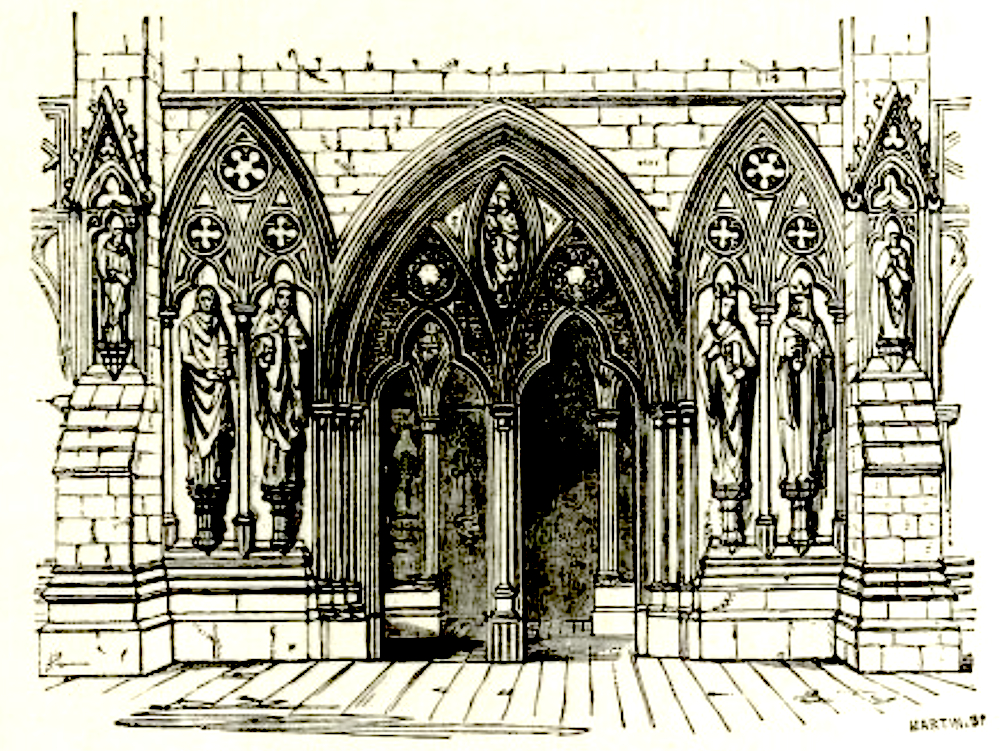
Entrance to the Medieval Court at Sydenham (Wyatt 43).
The Medieval Court helped cement and further the reputations of the individual artists and craftsmen involved, and none more than John Hardman. When the Crystal Palace reopened in Sydenham with a permanent Medieval Court containing casts of medieval sculpture and furnishings, Hardman & Co. were commissioned to make some modern panels of stained glass in the medieval style (Wyatt and Waring 1854). John Gregory Crace, who had also contributed to the 1851 Medieval Court, was responsible for decorating many of the courts in the Sydenham Crystal Palace; he was also appointed Superintendent of Decoration for the building which housed London's second International Exhibition of 1862. Medieval courts, exhibiting both ancient and modern works, became a prominent feature at later exhibitions held in Britain, Australia, and the United States (Ganim; D'Arcens). The Medieval Court had a lasting influence on the development of the Gothic Revival and ecclesiastical stained glass. In the decades following the Great Exhibition, Gothic became the dominant architectural style for ecclesiastical, civic, and domestic buildings across Britain and its colonies. Several examples of furnishings in the Gothic style were included amongst the 244 works purchased from the Great Exhibition for the South Kensington Museum (now the Victoria and Albert Museum) by a committee including Richard Redgrave, Henry Cole, John Rogers Herbert, Owen Jones, and A.W.N. Pugin (Wainwright 357-64). A.W.N. Pugin did not live to see the full impact of his Medieval Court on modem design, but it was a successful venture that boldly demonstrated the beauty and suitability of the medieval style for stained glass and other furnishings, and put into practice his ideals of collaborative artistic partnerships. This unique exhibit drew upon Pugin's multiple talents and varied experience as theatre designer, serious church architect, devout Catholic, and shrewd businessman.
Bibliography
Allen, Jasmine. "Stained Glass and the Culture of the Spectacle, 1780-1862," in Visual Culture in Britain, vol. 13. no 1 (2012): 1—23.
____. "Stained Glassworlds: Stained Glass at the International Exhibitions, c.1851-1900," PhD thesis, University of York, 2013.
Allwood, John. "International Exhibitions and the Classification of Their Exhibits," in Journal of The Royal Society for the Encouragement of Arts, Manufactures and Commerce, vol. 128, no. 287 (June 1980): 450-55.
Belcher, Margaret, ed. The Collected Letters of A.W.N. Pugin, vol. 2. Oxford, 2003.
_____. The Collected Letters of A.W.N. Pugin, vol. 3. Oxford, 2009.
_____. The Collected Letters of A.W.N. Pugin., vol. 5, Oxford, 2015.
"The Birmingham Exhibition of Manufactures and Art," in Art Journal (1 October 1849): 293-321.
"The Birmingham Exposition," in Art-Union (December 1848): 349-51.
Bontemps, Georges. Examen historique et critique des verres, vitraux, cristaux composant la classe XXIV de l’Exposition Universelle de 1851. Paris and London, 1851.
Brooks, Chris. The Gothic Revival. London. 1999.
Buzard, James. "Conflicting Cartographies: Globalism, Nationalism and the Crystal Palace Floor Plan," in J. Buzard, J. W. Childers and E. Gillooly, eds. Victorian Prism: Refraction of the Crystal Palace. 40-82. Charlottesville and London, 2007.
Cassell, John. The Illustrated Exhibitor, a Tribute to the World's Industrial Jubilee; Comprising Sketches, by Pen and Pencil of the Principal Objects in the Great Exhibition of the Industry of All Nations, 1851, London, 1851.
Cheshire, Jim. Stained Glass and the Gothic Revival. Manchester and New York, 2004.
D'Arcens, L. "The Last Thing One Might Expect": The Medieval Court at the 1866 Melbourne Intercolonial Exhibition," in The La Trobe Journal, vol. 81 (Autumn 2008): 26-39.
"The Design of the Crystal Palace," in The Ecclesiologist (1851): 270.
Dickinson. Dickinson's Comprehensive Pictures of the Great Exhibition of 1851. London, 1854.
"Ecclesiological Aspect of the Great Exhibition", in The Ecclesiologist, vol. 9 (1851): 178-90.
Ellis, Robert. Official Descriptive and Illustrated Catalogue. London, 1851.
Fisher, Michael. Hardman of Birmingham: Goldsmith and Glasspainter. Ashbourne, 2008.
_____. "John Hardman and Company: Pugin’s Glasspainters," in The Antiques Magazine (April 2009): 82-87.
Ganim, J.M. "Medievalism and Orientalism at the World Fairs," in Studia Anglica Posnaniensia, vol. 38 (2002): 170-90.
"The Gigantic Water-Lily in Flower at Chatsworth," in The Illustrated London News (17 November 1849): 328.
Gilchrist, A. and K. Barley. "Reconstruction of the “Charity” Window after Reynolds for the Soane Museum," in Vidimus, no 67 (March 2013). http://vidimus.org /issues/issue-67 /feature/
Harrison, Martin. Victorian Stained Glass. London, 1980.
Hill, Rosemary. God’s Architect: Pugin and the Building of Romantic Britain. London, 2007.
Leapman, Michael. The World for a Shilling: How the Great Exhibition of 1851 Shaped a Nation. London, 2001.
Lewis, Michael J. The Gothic Revival. London, 2002.
"The Medieval Court, Painted Glass," in The Illustrated London News (20 September 1851): 362.
Pevsner, Nikolaus. High Victorian Design: A Study of the Exhibits of 1851. London, 1951.
"The Pilgrims to Rome." Punch, vol. 20 (1851): 230-31.
Pugin, A. "Lectures on ecclesiastical architecture. Delivered to the Students of St. Mary’s College, Oscott, by A. W. Pugin, Professor of Ecclesiastical Antiquities in that College," in Catholic Magazine, vol. 2, no 4 (April 1838): 193-213.
_____. "Lectures on ecclesiastical architecture. Delivered to the Students of St. Mary’s College, Oscott, by A. W. Pugin, Professor of Ecclesiastical Antiquities in that College. Lecture the Third," in Catholic Magazine, vol. 3, no. 24 (January 1839): 17-34.
_____. The True Principles of Pointed or Christian architecture. London, 1841.
Ruskin, John. The opening of the Crystal Palace considered in some of its relations to the prospects of art. London, 1854.
Shepherd, Stanley. "A.W.N. Pugin and the Making of Medieval-type Glass," in The Journal of Stained Glass, vol. 21 (1997): 1-11.
_____. The Stained Glass of A.W.N. Pugin. Reading, 2009.
"Stained Glass Gallery," in Dickinson's Comprehensive Pictures of the Great Exhibition of 1851. From the Originals Painted for H. R. H. Prince Albert by Messrs. Nash, Haghe, and Roberts, R.A.. London, 1854.
Wainwright, Clive. "Principles True and False: A. W. N. Pugin and the Foundation of the Museum of Manufactures," in The Burlington Magazine, vol. 136, no 1094 (June 1994): 357-364.
Wedgwood, Alexandra. “The Mediaeval Court," in P. Atterbury and C. Wainwright, eds. Pugin: A Gothic Passion. New Haven and London, 1994. 237-45.
Winston, Charles. "Awards and Notices — Glass Paintings," in Jury Reports IV: Classes XXVIII-XXX. London, 1852. 533-35, 680-707.
Wyatt, Matthew Digby, and J. Waring. The Mediaeval Court in the Crystal Palace. London, 1854.
Yapp, G. W., ed. Official Catalogue of the Great Exhibition of the Works of Industry of All Nations, 1851. London, 1851.
Created 28 September 2026