
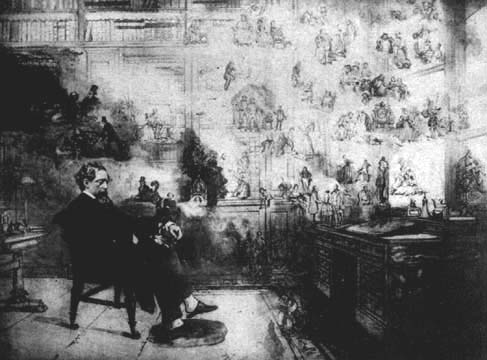
A Souvenir of Dickens, or Dickens's Dream by Robert W. Buss (1875). Source: William Glyde Wilkins and B. W. Matz. Charles Dickens in Caricature and Cartoon. Boston: The Bibliophile Society, 1924. Scanned image by George P. Landow; additional text by Philip V. Allingham. [Click on the image to enlarge it.]
Commentary from Stephen Jarvis's Death and Mr. Pickwick (2015)
'Tell me — do you know the print that appeared about eighteen months after Dickens's death, showing his empty chair at his writing desk?' [The Graphic, 9 June 1870]
'I have seen it, yes.'
'What a funny combination of names Dickens and I would have made — The Pickwick Papers, written by Boz, drawn by Buss.'
Over the succeeding weeks, 'written by' was omitted from the artist's thinking, but 'Boz, drawn by Buss' was his obsession, judging by the numerous sketches of Dickens's characters which he drew while still in bed, for often he did not have the strength to rise. The sketches concerned Dickens's entire career, from Pickwick onwards, as though Buss were determined to prove not only that he was worthy to be Seymour's successor, but that he could draw the whole of Dickens's work, a feat accomplished by no other illustrator who had partnered the author.
Buss's conception was a grand watercolour portrait of Dickens, with characters from the novels in the background, beginning with Mr. Pickwick and Sam Weller in the very positions they adopted in Browne's drawing, with Sam half-turning, and Mr. Pickwick admiring — the drawing that Buss would have made, had he not been dismissed.
With great exertion, he pulled himself out of the blankets one morning and started work on the watercolour, the easel having been placed in readiness beside his bed. He used a photograph of Dickens as his model, and gradually, over a number of weeks, his picture of Dickens materialised, with the author sitting in a chair in the library, while the characters floated among the books on the shelves as if emerging from Dickens's imagination.
Robert Buss died on 26 February 1875. At the time of his death, barely a quarter of the picture had been coloured, and that mostly of Dickens himself. [Jarvis, pp. 746-747]
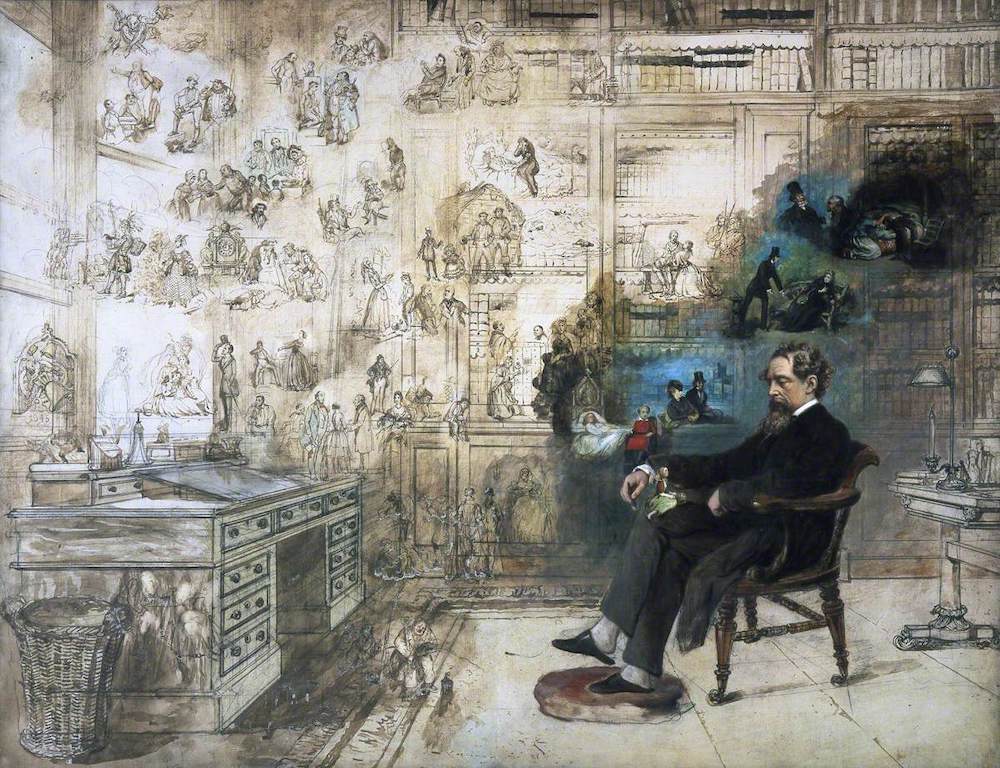
A Souvenir of Dickens (also known as Dickens's Dream) by Robert William Buss. Image credit: Charles Dickens Museum, London. Reproduced via Art UK under the terms of the Creative Commons Attribution-NonCommercial-ShareAlike licence (CC BY-NC-SA). [Click on image to enlarge it.]
Leon Litvak's Analysis: "a swirling cloud of over 75 of his characters" (2025)

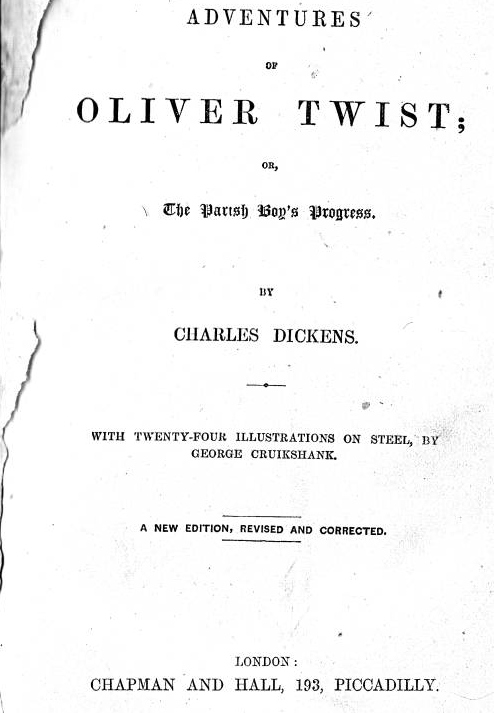
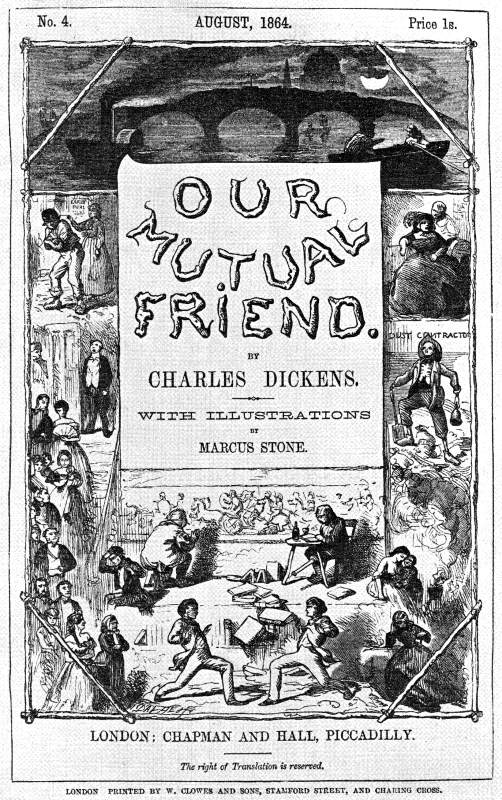
Leon Litvak in his recent Dickensian article notes that illustrator Robert William Buss (1804-75) worked only briefly with Dickens on a single monthly number after the suicide of the first Pickwick collaborator, Robert W. Seymour (1798-1836). Nevertheless, shortly after Dickens's death, Buss reflected on that brief relationship, and planned a fitting visual memorial to the great novelist. However, it remained a work in progress at Buss's death on 26 February 1875.
He studied the images of artists who had longer-term collaboration with Dickens, especially Phiz (Hablot K. Browne), who had illustrated most of the major works), as well as George Cruikshank, who worked on Oliver Twist, Marcus Stone, who produced drawings for Our Mutual Friend, and finally Sir Luke Fildes, illustrator of Dickens's last complete novel, The Mystery of Edwin Drood. [Litvak, 201]

Buss's tinted version of Fildes' Jasper's Sacrifices (originally, August 1870).
Buss made trial sketches, and carefully worked out the placement of figures, fixed in the poses they adopt in the original images. To paint Dickens he turned to a famous photograph taken by John Watkins in 1861 an iconic engraving, depicting the author in a serious pose, as if lost in thought. To reproduce the study, he turned to an iconic engraving by Luke Fildes, entitled The Empty Chair published in The Graphic soon after Dickens's death, and presenting a vacated seat in the author's beloved country home. [Litvak, 201]
As there is no record of its having been commissioned, it seems that Dickens's Dream was a deeply personal work, representing Buss's last chance to create and engage with Dickensian subjects. [Litvak, 202]
Litvak identifies specific figures in a roughly chronological sequence of texts [links to these figures have been added in the following list]:
- 1. Little Nell on his knee in colour from The Old Curiosity Shop within Dickens's wrist
- 2. Little Paul Dombey in colour above Dickens's right arm, from Dombey and Son
- Little Nell on her deathbed in colour from The Old Curiosity Shop (above Dickens's right hand)
- 4. Upper left among the untinted sketches: Mr. Pickwick from the opening of The Pickwick Papers
- 5. & 6. Upper left untinted sketches: Sam and Tony Weller from The Pickwick Papers
- 7. Upper left untinted sketches: Mr. Bumble from Oliver Twist
- 8. Upper left untinted sketches: Smike from Nicholas Nickleby
- 9. Upper left untinted sketches: Quilp from The Old Curiosity Shop
- 10. & 11. Upper left untinted sketches: Fagin and Sikes from Oliver Twist
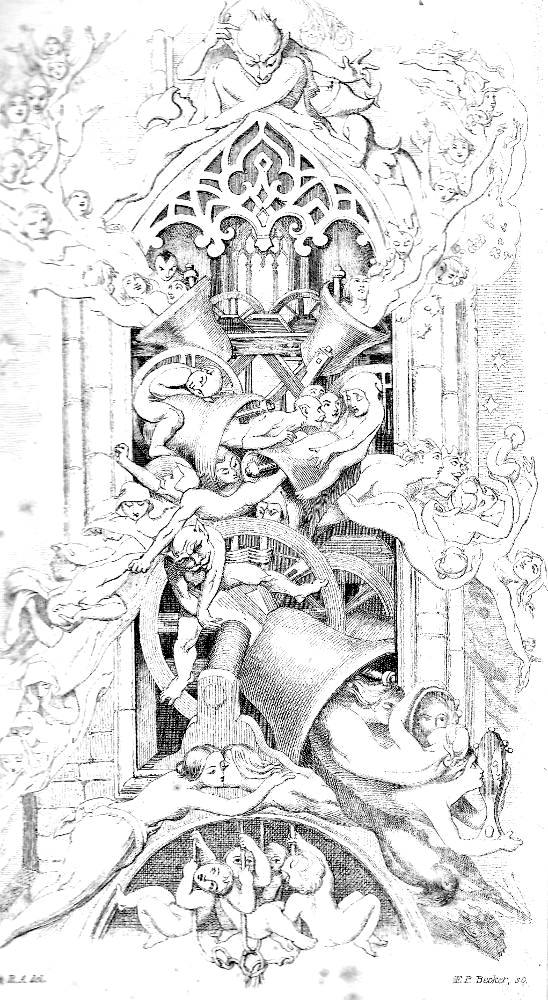
- Upper left untinted sketches: Daniel Maclise's Christmas Book design for the frontispiece of The Chimes
- 12. & 13. Below: Mr. and Mrs. Squeers, and Nicholas Nickleby at Dotheboys Hall in Nicholas Nickleby
- 14., 15, & 16. Below: Ralph Nickleby with Mrs. Nickleby and Kate in Nicholas Nickleby
- 17. Below: Mr. Mantalini in Nicholas Nickleby
- 18. Below: Young Barnaby Rudge with Grip the Raven in Barnaby Rudge
- 19. Below: Dolly Varden in Barnaby Rudge
- 20.-23. Below: Nell and her grandfather, together with Codlin and Short's Pinch and Judy dolls in The Old Curiosity Shop
- 24. & 25. Below: Dick Swiveller and the Marchioness in The Old Curiosity Shop
- 26. & 27. Below: Paul Dombey and Florence in Dombey and Son
- 28. Below: Mr. Dombey in Dombey and Son
- 29. & 30. Below: Edith Dombey and Carker in Dombey and Son
- 30. Below: Captain Cuttle in Dombey and Son
- 31. & 32. On the side of the desk, next to the wastepaper bin: Jenny Wren and Riah in Our Mutual Friend
- 33.-35. Reading downward from the top from the top of the middle of the painting, right to left, upper left untinted sketches: Mr. Pecksniff, Tom Pinch and Mrs. Gamp from Martin Chuzzlewit
- 36. & 37. Reading downward from the top from the top of the middle of the painting: Scrooge and Marley's Ghost from A Christmas Carol
- 38. & 39. Reading downward from the top from the top of the middle of the painting: David Copperfield and Dora from David Copperfield
- 40. Reading downward from the top from the top of the middle of the painting: Steerforth and the shipwreck from David Copperfield
- 41. & 42. Reading downward from the top from the top of the middle of the painting: Ham and Daniel Peggotty in front of their boathouse from David Copperfield
- 43.-46. Mr. Micawber, Miss Mowcher, Uriah Heep, and David as a waif from David Copperfield
- 47. Betsey Trotwood from David Copperfield
- 48-50. John Jarndyce, Esther Summerson, and Sir Leicester Deadlock from Bleak House
- 51. Mr. Krook and his cat from Bleak House
- 52. Lady Deadlock from Bleak House
- 53. Jo, the crossing-sweeper from Bleak House
- 54. Little Dorrit at the prison door from the monthly wrapper of Little Dorrit
- 55. & 56. Mrs. Clennam and Mr. Flintwich from Little Dorrit
- 57. Maggy from Little Dorrit
- 58. & 59. Blandois/Rigaud from Little Dorrit
- 60. William Dorrit from Little Dorrit
- 61.-63. Miss Havisham and Pip, and Joe and Pip from Great Expectations
- 64. Joe and Orlick from Great Expectations
- 65. In front of Dickens's feet, Mr. Boffin at the dust heap from Our Mutual Friend
- 66. & 67. Right-hand side: Lucie Manette and her father from A Tale of Two Cities
- 69. & 70. Durdles and Mr. Sapsea in The Mystery of Edwin Drood
- 71. & 72. John Jasper and Rosa Bud in The Mystery of Edwin Drood
- 73. John Jasper, observed by Princess Puffer in The Mystery of Edwin Drood
- 74. Rosa and Mr. Grewgious (in colour, in front of Dickens's face) from The Mystery of Edwin Drood

Bibliography
Jarvis, Stephen. Death and Mr. Pickwick. New York: Farrar, Straus and Giroux, 2015. vii + 802 pp.
Litvak, Leon. "Stories from the Charles Dickens Museum Collection: Dickens's Dream." The Dickensian, No. 526, Vo1. 121, Part II (Summer 2025): 200-202.
Wilkins, William Glyde and B. W. Matz. Charles Dickens in Caricature and Cartoon. Boston: The Bibliophile Society, 1924. No. 50.
Created 19 July 2007
Last modified 13 January 2026