
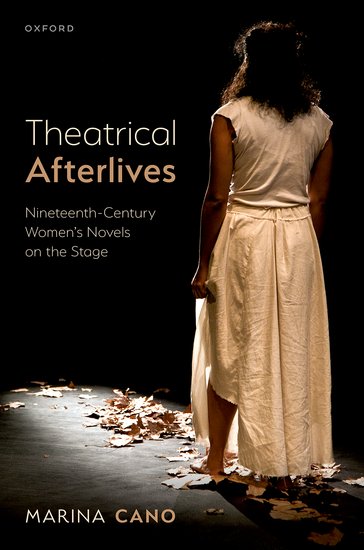

arina Cano has written extensively about performed adaptations of literature, having authored Jane Austen and Performance (2017) and co-edited with Rosa García-Periago Jane Austen and William Shakespeare: A Love Affair in Literature, Film, and Performance (2019). In her latest book, Theatrical Afterlives: Nineteenth-Century Women's Novels on the Stage, Cano extends her prior work by exploring dramatized adaptations of novels by Jane Austen, Elizabeth Gaskell, George Eliot, Mary Elizabeth Braddon, Ellen Wood, Charlotte Brontë, and Emily Brontë. Although the novels represented in Theatrical Afterlives are all familiar, the performances of these novels are remarkably varied, as Cano shows.
Theatrical Afterlives opens with a description of a youth theatre's "eco-adaptation" of Pride and Prejudice in Limerick, Ireland in 2023; another chapter discusses Clifton Tayleure's 1861 dramatization of East Lynne featuring the Victorian actress Lucille Western. In perhaps the book's most compelling chapter, Cano recounts in detail a unique adaptation of Pride and Prejudice performed by the inmates of an American women's prison in 2019.
Cano asserts that studying such diverse adaptations can reveal key "aspects of the source novels' use, genre, and reception" and "expose latent and often quietly progressive strands in the source texts" (2). Cano sees the relationship of the original novels to their adaptations as one of "reciprocity and creative tension." Cano finds that the novels are enhanced by adaptation, which shed new light on concerns, sympathies, and values present but not overt in the source text (8).
As Cano notes, theatrical adaptations of works by nineteenth-century women writers have received little scholarly attention (Austen excepted), so the book represents an important step toward "salvaging" some of this understudied history (4). However, the scope of the performances chosen for study varies considerably from chapter to chapter. While Cano cites Paul Rae's definition of "real theatre," a holistic approach that includes consideration of the materiality of theatre, as a theoretical inspiration for Theatrical Afterlives, she notes that a thorough study of all necessary elements is nearly impossible when discussing many different productions within a single chapter (13-14).
The chapter on the Brontës, for example, discusses productions of Wuthering Heights from 1934, 1944, 2006, 2014, 2016, 2019, focusing on how each of these productions depicts "Irishness." In contrast, the tight focus of the chapter on Pride and Prejudice allows Cano to give a more complete account of the performances as well as a richer, more nuanced analysis of the choices made in these adaptations. This chapter focuses primarily on only two productions: First Impressions, performed in 2019 by the inmates of a women's prison in Vandalia, Missouri, and its inspiration, a performance of First Impressions by the local Slightly Askew Theatre Ensemble in 2017. Cano thoroughly examines Vandalia adaptation, describing the costuming, casting, and staging of the performance in light of the many limitations imposed by its performers being incarcerated.
This chapter also includes quotes from the performers as they describe their relationship to Austen's novel (some found it nearly impossible to read, while others admitted a preference for Seth Grahame-Smith's parody Pride and Prejudice and Zombies), and, most significantly, their feelings toward its characters (124, 141). When one performer explains that her favorite character is Lydia Bennet because she is "'young, naive, so full of life,'" Cano notes that the performer emphasizes Lydia's "innocence and inexperience, rather than her moral guilt," and sympathetically reframes the character as a "victim-survivor," a perspective likely shaped by the incarcerated performer's lived experiences (134-35). The inmate performers' accounts are both affecting and insightful: they disclose how "free" they feel when performing, and how much they identify with the ways that the Bennet sisters are publicly scrutinized and constrained (129-130). The inclusion of several photographs of the production conveys a powerful sense of the staging and energy of the performance. This chapter convincingly and movingly demonstrates how amateur theatrical performance can prompt new insights into a well-studied text.
In her chapter on adaptations of Gaskell's Cranford, Cano again considers amateur theatrical adaptations with an all-female cast, examining sketches from Cranford that were performed by women's suffrage advocates. Cano describes several stagings of scenes from Cranford, most notably the "card party" scene, written and performed by members of the Actresses' Franchise League or local divisions of the Women's Freedom League in the early twentieth century. These stagings were part of suffragist pageants, fairs, or social meetings. Because of the small scale of these productions, details of script, casting, and staging are often scarce, so much of the chapter is devoted to exploring why adapting Cranford particularly appealed to suffragists. Cano investigates the ways such productions would amplify "the novel's inner suffrage sympathies" (113).
In a similar vein, Cano considers how dramatized productions of Braddon's most famous novel, Lady Audley's Secret, and Wood's most famous novel, East Lynne, depicted their (anti-)heroines as "female agitators, professional women, and/or figures of domestic defiance," anticipating similar descriptors that would be assigned to the "New Woman" decades later (57). Adaptations of these novels were extremely popular, with at least two hundred and sixty-four different productions of East Lynne and more than fifty productions of Lady Audley's Secret in 1870s and 1880s alone (54-55). Cano observes that since some of these dramatizations were staged within mere months of the serialization of the original novels, many theatre-goers may have encountered the stories and their characters for the first time as they appear on the stage rather than the page, thus shaping how the character is perceived in popular imagination (57).
As Cano points out, in Braddon's novel, while Lady Audley may be the title character, the protagonist is Robert Audley, who is investigating his friend George's disappearance, and, eventually, Lady Audley's history. In the dramatized versions of the 1860s, however, Lady Audley moves from object to subject as she takes center stage. Cano notes that in C. H. Hazlewood's 1863 adaptation, Lady Audley speaks twice often as Robert (59). In the novel, readers do not learn Lady Audley's backstory until the novel's third volume, but in the play versions explored here, this information is provided at the beginning of the play where, Cano contends, it assists in "shift[ing] the audience's sympathies to the main character" (64).
Attempts to engender the audience's sympathy are even more overt in dramatic adaptations of East Lynne. These adaptations amplified the book's pathos by adding new, deliberately heartrending scenes, such as Lady Isabel revealing her true identity to her son on his deathbed (70). The chapter includes posters advertising productions of East Lynne that focus primarily — or even solely — on the actress playing Lady Isabel, emphasizing her as the story's central figure and tragic heroine. Cano concludes that the theatrical afterlives of these sensation novels suggest that "the scale of sympathy might be titled toward the female transgressor: the bigamist, the murderess, the runaway mother [who] is indeed the heroine in her own right—to be admired, pitied, and identified with, rather than condemned for her transgressions" (87).
The chapters discussed above constitute what Cano refers to, in her Introduction, as "[t]he core three chapters" (18). The remaining two chapters are broader in scope and less specific in their considerations of individual dramatic adaptations. The first of these considers theatrical elements of George Eliot's novels Adam Bede and The Mill on the Floss and briefly discusses a staged adaptation of each from the 1990s. Cano notes that Eliot refused to approve theatrical adaptations of her work during her lifetime, so rather than considering why Eliot's novels have been adapted for the stage more rarely than her contemporaries, Cano asks, "Why have the novels been adapted at all"? (24). Cano argues that these novels are inherently theatrical, explaining ways that they often make a "metatheatrical wink to the audience," and describing scenes in which characters create melodramatic tableaux on the page (25). In her discussion of OpticNerve Performance Group's 2016 performance of Helen Edmundson's 1994 adaptation of The Mill on the Floss, Cano focuses on its inclusion of character commentary that functions like a Greek chorus, which, she contends, is an understudied element present in Eliot's novels that has been amplified onstage (41-45).
The book's final chapter focuses on the ways that Irish adaptations of Jane Eyre and Wuthering Heights "channel some of the conditions of their making by stressing violence, aggression, unfair appropriation, abuse of power, and separation" as well as casting characters as Irish and including tropes common to Irish drama (147). Cano observes that while Jane Eyre has much more frequently been adapted worldwide than Wuthering Heights, in Ireland after the 1930s, Wuthering Heights proved to be more popular as a play. Cano posits that Heathcliff's traumas, struggle for respect, and "obsession with landownership" may have particularly resonated with Irish audiences (156). The chapter also includes discussion of, and dialogue from, productions where Heathcliff is depicted as Irish and speaks the Irish language. It is a somewhat unexpected turn for a book that heretofore has primarily focused on women as a disenfranchised group, though it overtly addresses the impact of class, an issue that is present but more understated in previous chapters.
Theatrical Afterlives treads familiar ground while also breaking into territory that is new and original. All the titles considered by Cano are part of the traditional nineteenth-century literary canon, but the many unique adaptations explored in the book offer refreshingly original perspectives on these novels. The book's inclusion of photos, playbills, and posters of various adaptations enriches Cano's study. The chapter on staged productions of East Lynne in the 1860s even explores the ways in which music was incorporated into the production and how it varied regionally, allowing for a more complete understanding of the full theatrical experience at the time (81-83). Cano also includes examples of how performers responded to audience reactions at particular performances, such as when an audience member mocked the actress Ada Gray in her final deathbed scene in East Lynne, and she rebuked him while still in character (86). These wonderful details are reminders of how dynamic and engaging such a performance would have been to a nineteenth-century audience.
Particularly in the "core three chapters," in which Cano considers adaptations of Lady Audley's Secret, East Lynne, Cranford, and Pride and Prejudice, Cano makes a compelling case for the merits of further scholarly consideration of both professional, and — perhaps especially — amateur theatrical productions to explore how these texts speak to diverse audiences. The book's focus on women authors as a marginalized group, and their reception and adaptation by similarly marginalized groups, such as the suffragists of the early twentieth century and the incarcerated performers of the twenty-first, emphasizes how theatrical adaptation can be an act of reclamation. In bringing together such a wide range of productions, Cano demonstrates that the afterlives of these novels are as rich as the original texts themselves as they continue to be reshaped via theatrical interpretation and resonate with new audiences.
Links to Related Material
- Music, Theater, and Popular Entertainment in Victorian Britain
- Victorian Drama
- Women in Victorian Literature — A Literary Overview
Bibliography
[Book under review] Cano, Marina. Theatrical Afterlives: Nineteenth-Century Women’s Novels on the Stage (Oxford: Oxford UP, 2026).
First Impressions, dir. Rachel Tibbetts. Performed at the Women’s Eastern Reception, Diagnostic and Correctional Center in Vidalia, Missouri, 2019.
Rae, Paul. Real Theatre: Essays in Experience (Cambridge: Cambridge UP, 2019).
Created 21 September 2026
Last modified 22 September 2026