
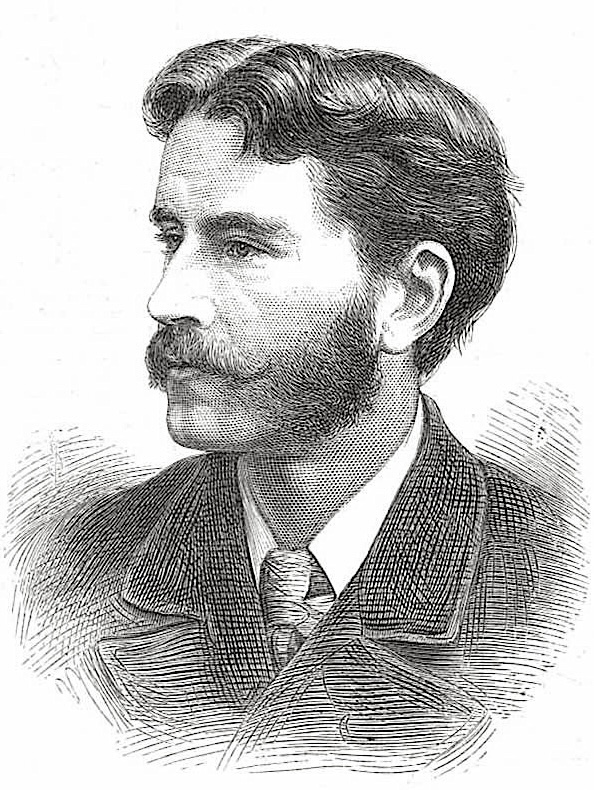
Engraving of Frank Dicksee,
The Illustrated London News, 30 April 1881, p. 429.
Frank Dicksee was born in Russell Place, Fitzroy Square, in London on 27 November 1853, the elder son of the painter and etcher Thomas Francis Dicksee. His sister Margaret also became a painter, as did their cousin, Herbert Thomas Dicksee. He was educated at the Rev. G. Henslow's school in Bloomsbury until age sixteen. Frank received his early artistic training from his father. He attended the Royal Academy Schools from 1871-75, and was awarded a Royal Academy silver medal in 1872 and a gold medal in 1875 for his painting Elijah confronting Ahab and Jezebel in Naboth's Vineyard. In 1876 this painting became the first that he exhibited at the Royal Academy. In the early 1870s he joined the Langham Sketching Club to improve his proficiency in life drawing. From 1872-74, while still a student, he exhibited at the Society of British Artists in Suffolk Street. He began his artistic career as an assistant to Henry Holiday, primarily working on designs for stained glass and decorative work in general. He began to achieve recognition in the late 1870s when his painting Harmony was purchased in 1877 by the Chantrey Bequest. He also found success as an illustrator for books and magazines such as The Cornhill Magazine, Cassell's Magazine, and The Graphic. In 1881 he visited Italy for the first time.
Dicksee became an Associate of the Royal Academy in 1881, a full academician in 1891, and its president in 1924. Dicksee was elected a member of the Royal Institute of Painters in Water Colours in 1891 and the Royal Society of Portrait Painters in 1926. He was made an Honorary Member of the Royal Institute of Oil Painters in 1898. In 1925 he was made an Honorary Member of the Royal Society of Painter-Etchers and Engravers, the Royal Society of Miniature Painters Sculptors and Gravers and the Royal Scottish Academy. He was awarded a medal at the Exposition Universelle in Paris in 1900. That same year his painting The Two Crowns was voted the most popular picture at the annual Royal Academy exhibition and was purchased by the Chantrey Bequest.
Dicksee lived for some time at 80 Peel Street, Campden Hill, Kensington, but in 1898 moved to 3 Greville Place in St John's Wood. He was knighted in 1925 and named a Knight Commander of the Royal Victorian Order by King George V in 1927. Dicksee never married. He died on 17 October 1928 in London. After the funeral service at Westminster Abbey he was buried in the family grave at Hampstead Cemetery.
Bibliography
Christian, John. The Last Romantics. The Romantic Tradition in British Art. London: Lund Humphries, 1989, 120.
Dibdin, E. Rimbault. "Frank Dicksee - His Life and Work." Special issue of The Art Annual, 1905.
Dickens, Mary Angela. "A Popular painter: Mr. Frank Dicksee, R.A." The Windsor Magazine V (December, 1896): 385-91.
Gramling, Hilleary. "Dicksee the Artist." Victorian Artists at Home. Web. 30 June 2026. https://artistsathome.emorydomains.org/exhibits/show/victorian-artists-at-home/frank-dicksee--a-r-a-/the-artist--frank-dicksee
Hodges, Sydney. "Mr. Frank Dicksee, A.R.A." The Magazine of Art X (1887): 217-22.
Toll, Simon. Frank Dicksee 1853-1928, His Art and Life. Woodbridge: ACC Art Books, 2016.
Created 30 June 2026