
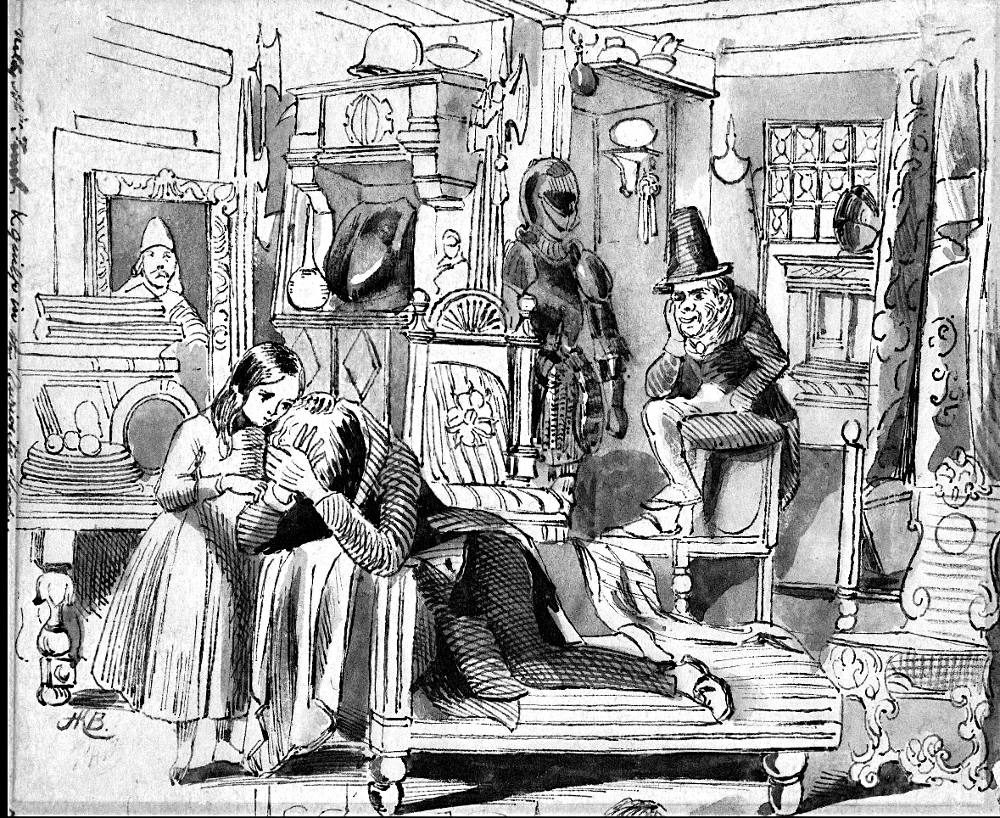
Little Nell as Comforter by Phiz [after George Cattermole]. "Mr. Daniel Quilp, having entered unseen, was looking on with his accustomed grin." — Chapter IX, The Old Curiosity Shop, Part 7. Original date of serial publication: 20 June 1840 (tenth plate in the series) in Master Humphrey's Clock, Part 10. [Click on both images to enlarge them.] The above image appears courtesy of The Rare Book Department, Free Library of Philadelphia, and of correspondent Alistair MacNichol, who first brought it to our attention.
Passage Illustrated: Quilp conducts covert surveillance
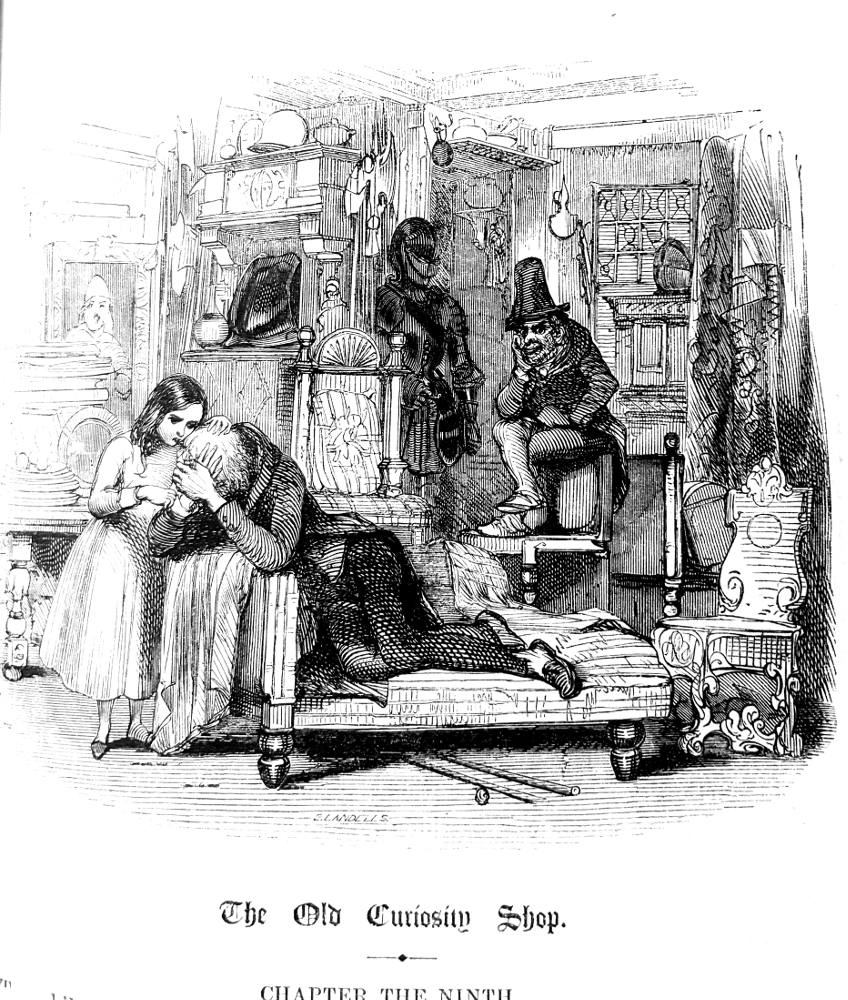
Right: George Cattermole's original print from wood-engraving positions Quilp well in the background as the hideous dwarf observes Nell comfort her grandfather in the curiosity shop; see also Harry Furniss's reinterpretation which foregrounds the observer, Quilp watches Nell comforting her Grandfather (1910).
These were not words for other ears, nor was it a scene for other eyes. And yet other ears and eyes were there and greedily taking in all that passed, and moreover they were the ears and eyes of no less a person than Mr. Daniel Quilp, who, having entered unseen when the child first placed herself at the old man’s side, refrained — actuated, no doubt, by motives of the purest delicacy — from interrupting the conversation, and stood looking on with his accustomed grin. Standing, however, being a tiresome attitude to a gentleman already fatigued with walking, and the dwarf being one of that kind of persons who usually make themselves at home, he soon cast his eyes upon a chair, into which he skipped with uncommon agility, and perching himself on the back with his feet upon the seat, was thus enabled to look on and listen with greater comfort to himself, besides gratifying at the same time that taste for doing something fantastic and monkey-like, which on all occasions had strong possession of him. Here, then, he sat, one leg cocked carelessly over the other, his chin resting on the palm of his hand, his head turned a little on one side, and his ugly features twisted into a complacent grimace. And in this position the old man, happening in course of time to look that way, at length chanced to see him: to his unbounded astonishment. [Chapter IX, 36]
Commentary: Phiz copies Cattermole
Now, among other improvements, I have turned my attention to the illustrations, meaning to have woodcuts dropped into the text, and no separate plates. I want to know whether you would object to make me a little sketch for a woodcut — in indian-ink would be quite sufficient — about the size of the enclosed scrap; the subject, an old quaint room with antique Elizabethan furniture, and in the chimney-corner an extraordinary old clock — the clock belonging to master Humphrey, in fact, and no figures. ["Dickens to Cattermole," 13 January 1840; quoted in Kitton, 122]
The version of Little Nell as Comforter published in Part 7 (20 June 1840) and used for the first volume edition of the OCS was indeed by architectural designer and painter George Cattermole; no less an authority than J. A. Hammerton (1910) in The Dickens Picture-Book ascribes the wood-engraving to Cattermole, and no critic supports the contention that the original wood-engraving was by “HKB,” as Phiz signs himself throughout The Old Curiosity Shop. The assignment of this composition to Cattermole seems perfectly consistent with Dickens's original intentions for the program of illustration suggested in the 13 January 1840 letter. However, Frederic G. Kitton makes reference to Browne's having redrafted a number of the Cattermole interiors (123). Moreover, Michael Steig in “Master Humphrey’s Clock and Martin Chuzzlewit,” specifically notes that Phiz copied a number of the Cattermole plates:
The stylistic differences between the two illustrators are especially of interest because Browne traced all of George Cattermole's drawings for the earliest numbers — and some of the later ones as well — and transferred them to the woodblock. 7 (53)
Since after Dickens's death Phiz destroyed all his correspondence with Dickens, we cannot be sure what Browne's intention was, and whether Dickens himself suggested the redrafting. Certainly, at the time that this number was issued, Cattermole was still very much the lead illustrator, and Dickens does not even mention Browne by name in his correspondence with Cattermole at the time, as Michael Slater notes in The Oxford Reader's Companion to Dickens. In the plate signed “HKB,” an examination of the area behind Quilp's head, to say nothing of Quilp himself, reveals that the composition, albeit similar, is not identical to that in the published version of the serial novel: these are two entirely different composite woodblock engravings. This point is supported in an extended note by Steig for this attribution in the third chapter of Dickens and Phiz:
7. It has always been assumed that at some point fairly early, Cattermole took over the transferring of his own drawings [from paper sketch to composite woodblock]; yet among the tracings in the Gimbel Collection there are ones for Cattermole's designs for Barnaby Rudge, all initialled “HKB,” indicating that Browne continued to do at least some of this work for Cattermole nearly all the way through Master Humphrey's Clock. [327]
According to Valerie Browne Lester, Dickens, recognising the strengths and weaknesses of his principal illustrators, "divided up the work: Phiz would be more responsible for people (especially the low characters), active moments, and comic rascality, while Cattermole would embark upon loftier, antiquarian, angelic, and architectural subjects" (78). During his “Clockworks” venture with George Cattermole, Samuel Williams (1788-1853), and Daniel Maclise (1806-70) Phiz was still very much the beginning of his career as a book illustrator. Thus far, he had been a caricaturist rather than an artist: consider, for example, his work for Dickens prior to 1840, notably Sunday under Three Heads (1836) through Nicholas Nickleby (1838-39). Studying a steel-engraving such as Mr. Ralph Nickleby’s First Visit to His Poor Relations (April, 1838), we can see how much Phiz learned from Cattermole about creating detailed but atmospheric interiors. If we then consider his programs of illustration for Dombey, Copperfield, and A Tale of Two Cities, we can see how far he advanced after this early Cattermole copy. Note how awkward his interior in his version of Little Nell as Comforter is when one considers the Cattermole original. On the other hand, the heads of both Nell and Quilp are thoroughly convincing although radically different, although Nell comes from realistic portraiture whereas Quilp comes from the satirical and caricatural tradition of Georgian political commentator Thomas Rowlandson (1756-1827), bawdy cartoonist James Gillray (1756-1815), and Phiz's great contemporary George Cruikshank (1792-1878), "The Modern Hogarth."
Related Materials
- Dickens's The Old Curiosity Shop (homepage)
- The Old Curiosity Shop Illustrated: A Team Effort by "The Clock Works"
- Illustrated Editions of The Old Curiosity Shop
Scanned image, caption, and commentary by Philip V. Allingham. [You may use this image without prior permission for any scholarly or educational purpose, as long as you (1) credit the person who scanned the image, and (2) link your document to this URL in a web document or cite the Victorian Web in a print one.]
Bibliography
Browne, Hablot Knight ["HBK"]. "Original Illustration for Old Curiosity Shop." Little Nell as Comforter [after Cattermole]. Accession Number: 87-1465. Call Number: Elkins — MHC. Rare Book Department. Philadelphia: The Free Library. No. cdc385101.

Dickens, Charles. The Old Curiosity Shop in Master Humphrey's Clock. Illustrated by Phiz, George Cattermole, Samuel Williams, and Daniel Maclise. 3 vols. London: Chapman and Hall, 1841; rpt., Bradbury and Evans, 1849.
_______. The Old Curiosity Shop. Illustrated by Harry Furniss. The Charles Dickens Library Edition. 18 vols. London: Educational Book, 1910. Volume V.
Hammerton, J. A. The Dickens Picture-Book. The Charles Dickens Library Edition. 18 vols. London: Educational Book, 1910. Volume XVII.
Kitton, Frederic G. "George Cattermole." Dickens and His Illustrators. Rpt. from the 1899 edition. Honolulu, Hawaii: University Press of the Pacific, 2004. Pp. 121-125.
Lester, Valerie Browne. Phiz: The Man Who Drew Dickens. London: Chatto and Windus, 2004.
MacNichol, Alistair. (personal correspondence). “The illustration 'Little Nell As Comforter' was not drawn by George Cattermole but by Hablot Knight Browne.” (19 November 2025).
Slater, Michael. "The Master Humphrey Experiment: 1840-1841." Charles Dickens. London and New Haven: Yale U. P., 2009. Pp. 140-174.
Steig, Michael. Chapter 3. "From Caricature to Progress: Master Humphrey's Clock to Martin Chuzzlewit." Dickens and Phiz. Bloomington & London: Indiana U. P., 1978. Pp. 53-85.
Vann, J. Don. "The Old Curiosity Shop in Master Humphrey's Clock, 25 April 1840-6 February 1841." Victorian Novels in Serial. New York: MLA, 1985. Pp. 64-65.
Created 30 November 2025